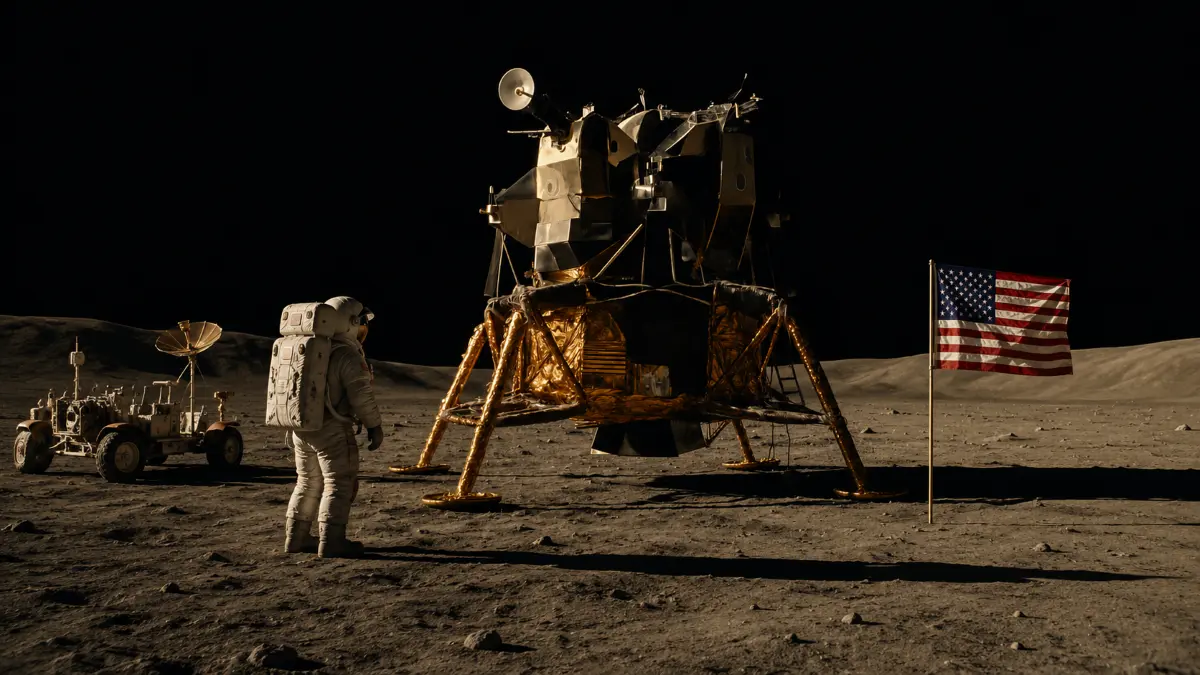

The first human moonwalk was more than a giant leap for mankind, it was a masterclass in overcoming extreme technological hurdles. On July 20, 1969, Apollo 11’s crew successfully made the first human landing on the Moon in the Sea of Tranquility. Americans Neil Armstrong and Buzz Aldrin became the first humans to walk on the Moon six and a half hours later.
This achievement wasn’t just about planting a flag or making history headlines. It demanded solutions to unprecedented problems in engineering, computing, and materials science. Getting humans safely to the lunar surface and back required innovations in navigation, life support, and communication systems that pushed the limits of 1960s technology.
At the time, space travel was still a nascent field. The Apollo 11 mission proved that complex, manned space operations were feasible. The mission’s success relied on real-time data processing, precision guidance systems, and the development of lightweight, durable spacesuits. These technologies addressed critical challenges: how to survive in a vacuum, how to operate equipment remotely, and how to maintain communication across 240,000 miles.
What changed because of this event was a new benchmark for technological ambition. The mission’s breakthroughs accelerated advancements in microelectronics and computer engineering. The Apollo Guidance Computer, one of the first to use integrated circuits, laid groundwork for the miniaturization that powers today’s devices. The mission also spurred innovations in telemetry and remote sensing that have since become standard in many fields.
The ripple effects extended beyond aerospace. Materials developed for space suits and spacecraft influenced industries from firefighting gear to medical devices. The problem-solving mindset cultivated by Apollo engineers set a template for tackling complex, interdisciplinary challenges in technology and engineering.
Why does the first human moonwalk still matter? It serves as a reminder that pushing boundaries requires not just bold vision but rigorous technical execution. The mission’s legacy lives on in ongoing space exploration efforts and in everyday tech that benefits from the Apollo program’s innovations. It also underscores the importance of systems engineering, integrating hardware, software, and human factors, to achieve ambitious goals.
Looking back, the moonwalk was a moment when humanity’s curiosity met its capacity to innovate. It wasn’t just a step on the lunar surface but a leap in technological capability, inspiring generations to think bigger and engineer smarter.