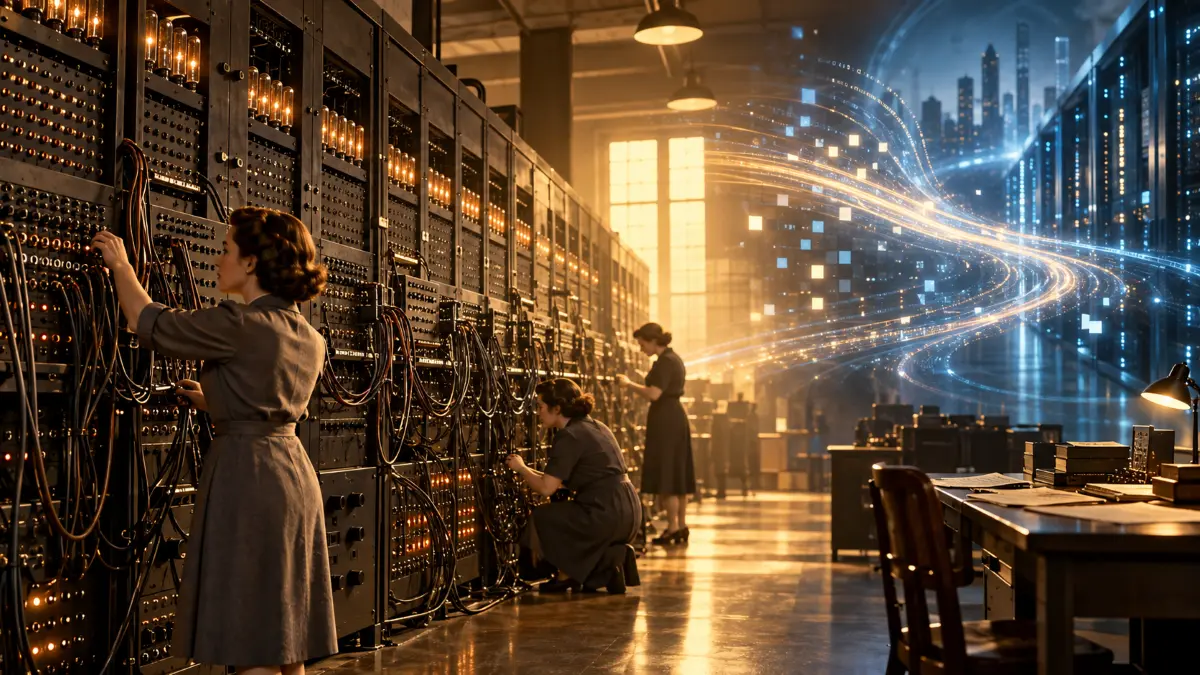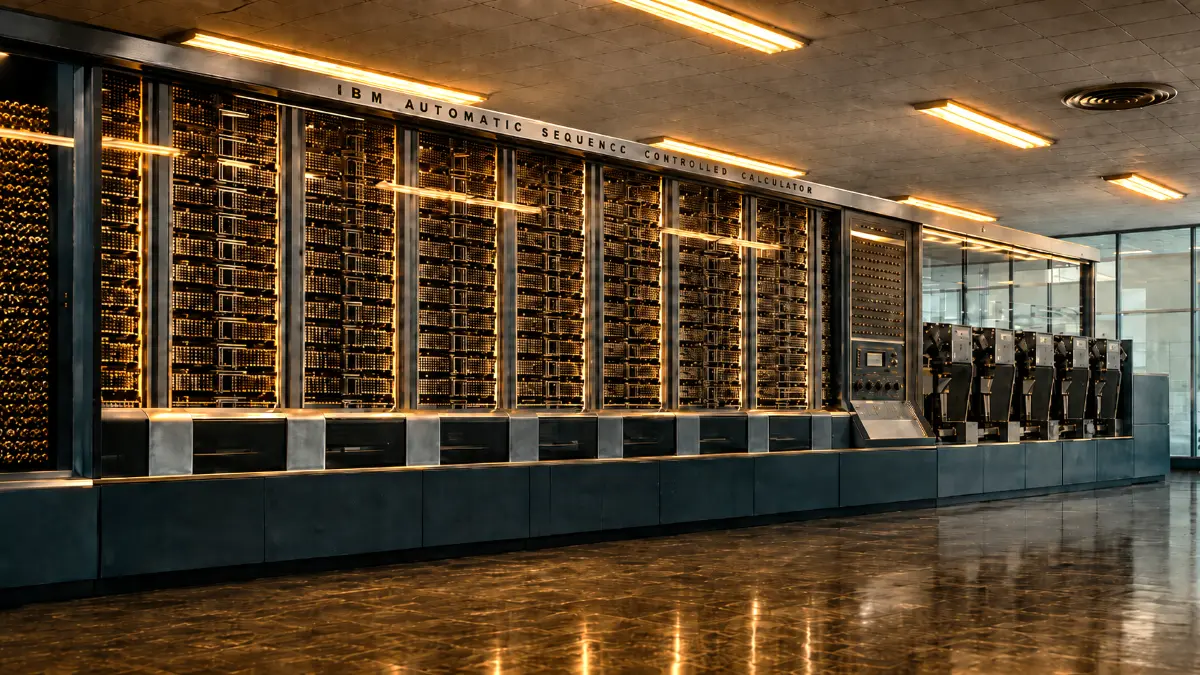

The hum of gears and the clatter of relays marked a quiet but profound moment in computing history. On August 7, 1944, IBM presented Harvard University their Automatic Sequence Controlled Calculator (ASCC), an electro-mechanical computer devised by Howard H. Aiken and built by IBM. Harvard renamed the ASCC the Harvard Mark I.
Unlike the fully electronic ENIAC under construction at the time, the Mark I was not a leap in raw technological innovation. Instead, it was the first large-scale digital calculator ever built, a massive machine that bridged the gap between mechanical calculators and the electronic computers that would soon follow.
At the time, the Mark I mattered because it demonstrated the feasibility of automating complex calculations on a scale never before attempted. It was a practical tool that could perform lengthy mathematical operations without human intervention, a significant step forward for scientific research and military applications during World War II.
The Mark I’s design combined mechanical components with electrical switches, enabling it to handle calculations with precision and reliability. This hybrid approach solved a critical problem: how to automate computation before fully electronic components could be perfected. It was a proof of concept that large-scale automated calculation was possible and useful.
What changed because of the Mark I was less about the immediate technology and more about the mindset it inspired. It sparked a desire for more powerful, faster, and more efficient computing machines. The Mark I showed that digital calculation could be scaled up, setting the stage for the electronic computers that would soon dominate the field.
Its legacy lies in how it shaped the trajectory of computing development. The Mark I was a stepping stone that helped define what a computer could be. It influenced subsequent designs and encouraged investment in computing technology, even as fully electronic machines like the ENIAC were emerging.
Today, the Harvard Mark I still matters as a symbol of early computational ambition. It reminds us that progress often comes in stages, with hybrid solutions paving the way for breakthroughs. Understanding the Mark I helps us appreciate the complexity of early computing challenges and the incremental steps that led to the digital age.
Reflecting on this event highlights how innovation is often about building on what came before. The Mark I was not the fastest or most advanced, but it was a crucial link in the chain of computing history. It’s a reminder that the path to today’s technology was shaped by machines that dared to automate the impossible.