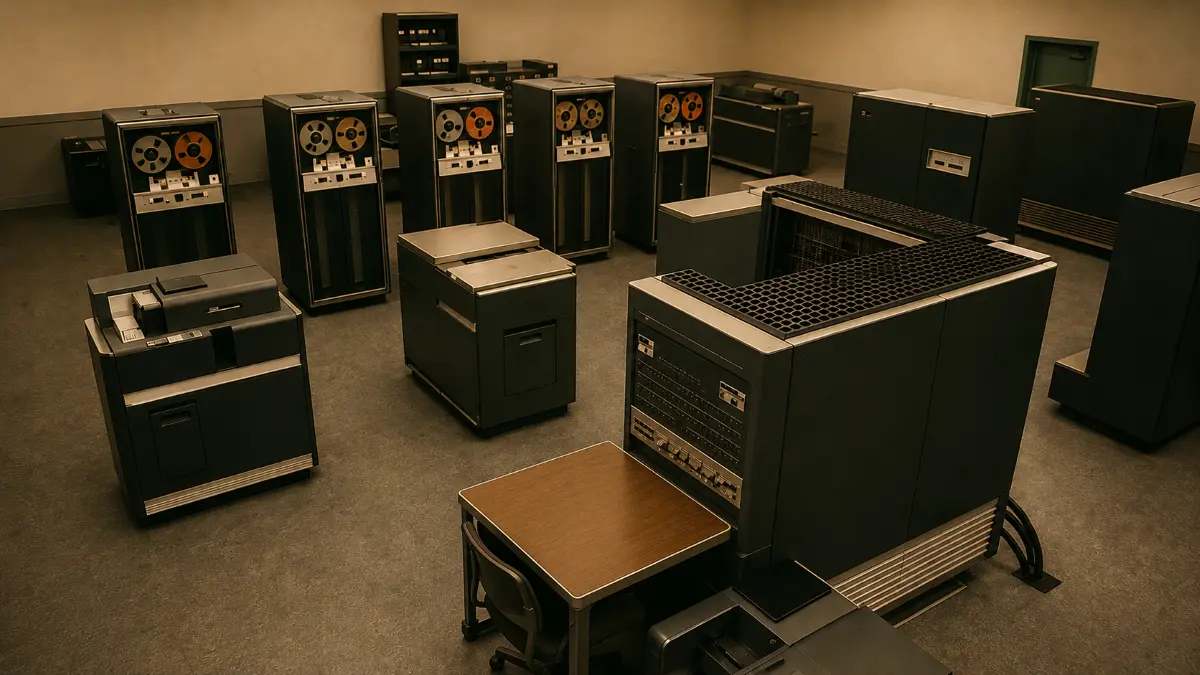

June 22, 1954, marked a defining moment in computing with the announcement of the IBM 704. This machine was not just another step forward; it introduced built-in hardware floating-point arithmetic and indexing, features that reshaped how computers processed data and executed programs.
Before the IBM 704, computers handled floating-point calculations in software, which was slow and inefficient. By embedding floating-point arithmetic directly into hardware, the IBM 704 drastically accelerated complex mathematical computations. This advancement was critical for scientific and engineering applications that demanded high precision and speed.
The inclusion of indexing in hardware was equally transformative. Index registers allowed programs to manipulate arrays and loops more efficiently, streamlining memory access and control flow. This feature laid the groundwork for more sophisticated programming techniques and structured code.
The IBM 704’s architecture directly influenced the development of high-level programming languages. FORTRAN, designed for scientific and engineering calculations, leveraged the machine’s floating-point capabilities to deliver unprecedented performance. Meanwhile, LISP, a language foundational to artificial intelligence research, benefited from the IBM 704’s indexing and memory management features.
At the time, the IBM 704 solved a fundamental problem: how to make computers more accessible and powerful for complex, real-world tasks. It moved computing beyond simple arithmetic and basic data processing into a realm where machines could handle intricate algorithms efficiently.
The ripple effects of the IBM 704’s innovations are still felt today. Floating-point arithmetic remains a cornerstone of modern computing, essential for everything from graphics rendering to machine learning. Indexing and memory management principles introduced by the 704 continue to underpin programming language design and compiler optimization.
In essence, the IBM 704 was a catalyst for the evolution of software and hardware working in tandem. It demonstrated how hardware innovations could unlock new programming paradigms and applications, setting a pattern that continues in today’s tech landscape.
Reflecting on the IBM 704’s legacy reminds us that breakthroughs in computing often come from rethinking how machines handle fundamental operations. This event on June 22, 1954, was more than a product launch; it was a blueprint for the future of digital computation.