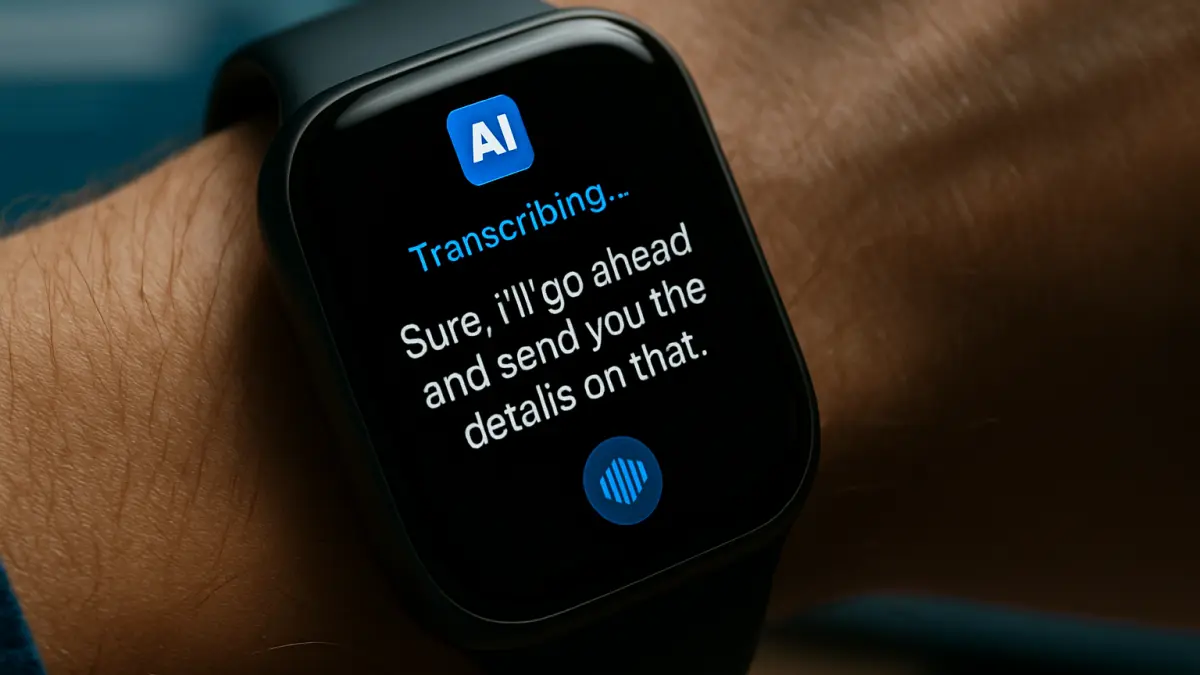

Apple’s latest Apple Watch update introduces AI-powered features that can transcribe recent speech and generate summaries of nearby conversations, expanding the role of the wearable from a health and notification device into a more context-aware personal assistant. The feature is designed to help users recall recent interactions and understand what happened around them without manually taking notes.
Apple says the system is built with privacy protections in mind, including processing designed to minimize retention of raw audio. The company says the original audio is not permanently stored after the relevant processing is completed. Even so, the technology raises broader questions because the watch must still capture surrounding speech in order to analyze and summarize it.
That distinction is important. A device does not necessarily need to save a recording for privacy concerns to exist. People nearby may not know that their words are being processed, transcribed, or included in a summary. In workplaces, restaurants, meetings, classrooms, or private conversations, that could create uncertainty around consent and expectations of privacy.
The feature also marks a notable evolution in how Apple is positioning the Apple Watch. The device has traditionally emphasized fitness, health monitoring, communications, and safety. Ambient AI moves it closer to becoming an always-available contextual assistant that can interpret not only what the wearer does, but also what is happening around them.
That could make the watch significantly more useful. Users could potentially review the substance of a recent conversation, remember a recommendation they heard earlier, or receive a concise recap of events without actively opening an app. For people who attend frequent meetings or manage busy schedules, that kind of passive assistance could reduce the need for constant note-taking.
But the convenience comes with trade-offs. The central privacy issue is not simply whether Apple saves audio files. It is whether surrounding people understand when speech is being analyzed, how much of a conversation is processed, whether transcription happens continuously or only under specific conditions, and what controls users have over the feature.
There are also questions around activation. If the feature runs only when explicitly triggered, the privacy implications are more limited. If it operates continuously in the background or maintains a rolling window of recent audio, the technology moves much closer to an always-listening model. The exact behavior of that listening window, including how long speech remains temporarily available for processing, will be important in determining how users and regulators view the feature.
The broader technology industry has been moving in this direction for years. Smart speakers, voice assistants, smartphones, earbuds, and AI wearables increasingly rely on microphones that remain available for contextual interaction. Apple’s move brings that same trend to a device that is worn continuously and often accompanies users into environments where people may not expect conversations to be analyzed.
Apple’s privacy reputation could therefore become a major part of how the feature is received. The company has historically emphasized on-device processing, encryption, and data minimization as differentiators from competitors. If the new Apple Watch capabilities rely heavily on local processing and give users clear controls, Apple may be able to position the technology as a privacy-conscious form of ambient AI.
Transparency will be critical. Users will want to know when the feature is active, whether there is a visible or audible indicator, how summaries are stored, whether transcripts are synchronized across devices, and whether the system can be disabled entirely. These details may matter as much as the AI capability itself.
The legal environment could also complicate adoption. Recording and consent laws vary by jurisdiction, and even if Apple does not permanently store raw audio, transcription of nearby speech may still raise legal or workplace-policy questions in some settings. Employers, schools, and regulated industries may need to decide whether such features are appropriate in sensitive environments.
Strategically, Apple is entering a space where the definition of a wearable is changing. The Apple Watch is no longer just tracking heart rate, workouts, messages, and notifications. It is beginning to interpret the user’s surroundings and turn real-world activity into AI-generated context.
That could become one of the most important directions for wearable computing. If users accept ambient AI as helpful rather than intrusive, similar features could spread quickly across watches, earbuds, glasses, and other personal devices.
What remains to be seen is whether consumers will be comfortable with technology that can understand conversations happening around them, even when raw recordings are not retained. The success of Apple’s approach may depend less on the sophistication of the AI and more on whether users feel they remain in control of when their watch is listening, what it processes, and what happens to the resulting data.