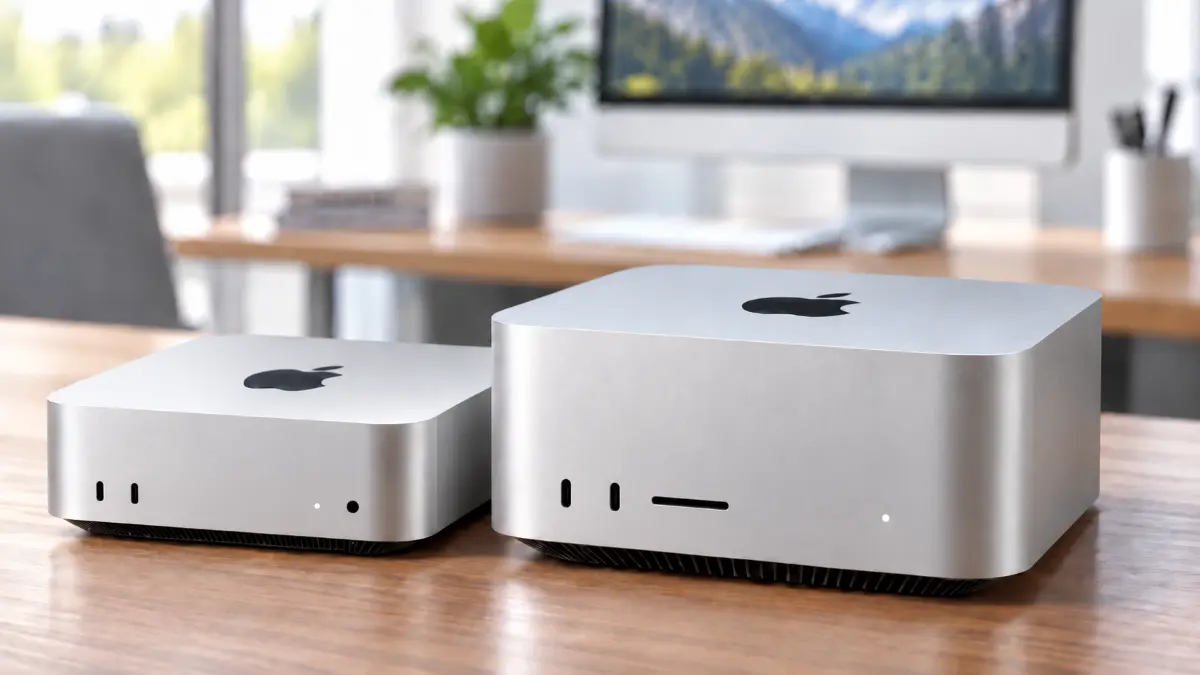

Apple’s new Mac mini and Mac Studio officially launch tomorrow, September 22, with both desktops reaching customers, Apple Stores, and authorized resellers after being announced in August. The refresh keeps the familiar compact designs but brings major performance gains through Apple’s latest silicon.
The new Mac mini is available with either the M6 or M5 Pro, while the Mac Studio moves to M5 Max and the new M5 Ultra. There are no major exterior redesigns this year. Apple’s focus is almost entirely on performance, AI acceleration, faster storage, and updated connectivity.
Mac mini Debuts Apple’s New M6 Chip
The biggest change in the Mac mini is the arrival of the M6, Apple’s first 2-nanometer Mac chip.
Apple says the M6 configuration delivers up to 40 percent faster CPU performance, up to 2x faster graphics, up to 2x faster storage, and as much as 4x faster AI performance compared with the previous generation. Neural Accelerators are integrated directly into the GPU, giving the machine substantially more capability for local AI workloads and Apple Intelligence features.
The M6 Mac mini uses a 12-core CPU and 12-core GPU, while the more powerful M5 Pro configuration is aimed at heavier workloads such as software development, video production, 3D work, and game development. Early testing suggests the M6 is particularly strong in single-core performance, while the M5 Pro retains an advantage in highly multithreaded workloads.
Connectivity Gets a Meaningful Upgrade
The Mac mini also receives updated networking hardware.
Both models now support Wi-Fi 7 and Bluetooth 6, along with 2.5Gb Ethernet as standard. A 10Gb Ethernet option remains available for users who need faster wired networking.
That makes the compact Mac more attractive for workstation, development, server, and always-on desktop roles where fast local networking can matter as much as raw processor performance.
The physical enclosure remains essentially unchanged, maintaining the very small footprint Apple introduced with the previous redesign.
Mac mini Starts at $899
One notable change is price.
The M6 Mac mini now starts at $899, meaning Apple no longer offers the previous $599 entry-level configuration. That raises the barrier to entry considerably, although the new machine also brings significantly more performance and upgraded connectivity.
The M5 Pro version sits higher in the lineup for users who need stronger sustained multicore and GPU performance.
Mac Studio Moves to M5 Max and M5 Ultra
At the professional end of Apple’s desktop lineup, the new Mac Studio starts at $2,499 with M5 Max.
The M5 Max version can be configured with an 18-core CPU, up to a 40-core GPU, and up to 128GB of unified memory. Apple says GPU performance can be up to 50 percent faster than the previous generation, while Neural Accelerators built into each GPU core provide a major boost for AI workloads.
The Mac Studio is aimed squarely at professional workflows such as software compilation, photography, music production, 3D rendering, game development, and high-resolution video editing.
M5 Ultra Pushes Local AI Much Further
The flagship M5 Ultra Mac Studio starts at $5,499 and represents Apple’s most powerful desktop configuration.
M5 Ultra can be configured with up to a 36-core CPU and 80-core GPU, along with as much as 512GB of unified memory and 1.2TB/s of memory bandwidth. Apple says AI compute performance can reach up to 4.3x that of the previous M3 Ultra, while graphics performance improves by as much as 1.8x.
That enormous unified-memory ceiling is particularly important for AI development. A 512GB configuration can run very large language models entirely on-device rather than relying on cloud GPUs, which is one of the clearest examples yet of Apple positioning the Mac Studio as a local AI workstation.
Apple is also enabling multiple Mac Studio systems to be linked through Thunderbolt 5 and RDMA, allowing teams to distribute AI inference workloads across several machines.
Built for Heavy Video and 3D Work
The M5 Ultra configuration is also designed for extremely demanding media workflows.
Its expanded Media Engine can simultaneously handle up to 33 streams of 8K ProRes 422 video at 30 fps, while the 80-core GPU targets real-time rendering, visual effects, simulation, and 3D production.
Early independent testing has shown significant gains over the previous M3 Ultra generation, particularly in GPU rendering and heavily parallel workloads.
Mac Studio Connectivity Also Improves
The new Mac Studio retains its familiar enclosure but adds Wi-Fi 7, Bluetooth 6, and Thunderbolt 5.
Thunderbolt 5 is particularly important at this level because it supports very fast external storage, PCIe expansion systems, high-resolution displays, and multi-machine AI configurations.
The design may be unchanged, but the internal platform is substantially more capable.
Two Very Different Desktop Macs
The Mac mini and Mac Studio now cover a much wider performance range.
The M6 Mac mini at $899 is positioned as the compact mainstream desktop, offering a substantial jump in CPU, GPU, storage, and AI performance without moving into workstation pricing.
The M5 Pro Mac mini sits between consumer and professional use, making more sense for developers, video editors, and users who regularly push multicore workloads.
The M5 Max Mac Studio at $2,499 targets demanding creative professionals, while the M5 Ultra model at $5,499 moves into workstation territory for AI development, 3D rendering, large-scale video production, and other workloads that can take advantage of huge amounts of unified memory.
Apple’s Desktop Strategy Is Increasingly About Local AI
The most important story behind tomorrow’s launch may not be raw benchmark numbers.
Both machines emphasize on-device AI, with Neural Accelerators built into Apple’s newest GPU architectures and macOS 27 providing the software layer for Siri AI, Apple Intelligence, and increasingly sophisticated local models.
The Mac mini makes that capability more accessible, while Mac Studio pushes it to an extreme with up to 512GB of unified memory and multi-machine clustering.
With both systems reaching stores on September 22, Apple’s desktop lineup now spans everything from a compact $899 machine to a workstation capable of running massive AI and professional workloads locally. The designs may look familiar, but the silicon inside represents one of the more significant performance upgrades Apple has brought to its desktop Macs in recent years.