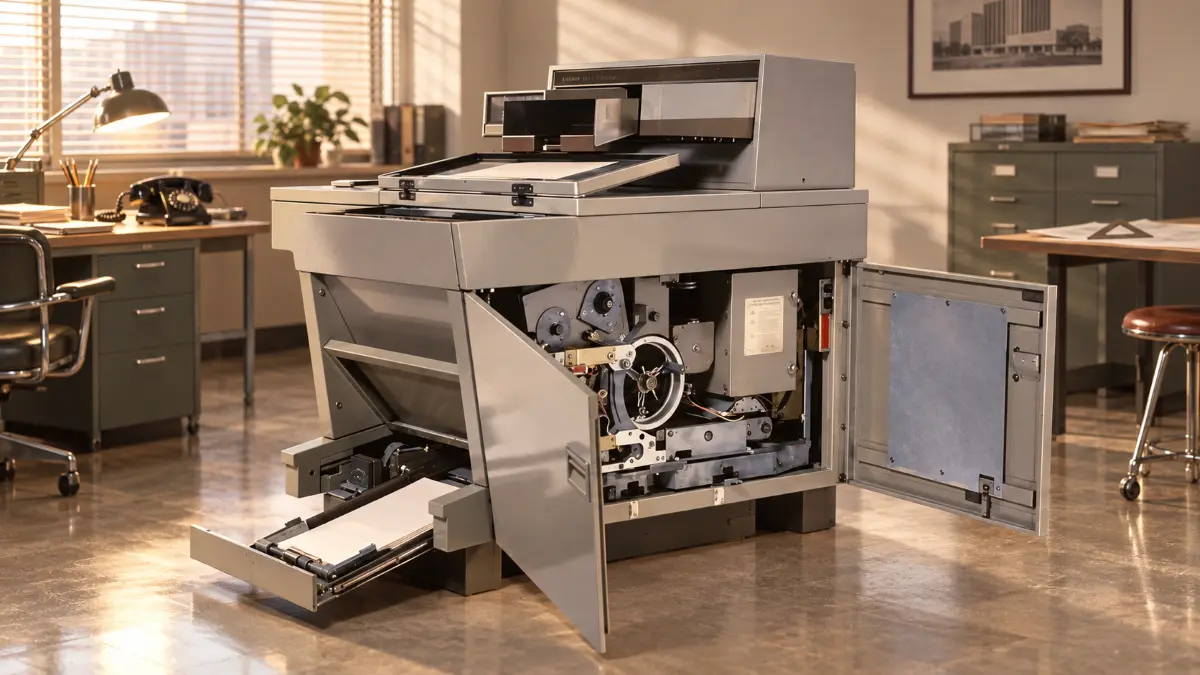

The Xerox 914 photocopier made its debut on September 16, 1959, in a live television demonstration from New York City. This wasn’t just another gadget launch; it was the moment when document reproduction took a giant leap forward. The Xerox 914 photocopier became the first successful machine of its kind, turning a complex, manual process into a fast, reliable, and accessible technology for offices everywhere.
Before the Xerox 914, copying documents was a cumbersome affair. Carbon paper or manual transcription were the norm, both time-consuming and error-prone. The introduction of this machine addressed a fundamental bottleneck in business and administrative workflows: how to quickly and accurately duplicate documents without retyping or relying on fragile carbon copies. The Xerox 914 photocopier solved this by using a novel dry process based on electrostatic photography, which was revolutionary at the time.
At its core, the Xerox 914 utilized a photoconductive drum that attracted toner particles to form an image, which was then transferred to paper. This process eliminated the need for wet chemicals and complex setups, making it safer and more practical for everyday office use. The machine’s ability to produce clean, clear copies on demand transformed how businesses handled paperwork. Suddenly, creating multiple copies of contracts, memos, and reports was no longer a bottleneck but a routine task.
The impact of the Xerox 914 extended beyond just speed and convenience. It fundamentally altered office culture and productivity. By automating document duplication, it freed up staff time and reduced errors associated with manual copying. This shift enabled organizations to scale operations and improve communication internally and externally. The Xerox 914 also laid the groundwork for the modern office environment, where digital and physical document management systems coexist.
Its success sparked a wave of innovation in office technology. The photocopier became a staple in workplaces worldwide, influencing everything from document security to printing technology. The Xerox 914’s design and functionality set a benchmark that competitors had to meet or exceed, pushing the entire industry forward. It also helped cement Xerox’s reputation as a leader in imaging and copying technology, a legacy that continues to influence tech development today.
Why does the Xerox 914 still matter? Even as digital document management dominates, the photocopier remains a vital tool in many contexts. The principles behind the Xerox 914’s electrostatic copying process underpin modern laser printing technology. Understanding this lineage helps explain how physical and digital document workflows evolved in parallel. The Xerox 914’s introduction was a key step in bridging analog and digital office practices, a hybrid reality that persists.
Looking back, the Xerox 914 photocopier’s debut on September 16, 1959, was more than a product launch. It was a technical breakthrough that reshaped how organizations handle information. By solving the problem of fast, reliable document reproduction, it influenced office productivity and technology development for generations. Its legacy is a reminder that sometimes the most transformative tech innovations come from rethinking everyday tasks.