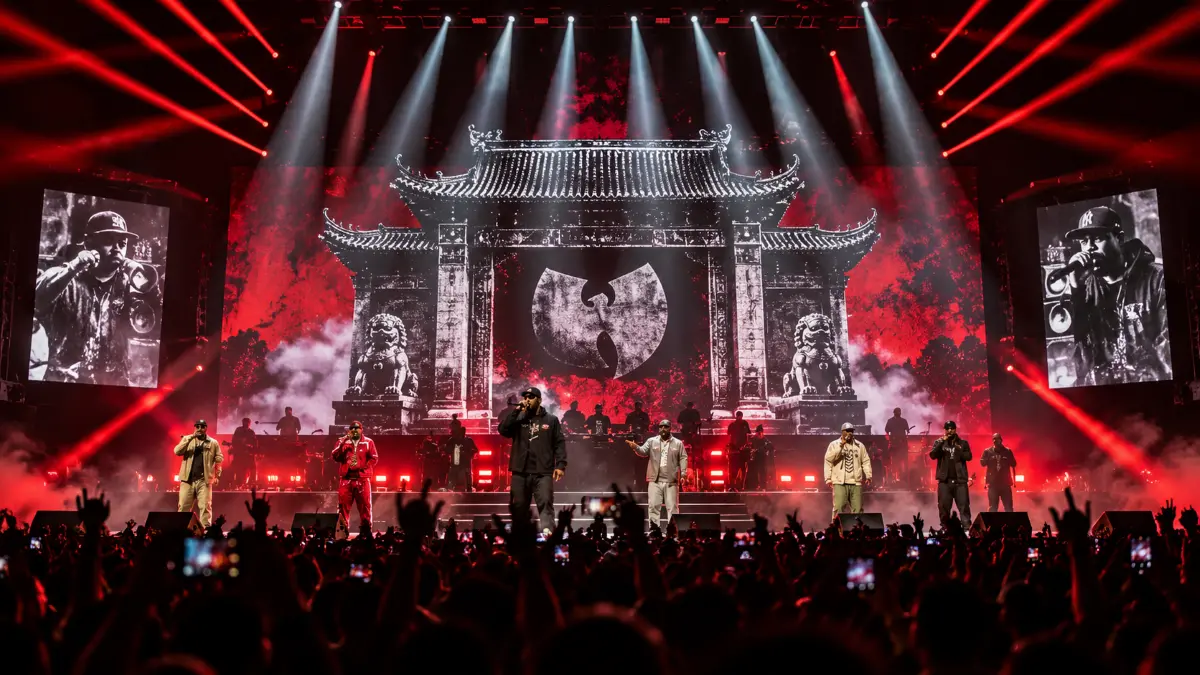

On a Wu-Tang Clan stage, the difficult part is not turning on another hundred lights. It is knowing who needs the light three seconds from now.
A verse can jump from RZA to Inspectah Deck, Ghostface Killah, Method Man, Raekwon, GZA, U-God, or Masta Killa almost instantly. Young Dirty Bastard can take over material associated with his late father, Ol’ Dirty Bastard. Cappadonna may enter another section. Guests can appear. The running order itself may not behave the way a tightly sequenced arena production normally does.
That makes the technology behind Wu-Tang Forever: The Final Chamber unusually interesting. It is sophisticated not because it removes unpredictability, but because it has been designed to survive it.
Wu-Tang is currently in the middle of a North American Final Chamber run, with U.S. dates continuing into early October. The September leg has already passed through Massachusetts, New Jersey, Ohio, Michigan, and other markets before continuing south and west.
The current run can bring together RZA, GZA, Method Man, Raekwon, Ghostface Killah, Inspectah Deck, U-God, and Masta Killa, with Cappadonna also part of the broader touring lineup and Young Dirty Bastard carrying material associated with his late father, Ol’ Dirty Bastard. Exact appearances can vary by show. At the September 8 Toronto performance, for example, RZA, GZA, Method Man, Raekwon, Ghostface Killah, Inspectah Deck, U-God, Masta Killa, Young Dirty Bastard, and DJ Mathematics were photographed together, while Cappadonna was absent from that particular date.
For a production crew, that many personalities on one stage turns a concert into a real-time systems problem.
Table of Contents
Why Final Chamber’s Technology Has to Adapt
There is an important distinction to make before looking under the hood.
A global tour is not one permanently frozen equipment package. Venues change. Suppliers change. Local crews change. Hardware can change between continents and tour legs.
Some of the clearest technical documentation for Final Chamber comes from its 2026 European run, where PRG supplied lighting, video, and rigging. Performer-tracking documentation also identifies PRG as the supplier in Europe and Australia and Fuse as the U.S. supplier. Meanwhile, the most detailed published account of the tour’s American audio system describes the 2025 North American leg.
That means it would be misleading to pretend every rack, speaker, processor, and lighting fixture documented in Europe is necessarily sitting in exactly the same position at every U.S. show today.
What is more revealing is the production architecture behind the tour. Large-scale video, fast performer tracking, lighting that can be operated spontaneously, resilient processing, and audio designed around intelligibility.
Those systems reveal how a technologically complex concert stays flexible.
The Stage Is a Data System
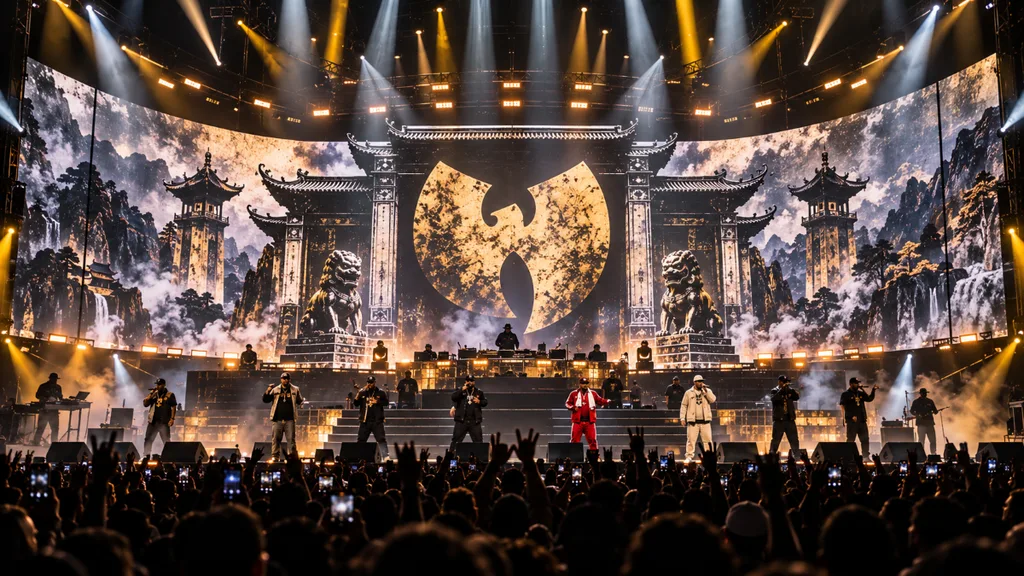
The most obvious piece of technology is also the biggest.
For the European production, a curved rear-stage LED wall measured approximately 18 meters wide by 9 meters high. Two additional IMAG screens, used for magnified live camera imagery, measured roughly 5 by 7 meters each. Rather than showing basic camera feeds, visual effects were layered into the live imagery to make those screens feel integrated with the larger production.
ROE Visual’s Vanish V4ST LED platform formed the main canvas. Its mechanical design allowed the production team to create the enormous curved structure without suspending the whole wall from a conventional overhead truss. That matters creatively, but it also matters operationally. A touring system has to be built, tested, performed on, dismantled, loaded, transported, and reconstructed over and over again.
A spectacular display that takes too long to assemble is not necessarily a good touring product.
Behind the wall, the video system becomes less glamorous and more interesting.
Six Brompton Tessera SX40 processors were documented in the European configuration, with five active units and one spare distributing data across 12 distribution boxes. Redundancy becomes essential when the stage itself depends on millions of pixels behaving correctly.
If a conventional piece of scenery fails, the audience may notice the problem. If the primary digital canvas loses data during a performance, an entire visual environment can disappear. If the primary digital canvas loses data during a performance, an entire visual environment can disappear.
That is why modern concert video increasingly resembles mission-critical infrastructure. Processing capacity matters, but so do redundancy, signal distribution, mechanical simplicity, and the ability to troubleshoot quickly.
Tracking the Voice, Not Just the Body
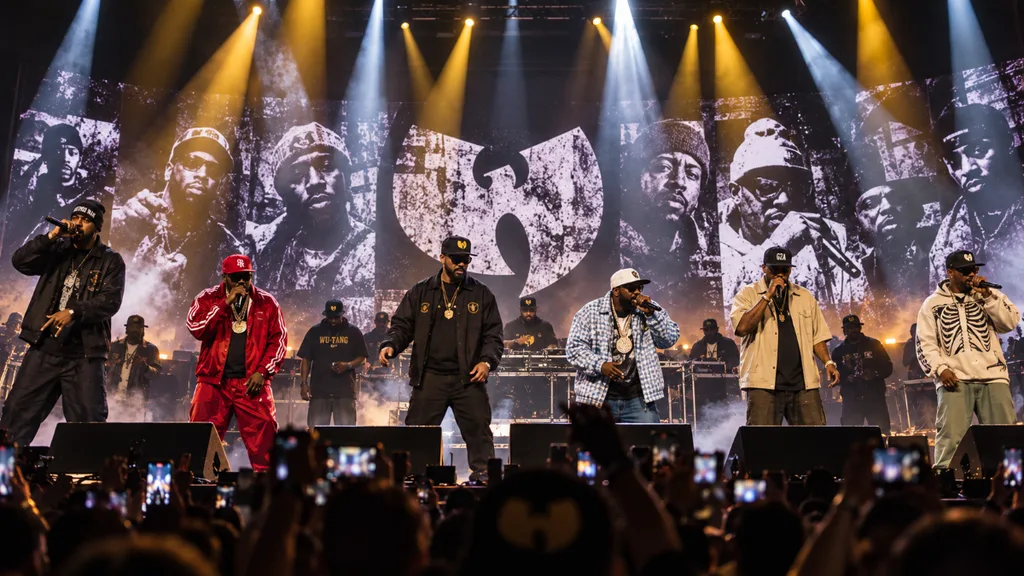
Lighting Wu-Tang presents a different problem.
Follow-Me documentation describes 10 to 11 members potentially commanding the stage simultaneously, with a setlist capable of arriving minutes before the show or even changing while the show is underway. The tour’s tracking system uses six Follow-Me targets and 12 Robe iForte LTX fixtures, pairing two lighting fixtures with each target.
That still does not fully explain why the system matters.
Tracking coordinates is relatively easy. Knowing which person matters at this exact musical moment is the harder task.
Creative direction for the tour called for the member delivering the verse to receive the primary light while others could fall visually into the background. Lighting director and programmer Jack Cannon uses a camera-based interface that lets him watch tracked performers and rapidly shift the emphasis when another rapper takes over.
A handoff may last only a handful of words.
That is where conventional automation reaches its limit. Software can know where Method Man is standing. It cannot necessarily infer that Ghostface is about to take the next bar, that an unexpected guest is walking onstage, or that a performer has suddenly moved somewhere the production did not anticipate.
Human judgment remains inside the loop.
And that may be the more important technology story. The strongest systems here do not eliminate operators. They give operators better information and faster control.
There is another practical benefit. Touring productions regularly depend on local personnel. Follow-Me’s team reported being able to train incoming spot operators using the camera workflow and stage reference points, sometimes getting inexperienced local operators functional in roughly 15 to 20 minutes. Calibration could be completed in about 10 to 15 minutes.
On a long tour, usability becomes part of reliability.
Why the Show Rejects Autopilot
Modern concerts can be extraordinarily automated.
Timecode can synchronize lighting, video, lasers, pyro, playback, and effects to fractions of a second. The result can be spectacular, but there is a tradeoff. The more tightly a production is synchronized, the more the performers may need to stay inside that structure.
Final Chamber pushes in the opposite direction.
The European lighting production was described as a fully busked show, meaning the cues were largely operated live rather than being driven by a fixed timecode sequence. GLP’s production documentation says the set could pull from dozens of songs in different orders.
That creates risk. A live operator can make a mistake. Different nights will not be visually identical. The crew has to know the material extremely well.
But it also creates freedom.
A lighting console becomes less like a playback device and more like another instrument. The operator can respond to an extended verse, a sudden pause, audience energy, an unexpected guest, or a change in running order.
The documented European rig included 79 GLP JDC Burst 1 fixtures and 36 impression X5 Bar 1000 units. The bars helped extend the linear, architectural look of the scenic environment, while the JDC units provided impact and movement across the stage and into the audience.
The impressive part is not the fixture count by itself.
It is that a large, technically dense rig remains playable.
Making Every Word Survive an Arena
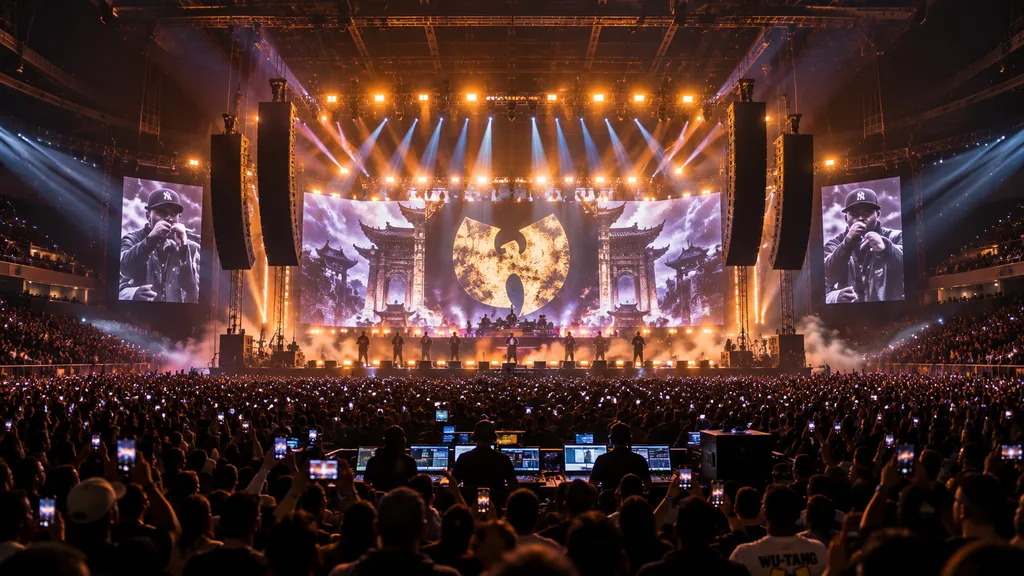
A visual cue can miss and the concert can recover. If the audience cannot understand the verses, a Wu-Tang show has a much more fundamental problem.
The best-documented American audio configuration comes from the 2025 North American Final Chamber leg, so it should not automatically be treated as the confirmed 2026 equipment list. But it illustrates the engineering problem unusually well.
Clair Global deployed a Cohesion system built around 68 CO12 loudspeakers, eight CO8 fills, 34 CP218 II+ subwoofers, a CP118+ drum sub, and more than 20 CM-series stage monitors. Cohesion said the system had to maintain lyrical intelligibility with around 10 members onstage at levels reaching roughly 115 to 120 dBA.
Volume alone is easy to misunderstand as the goal.
For hip-hop, intelligibility can be harder than raw output. Low-frequency energy is enormous. Multiple microphones may be active. Crowd noise is high. Reflections from a large venue can smear rapid vocals. A kick drum can still feel powerful under those conditions, but a dense Inspectah Deck verse can lose its edges quickly.
The engineering target is therefore not simply louder.
It is controlled coverage, clean vocal reproduction, sufficient headroom, useful stage monitoring, and low-frequency impact that does not bury the words carrying the performance.
That requires the PA, processing, microphone system, room geometry, monitor mix, and front-of-house engineer to behave like one integrated system.
One Tour, More Than One Technology Stack
There is a broader lesson hidden inside Final Chamber.
Fans experience a tour as one product. The logo is the same. The songs are familiar. The visual identity travels from city to city.
Behind the curtain, the technology can be much more modular.
PRG handled major parts of the European production. Fuse is identified with the U.S. performer-tracking deployment. The detailed Cohesion audio case study comes from the earlier North American leg. Local crews change almost nightly. Arenas, amphitheaters, festivals, rigging limits, acoustics, and available infrastructure all vary.
Consistency therefore does not come from shipping an absolutely identical technical environment everywhere.
It comes from creating a production design that can survive substitution.
That is a very different way to think about concert technology. The most important specification may not be the model number printed on a fixture or processor. It may be whether the workflow remains understandable when a different vendor supplies the hardware, whether calibration can happen quickly, whether redundancy is built in, and whether operators can adapt when the performance changes.
For global touring, flexibility is part of the specification.
Technology Without Erasing Wu-Tang
There is another failure mode that has nothing to do with equipment.
A legacy act can become so overproduced that the spectacle starts competing with what made the artist distinctive in the first place.
The Final Chamber design has instead leaned deeply into imagery already associated with Wu-Tang. The European stage used curved LED architecture and a gate-like scenic environment inspired by Shaolin and temple aesthetics. Lighting designer Ben Walton described the objective as extending that world beyond the screen and into the room through light, atmosphere, and scale.
That matters because production technology is ultimately a form of translation.
The screen translates Wu-Tang’s mythology into arena-scale imagery. Performer tracking translates rapid lyrical handoffs into visual focus. The PA translates closely packed verses into intelligible sound across thousands of seats.
Technology succeeds when the audience experiences those results without thinking about the infrastructure creating them.
What Final Chamber Says About the Future of Live Shows
It is tempting to look at modern concert technology and assume the destination is complete automation.
Final Chamber suggests something more interesting.
The valuable systems are increasingly the ones that combine automation with operator agency. Tracking identifies movement, but humans decide emphasis. LED processors handle an enormous data workload, but redundancy protects the creative intent. Advanced lighting fixtures can execute complex effects instantly, yet a person still decides when the moment calls for them.
That approach has implications beyond touring.
As live production becomes more software-driven, systems will need to become easier to reconfigure, easier to hand off between crews, and resilient enough to operate across different physical environments. The most valuable technology may not be the technology capable of producing the most elaborate programmed sequence. It may be the system that can adapt when reality refuses to follow the program. It may be the system that can adapt when reality refuses to follow the program.
Wu-Tang Clan is a particularly good test case because predictability has never been the point.
More than three decades after Enter the Wu-Tang (36 Chambers), the stage has evolved into a network of LED processors, tracking systems, cameras, lighting consoles, moving fixtures, digital audio infrastructure, and enormous PA arrays.
Yet the objective remains surprisingly simple.
When RZA, GZA, Method Man, Raekwon, Ghostface Killah, Inspectah Deck, U-God, Masta Killa, Cappadonna, or Young Dirty Bastard takes control of the moment, the production has to recognize it almost as quickly as the audience does.
The most impressive technology on Final Chamber is not the technology trying to run Wu-Tang Clan.
It is the technology fast enough to keep up with them.



Reader perspectives, questions, and reactions.
No comments yet. Start the conversation.