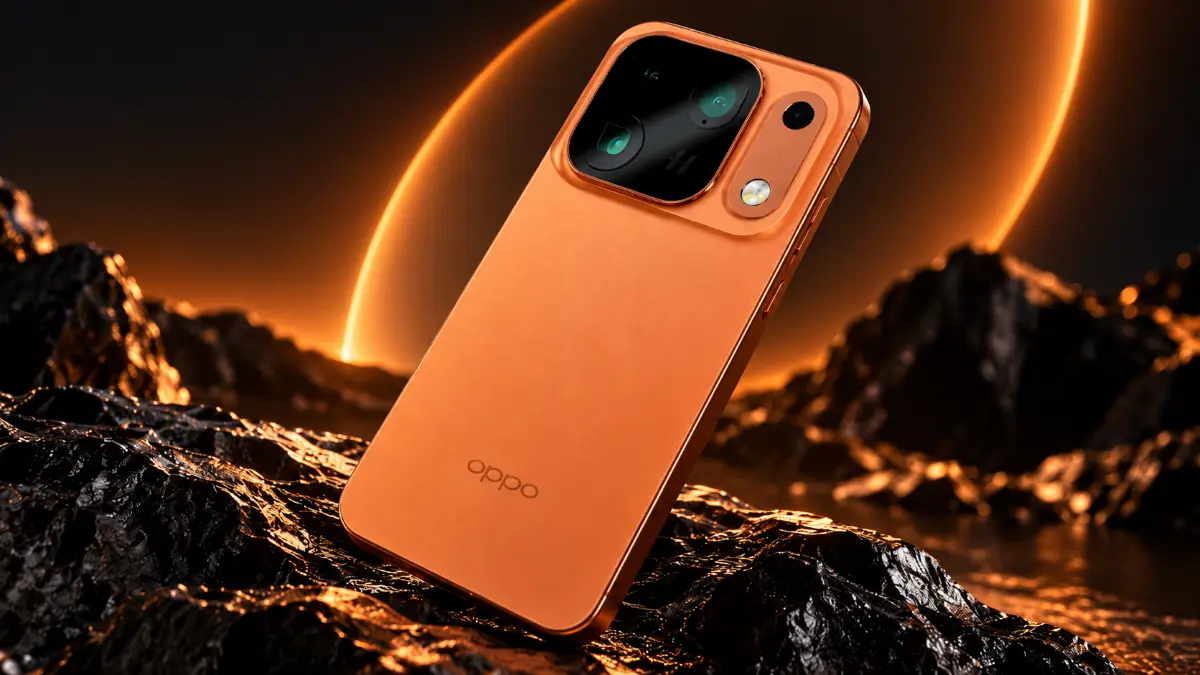

Oppo has launched the Find X10 Pro Max in China with an unusually ambitious approach to smartphone photography. Instead of reserving its highest-resolution sensor for the primary camera, the company has equipped all three rear cameras with 200-megapixel sensors.
That makes the Find X10 Pro Max the first smartphone with three 200MP rear cameras, covering the main, ultrawide, and telephoto perspectives. While that technically puts 600 megapixels of sensors on the back of the phone, adding the numbers together is largely meaningless. The more interesting story is what Oppo is trying to accomplish with them.
For years, even expensive flagship phones have concentrated their best imaging hardware in the main camera. Switch to the ultrawide or telephoto and users often encounter smaller sensors, lower resolution, weaker low-light performance, or reduced video capabilities.
Oppo is trying to narrow that gap.
Three 200MP Cameras, Three Different Jobs
The primary camera uses a 200MP Samsung ISOCELL HPC sensor with a large 1/1.3-inch format, optical stabilization, and an f/1.5 aperture.
Oppo claims the camera can capture as much as 17 stops of dynamic range, potentially preserving substantially more information across bright highlights and deep shadows.
That figure may ultimately matter more than the 200MP resolution.
Dynamic range is particularly important in difficult scenes such as a person standing against a bright sunset, a nighttime cityscape filled with illuminated signs, or an interior with daylight streaming through windows. Smartphones typically compensate for those extremes by combining multiple exposures computationally. A sensor capable of capturing more information from the outset gives that processing pipeline better material to work with.
The 17-stop figure remains a manufacturer specification, and independent testing will determine how much of that capability translates into finished photographs. But it indicates that Oppo is chasing more than resolution alone.
DeepPix Is About More Than Pixel Count
The main sensor incorporates DeepPix technology, designed to improve how efficiently individual pixels collect and retain light-generated charge.
This matters because extremely high-resolution smartphone sensors face an inherent challenge. Packing 200 million pixels into a relatively small imaging sensor means each individual photosite is tiny. Smaller pixels can capture less light, which can increase noise and reduce image quality in difficult conditions.
DeepPix is intended to improve the sensor’s ability to handle that information, particularly in high-contrast scenes.
The goal is not simply to produce enormous 200MP photographs. It is to give Oppo’s computational photography system more useful image data before software processing begins.
The Ultrawide Gets Flagship Treatment
Perhaps the most interesting camera is not the primary sensor at all.
The Find X10 Pro Max also uses a 200MP sensor for its ultrawide camera, paired with a 124-degree field of view.
Ultrawide cameras are frequently the weakest part of otherwise excellent smartphone camera systems. Manufacturers often pair an impressive main sensor with a noticeably smaller ultrawide, and the difference becomes particularly obvious indoors or after sunset.
Oppo’s approach gives the ultrawide substantially more image information to work with.
That does not automatically make it equal to the primary camera. Sensor dimensions, aperture, optics, stabilization, and image processing still influence the result. But Oppo is reducing one of the most obvious hardware compromises found in conventional triple-camera systems.
The additional resolution also provides greater freedom for distortion correction and cropping, both important for an ultrawide lens where the edges of the frame often require significant computational adjustment.
200MP Makes More Sense on the Telephoto
The third 200MP sensor powers the telephoto camera, where extreme resolution has another practical advantage: cropping.
Optical zoom remains preferable because it preserves genuine optical detail, but a high-resolution sensor gives the phone considerably more information when it needs to extend beyond the lens’s native focal length.
Oppo can combine optical magnification with sensor cropping and computational processing to produce intermediate and longer zoom levels without immediately exhausting the available image resolution.
The telephoto system also supports close focusing, allowing it to double as a macro camera. That could be particularly useful because a telephoto macro lets photographers capture small subjects from farther away instead of positioning the phone almost directly against them.
200MP Doesn’t Mean 200MP Photos All the Time
The headline resolution also needs some perspective.
Users are unlikely to capture full-resolution 200MP images every time they press the shutter.
High-resolution smartphone sensors typically use pixel binning, combining information from neighboring pixels to create a lower-resolution final image with better light sensitivity and reduced noise.
That means 200MP can be useful even when the resulting photograph contains far fewer than 200 million pixels.
The additional sensor information can feed HDR processing, digital zoom, noise reduction, detail reconstruction, cropping, and other computational photography techniques.
This is why comparing smartphone cameras purely by megapixel count has become increasingly misleading. What matters is how effectively the complete imaging system converts that information into a photograph.
Consistency Could Be Oppo’s Real Advantage
Using three high-resolution sensors could solve another persistent smartphone-camera problem: inconsistency between lenses.
Take a photograph with the main camera and colors may look excellent. Switch to the ultrawide and the white balance changes. Zoom in and the telephoto suddenly produces more noise or less dynamic range.
Video makes these differences even easier to notice because switching lenses can produce an obvious change in exposure, detail, or color while recording.
By starting with high-resolution sensors across all three cameras, Oppo has more room to normalize their output computationally.
Matching resolution does not mean matching image quality. Each camera still has different optics and sensor characteristics. But the processing pipeline no longer has to compensate for one camera beginning with dramatically less information than another.
For creators who routinely move between focal lengths, that consistency may prove more valuable than the ability to capture a full-resolution 200MP still.
Hasselblad Remains Part of the Equation
Oppo’s continuing partnership with Hasselblad adds another layer to the camera strategy.
Modern smartphone photography depends on much more than sensors. Color rendering, portraits, exposure, autofocus, sharpening, noise reduction, HDR processing, lens correction, and computational zoom can all have a greater impact on the finished image than the raw megapixel count.
That is also why Oppo’s triple-200MP strategy carries some risk.
Aggressive processing can erase natural texture. Excessive sharpening can make photographs look artificial. Poor HDR can flatten scenes that should have contrast. A 200MP sensor does not prevent any of those problems.
Oppo still has to make good decisions with the enormous amount of information the cameras provide.
Three 200MP Sensors Need Serious Processing Power
Processing data from three 200MP cameras places considerable demands on the phone’s silicon.
The Find X10 Pro Max uses MediaTek’s Dimensity 9600 Pro, providing the computational performance required for photography, video, AI processing, and other flagship workloads.
That processing capability has become inseparable from smartphone photography.
Pressing the shutter can trigger an entire computational pipeline. Multiple frames may be captured and aligned, exposures combined, moving subjects identified, noise reduced, highlights reconstructed, faces treated separately from backgrounds, colors adjusted, and fine detail sharpened before the finished photograph appears.
Three 200MP sensors potentially provide much more raw information to that pipeline.
The challenge is processing it quickly enough that users do not notice the complexity happening behind the shutter button.
An 8,000mAh Battery Supports the Hardware
Oppo has paired the imaging system and flagship processor with another unusually large specification: an 8,000mAh battery.
That is substantially larger than the approximately 5,000mAh capacities that became common among flagship Android phones over the previous several generations.
The extra capacity makes sense in a device designed for intensive photography, high-resolution video, AI workloads, and sustained processing.
Camera systems consume considerable power, particularly during extended video recording. Image sensors, stabilization systems, the display, processor, storage, and image-processing pipeline can all operate simultaneously.
The larger battery therefore complements the camera strategy rather than simply serving as another specification for the marketing sheet.
Oppo Is Challenging the Flagship Camera Hierarchy
The Find X10 Pro Max is interesting because it challenges a long-standing assumption in smartphone design: that one camera deserves the best hardware and the others can compromise.
That hierarchy made sense when high-end sensors were expensive, large, and difficult to accommodate inside increasingly thin phones.
Oppo is taking a different approach.
Instead of building one exceptional camera surrounded by supporting cameras, it is attempting to make all three rear cameras behave like primary cameras, while specializing each one for a different focal length.
That could matter more than the headline 600MP combined resolution.
If the approach works, users should not have to think about which camera provides the best image quality before composing a photograph. They should be able to choose the focal length that fits the scene.
Now the Numbers Have to Deliver
The Find X10 Pro Max has an extraordinary camera specification sheet, but smartphones have repeatedly demonstrated that larger numbers do not guarantee better photographs.
Three 200MP sensors create their own challenges. Huge quantities of image data require processing power and energy. High-resolution sensors still depend on lenses capable of resolving sufficient detail. Smaller individual pixels need sophisticated processing in low light. And computational photography can easily become too aggressive.
Independent real-world photography will therefore be the meaningful test.
Can the ultrawide approach the primary camera after sunset? Does the telephoto preserve natural detail at longer zoom levels? Are colors consistent when switching between cameras? Can Oppo exploit its claimed dynamic range without producing artificial-looking HDR? And can the phone sustain demanding photography and video workloads without excessive heat or battery drain?
Those questions are considerably more important than whether Oppo can technically place 600 million pixels on the back of a smartphone.
For years, manufacturers have competed to build the smartphone with the best main camera.
With the Find X10 Pro Max, Oppo is making a different bet: the best camera should simply be whichever lens you need at that moment.