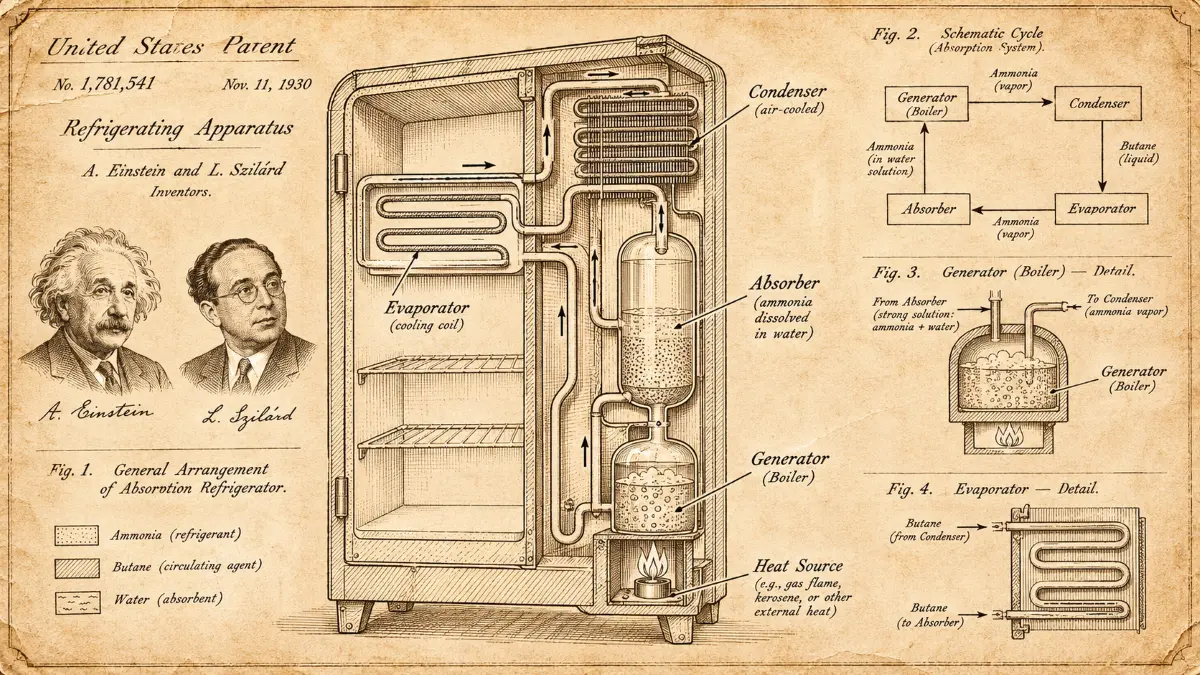

On November 11, 1930, Albert Einstein and Hungarian physicist Leó Szilárd received US Patent 1,781,541 for an unconventional refrigeration system designed to operate without the mechanical compressor found in conventional refrigerators. The invention used heat, gravity, and the physical behavior of different fluids to produce cooling, demonstrating an alternative to the electrically driven mechanical systems that were becoming increasingly common in households.
Although Einstein is primarily remembered for his revolutionary contributions to theoretical physics, his collaboration with Szilárd reflected a different side of his scientific interests: applying fundamental physical principles to practical engineering problems. Their refrigerator was not simply an academic experiment. It emerged from genuine concerns about the safety of household appliances at a time when refrigerant leaks could have deadly consequences.
The patented design never became a mainstream commercial product, but it remains a fascinating example of how thermodynamics, inventive engineering, and public safety concerns can intersect. Nearly a century later, the underlying questions it explored, including mechanical reliability, alternative energy sources, and safer refrigeration, remain relevant to the development of modern cooling technologies.
The Deadly Problem That Inspired Einstein and Szilárd
During the 1920s, household refrigeration was undergoing a major transformation. Mechanical refrigerators were beginning to replace traditional iceboxes, allowing families to preserve food without depending on regular deliveries of ice. However, early refrigeration systems often relied on hazardous chemicals, including ammonia, sulfur dioxide, and methyl chloride, which could escape if seals, valves, or other components failed.
According to historical accounts, Einstein and Szilárd became concerned about refrigerator safety after reports of a family dying from toxic refrigerant fumes. The tragedy highlighted a fundamental weakness in some contemporary appliances: moving mechanical components required seals and connections that could deteriorate or leak.
The two physicists began exploring refrigeration technologies that could eliminate vulnerable mechanical pumping mechanisms. Their collaboration started in 1926 and eventually produced a collection of inventions involving absorption refrigeration, fluid circulation, and electromagnetic pumping.
Rather than focusing exclusively on improving existing compressors, Einstein and Szilárd questioned whether mechanical compression was necessary at all. Their work drew on established principles of thermodynamics and earlier absorption-refrigeration research, combining them into alternative system designs intended to improve reliability.
How the Einstein-Szilárd Refrigerator Worked
The system described in US Patent 1,781,541 used three working fluids: butane, ammonia, and water. Instead of mechanically compressing refrigerant vapor, the apparatus relied on heat-driven circulation, selective absorption, condensation, and differences in vapor pressure.
In the patented arrangement, liquid butane entered an evaporator located inside the space being cooled. Ammonia gas was introduced into the same chamber, reducing the partial pressure of butane and allowing it to evaporate at a relatively low temperature. As the butane evaporated, it absorbed heat from its surroundings, producing the desired cooling effect.
The resulting mixture of butane vapor and ammonia traveled to another section of the apparatus, where water absorbed the ammonia. This separation allowed the butane to condense back into liquid form under suitable temperature and pressure conditions. The liquid butane could then return to the evaporator, repeating the cooling process.
Meanwhile, the ammonia-rich water solution flowed toward a heated generator. Applying heat released ammonia from the solution, allowing it to circulate back toward the evaporator. A separate heated section helped lift liquid through the system, while gravity assisted its return through the interconnected chambers.
The arrangement eliminated the need for a conventional mechanically driven compressor. However, it did not eliminate the need for energy. Heat was essential to maintain the refrigeration cycle, and the system still needed to reject waste heat to its surroundings.
The design also contained substances requiring careful handling. Ammonia is toxic at sufficient concentrations, while butane is flammable. Its proposed safety advantages therefore came primarily from reducing mechanical failure points and potential leakage paths, not from using entirely harmless chemicals.
Why a Refrigerator Without Moving Parts Mattered
The engineering appeal of the Einstein-Szilárd refrigerator lay in its mechanical simplicity. Conventional vapor-compression refrigerators use a compressor to raise the pressure of refrigerant vapor, enabling heat to be transferred from the refrigerated compartment to the surrounding environment. That process typically requires mechanical components, lubrication, and seals.
The patented absorption system approached the same fundamental problem through a different physical mechanism. By using heat to separate and circulate working fluids, it could operate without the moving compressor components that created maintenance and leakage concerns in early refrigeration equipment.
This offered several potential advantages. A sealed system with fewer moving parts could reduce mechanical wear, simplify certain maintenance requirements, and avoid the vibration associated with conventional compressors. It could also operate using a suitable external heat source rather than depending on an electrically driven compressor.
However, these advantages involved tradeoffs. Absorption refrigeration systems can require substantial heat input, and their efficiency depends heavily on system design and operating conditions. Eliminating moving parts does not automatically produce lower overall energy consumption.
Einstein and Szilárd were therefore exploring an alternative engineering architecture rather than a universally superior replacement for mechanical refrigeration. Their invention demonstrated that the same cooling objective could be achieved through a different combination of physical processes.
The Electromagnetic Pump and Other Experiments
The 1930 absorption-refrigerator patent was only one part of Einstein and Szilárd’s broader refrigeration research. The physicists also developed an electromagnetic pumping concept intended to move liquid metal without conventional moving mechanical parts.
This separate design used an electromagnetic field to propel a conductive liquid-metal mixture, which could then help compress or circulate refrigerant. The approach was technically distinct from the three-fluid absorption cycle described in US Patent 1,781,541.
The electromagnetic pump attracted industrial interest, including development work associated with the German electrical manufacturer AEG. Engineers constructed prototypes, but the technology encountered practical difficulties involving noise, materials, and efficiency.
The liquid-metal system required particularly careful engineering because the conductive materials involved could be chemically reactive. Early prototypes also suffered from significant operating noise, complicating the goal of producing a quiet household appliance.
Despite these obstacles, the electromagnetic pumping concept demonstrated the inventors’ willingness to explore unconventional solutions. Their refrigeration research generated numerous patent applications across several countries, covering different mechanisms and configurations.
The broader project also showed how difficult it can be to turn an elegant physical principle into a commercially viable product. A working prototype must satisfy requirements involving manufacturing costs, safety, energy efficiency, durability, and everyday usability.
Why the Einstein Refrigerator Never Became a Household Product
Despite the inventors’ scientific reputations and the originality of their engineering work, the Einstein-Szilárd refrigeration systems did not achieve widespread commercial production.
Several factors limited their prospects. The technologies required further development to become practical consumer appliances, while competing refrigeration systems continued improving. Manufacturers were increasingly able to produce reliable mechanical refrigerators at commercial scale, reducing the incentive to adopt unfamiliar alternatives.
The economic environment also changed dramatically. The Great Depression, which began in 1929, disrupted industrial investment and reduced the willingness of companies to finance experimental consumer technologies.
At roughly the same time, new synthetic refrigerants were being introduced as alternatives to some of the hazardous chemicals used in early refrigeration. These developments addressed part of the safety problem that had originally motivated Einstein and Szilárd.
Although some synthetic refrigerants were initially promoted for their improved safety characteristics, their environmental consequences became apparent decades later. Certain chlorofluorocarbons were eventually linked to ozone depletion, while many refrigerants also raised concerns about their contribution to climate change.
Einstein and Szilárd’s designs were not commercially successful, but their work remained an important example of engineering experimentation during a period of rapid technological change.
The Modern Relevance of Heat-Driven Refrigeration
Absorption refrigeration remains an established technology, although modern systems should not be described as direct descendants of the Einstein-Szilárd refrigerator. Absorption cooling existed before their collaboration, and the systems used commercially today often rely on different configurations and working-fluid combinations.
Heat-driven refrigeration can be useful where electricity is limited, where suitable waste heat is available, or where particular operating requirements make conventional compression systems less attractive. Applications have included recreational vehicles, specialized cooling equipment, and larger industrial or commercial systems that use available thermal energy.
Researchers have also investigated solar thermal refrigeration and other approaches intended to reduce dependence on electrically driven compressors. These technologies demonstrate the continuing relevance of alternative refrigeration cycles, especially when energy sources and local operating conditions favor heat-driven designs.
However, environmental performance depends on the entire system. The origin of the heat, the efficiency of the refrigeration cycle, the refrigerants used, and the equipment’s lifetime all influence its overall impact.
The Einstein-Szilárd invention should therefore be understood as an early exploration of alternative cooling architecture rather than a proven solution to modern refrigeration’s environmental challenges.
Its historical significance lies in demonstrating how established physical principles could be combined in unexpected ways to address a practical engineering problem.
Einstein’s Lesser-Known Contribution to Everyday Technology
The refrigerator patent offers a revealing perspective on Albert Einstein’s scientific career. Beyond relativity and theoretical physics, he remained interested in practical inventions and collaborated with engineers and other scientists on problems involving mechanical systems, energy, and electromagnetic phenomena.
Szilárd’s role was equally important. His expertise in thermodynamics and inventive engineering helped turn their shared ideas into detailed technical designs. The refrigeration project was a genuine collaboration rather than an invention that can be attributed to Einstein alone.
The patent also illustrates the relationship between scientific understanding and technological progress. Knowing the principles of thermodynamics does not automatically produce a successful appliance. Engineers must translate those principles into systems that operate reliably, efficiently, safely, and economically.
On November 11, 1930, the United States formally recognized one of Einstein and Szilárd’s attempts to solve that challenge through an unconventional refrigeration system.
The Einstein-Szilárd refrigerator never transformed household refrigeration, but its legacy remains valuable. It demonstrates that meaningful innovation can emerge from questioning familiar mechanical solutions, applying fundamental science to everyday problems, and recognizing that even technologies that never reach mass production can contribute to the history of engineering.