
On This Day: Bell’s first commercial Touch-Tone service replaced rotary dialing with electronic tones, changing how people used telephones and paving the way for interactive communication systems.
The familiar sound of a rotary telephone dial spinning back into place once defined how people made phone calls. Each digit required a physical movement, followed by a short wait before the next number could be entered. But on November 18, 1963, that familiar routine began to change. On that day, the Bell System introduced its first commercial Touch-Tone telephone service to customers in Carnegie and Greensburg, Pennsylvania. Developed through research at Bell Laboratories and manufactured by Western Electric, the new push-button telephones offered a faster way to dial numbers using electronic signaling rather than traditional rotary pulses. What appeared to be a simple change in telephone design would eventually influence automated customer service, interactive phone systems, and telecommunications technology for decades.
From Rotary Dials to Push Buttons
Before Touch-Tone service, rotary telephones were the standard way most Americans placed calls. Users inserted a finger into the appropriate numbered opening, rotated the dial, and waited for it to return before entering the next digit. The process generated electrical pulses that telephone exchanges interpreted to route calls. Although the system was effective, dialing could be time-consuming, particularly for longer telephone numbers.
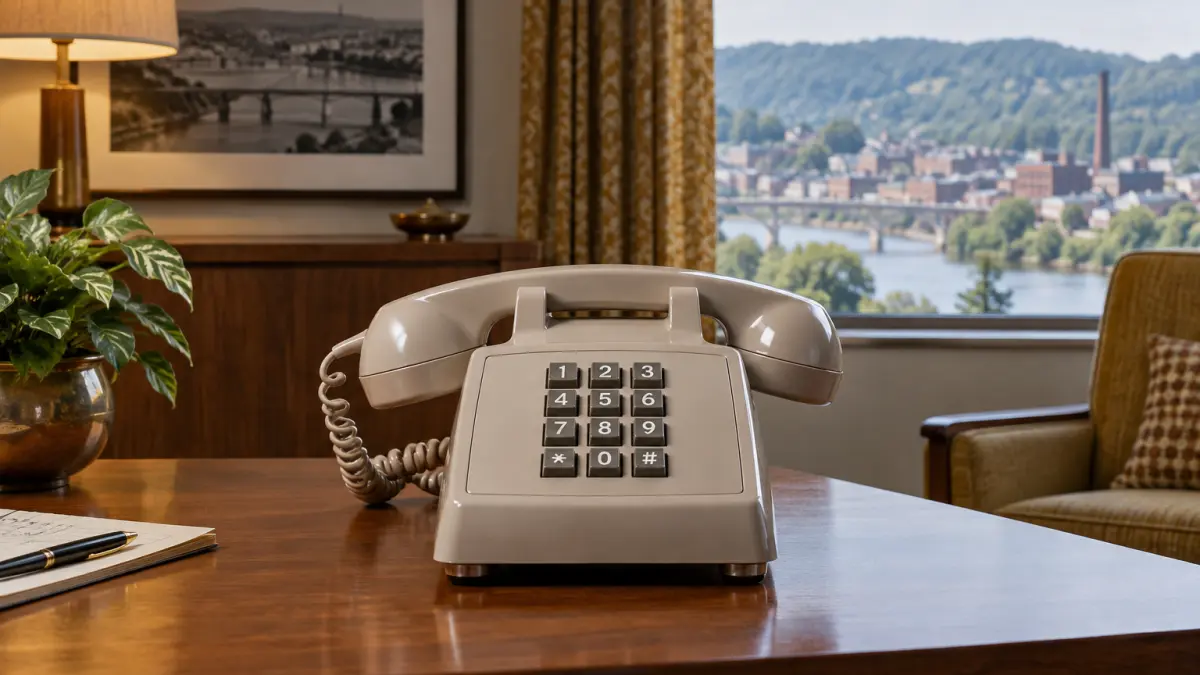
Touch-Tone introduced a fundamentally different approach. Instead of rotating a mechanical dial, users could press numbered buttons on a keypad. Each press generated an electronic signal that a compatible telephone exchange could recognize without waiting for a dial to return. The original commercial Touch-Tone telephones featured 10 buttons, representing digits 0 through 9. The familiar star (*) and pound (#) keys were introduced later. For customers in Carnegie and Greensburg, the new technology represented an important step toward faster and more convenient communication. Initially offered as a premium service for an additional charge, Touch-Tone gradually expanded throughout the Bell System.
How Touch-Tone Technology Worked
The technology behind Touch-Tone was called dual-tone multi-frequency signaling (DTMF). Rather than transmitting a series of electrical pulses, DTMF generated two simultaneous audio frequencies whenever a user pressed a button. Each digit corresponded to a unique combination, with one frequency selected from a low-frequency group and another from a high-frequency group. For example, pressing the number 5 generates tones at approximately 770 Hz and 1,336 Hz, which compatible telephone equipment can detect and interpret as the corresponding digit.
This approach offered several advantages over rotary pulse dialing. Buttons could be pressed in rapid succession, electronic tone detection reduced dependence on mechanical dialing mechanisms, and the same signaling concept could eventually be used to communicate with automated systems after a call had connected. Importantly, Touch-Tone did not immediately replace the telephone network’s existing switching infrastructure. Early services operated alongside established switching technologies, demonstrating that a new dialing method could improve the user experience without requiring the entire network to become electronic overnight.
Why the 1963 Introduction Mattered
The significance of Touch-Tone went beyond making telephone calls faster. The Bell System had already developed automated telephone exchanges decades earlier, but Touch-Tone introduced a more versatile method for sending information through the telephone network. Its two-frequency signaling system could communicate individual key presses clearly and efficiently, creating possibilities beyond selecting a telephone number. Over time, this capability became important for interactive systems that allowed callers to communicate directly with computerized services.
Instead of relying entirely on human operators, callers could eventually navigate menus, enter account information, retrieve messages, or select automated services using their telephone keypads. The introduction also reflected a broader shift in telecommunications engineering, as human interaction with the network became more immediate, flexible, and increasingly electronic. For Bell Laboratories, it represented the result of years of research into telephone design, usability, and signaling technology.
From Touch-Tone Dialing to Interactive Phone Systems
As Touch-Tone adoption expanded, its underlying signaling technology helped enable new applications. During the following decades, DTMF became a familiar part of telephone-based services, including automated banking, voicemail navigation, customer support menus, and interactive voice response systems. These systems could detect which numbers callers pressed and use that information to determine what action to take next. A caller might press 1 for account information, 2 for technical support, or enter a series of digits to retrieve a message.
Such interactions became commonplace, but the underlying concept was remarkable: a telephone keypad could function as a simple interface for communicating commands to a remote computer system. The same basic signaling approach also found applications in telecommunications equipment, remote control systems, and other technologies requiring recognizable audio-based commands. Touch-Tone helped transform the telephone from a device used primarily to establish voice conversations into an interface for interacting with automated services.
The Legacy of Touch-Tone in Modern Communication
More than six decades after its commercial introduction, Touch-Tone technology remains recognizable. Although smartphones primarily use digital signaling to establish calls, DTMF commands can still be generated or conveyed when users interact with automated telephone services. Modern networks may carry these commands through digital signaling mechanisms rather than transmitting the original analog tones end to end. Nevertheless, the familiar keypad interaction remains rooted in the technology introduced commercially in 1963.
The influence extends beyond traditional telephones. The idea that users can communicate structured commands through a simple interface became an important part of automated communication systems. What began with a 10-button telephone helped establish a pattern that remains familiar today: people interacting with technology through straightforward inputs that trigger increasingly complex operations behind the scenes.
A Small Change That Reshaped Telephone Communication
Looking back, the November 18, 1963, launch of Touch-Tone service was far more than the introduction of a new telephone design. It represented a meaningful advance in signaling technology, simplifying the dialing process and helping establish the foundation for later generations of interactive telephone services. The transition from rotary pulses to electronic tones did not happen everywhere overnight. Rotary telephones remained in use for decades, and automated switching had existed long before Touch-Tone arrived.
Yet the innovation changed how users communicated with the telephone network and expanded what a simple keypad could accomplish.
On this day in 1963, the Bell System introduced a technology that made dialing faster and helped open the door to a more interactive era of telecommunications.