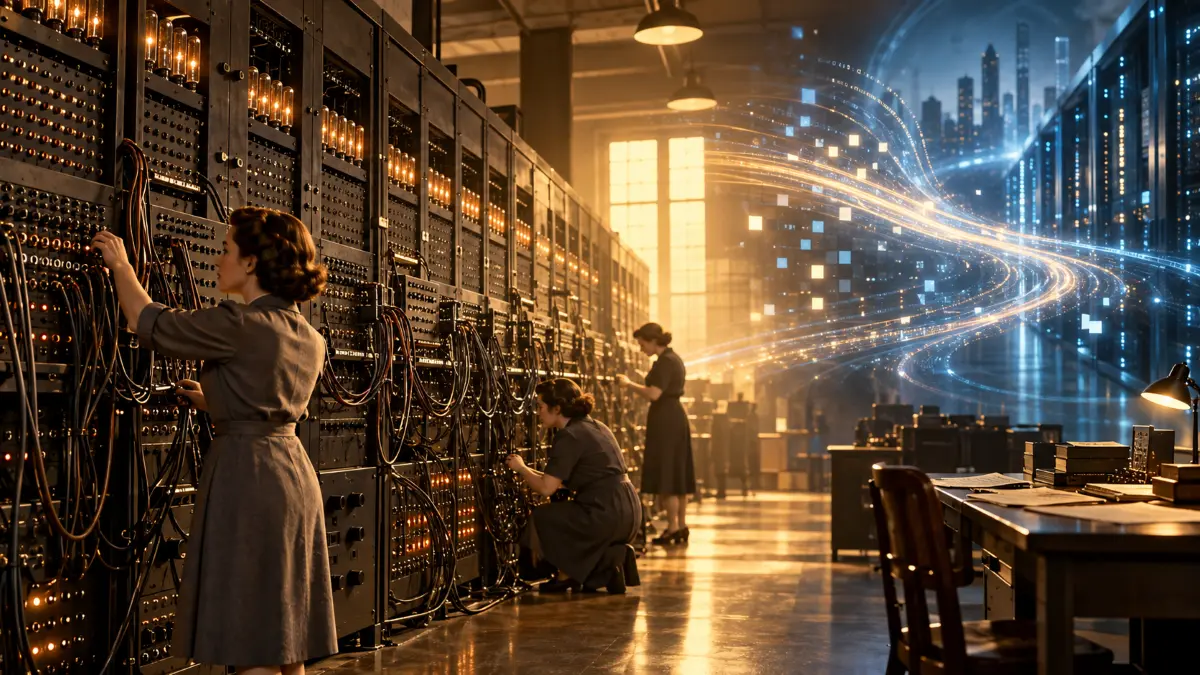

The hum of vacuum tubes and the clatter of punch cards fell silent on October 2, 1955, when the ENIAC computer was retired after eleven years of continuous service. This moment marked the close of a chapter in computing history, but its influence on technology remains unmistakable. The ENIAC computer retirement was not just about shutting down a machine; it was about acknowledging the dawn of fully electronic computation and the groundwork it laid for everything that followed.
ENIAC, short for Electronic Numerical Integrator and Computer, was considered the world’s first fully electronic computer. When it began operation in 1944, it shattered the limitations of mechanical and electromechanical calculators. Its retirement in 1955 signaled the end of an era dominated by a single, monumental machine. Yet, the ENIAC computer retirement was more than a farewell; it was a recognition of how far computing had come in just over a decade.
At the time, ENIAC was a behemoth of technology. It used nearly 18,000 vacuum tubes and occupied a space larger than a modern living room. Despite its size and complexity, it was capable of performing thousands of calculations per second, a staggering feat compared to human calculation speeds and earlier mechanical devices. The ENIAC computer retirement underscored the shift from experimental computing to more practical, scalable, and programmable machines.
What made ENIAC truly groundbreaking was its fully electronic design. Unlike earlier machines that relied on relays and mechanical parts, ENIAC’s electronic circuits allowed for unprecedented speed and reliability. It solved complex numerical problems that were previously impractical to tackle, such as artillery trajectory calculations during World War II. The retirement of ENIAC highlighted the transition from these pioneering machines to the next generation of computers that would embrace stored-program architecture and integrated circuits.
The legacy of the ENIAC computer retirement is deeply embedded in the evolution of modern computing. It demonstrated the viability of electronic digital computation and inspired innovations in computer architecture, programming, and hardware design. The lessons learned from ENIAC’s operation, both its capabilities and limitations, shaped the development of more efficient, compact, and versatile computers that followed.
Today, the ENIAC computer retirement remains a reminder of the relentless pace of technological progress. It shows how early electronic computing tackled real-world problems with the tools available and paved the way for the digital age. The machine’s retirement is a milestone that invites reflection on how foundational technologies evolve, get replaced, and yet continue to influence future innovations.
The story of ENIAC’s retirement is not just about a machine powering down. It’s about the enduring impact of early electronic computing on the digital infrastructure we rely on today. It’s a testament to human ingenuity and the continuous drive to push the boundaries of what machines can do.
As we look back on October 2, 1955, the ENIAC computer retirement reminds us that every technological endpoint is also a new beginning.