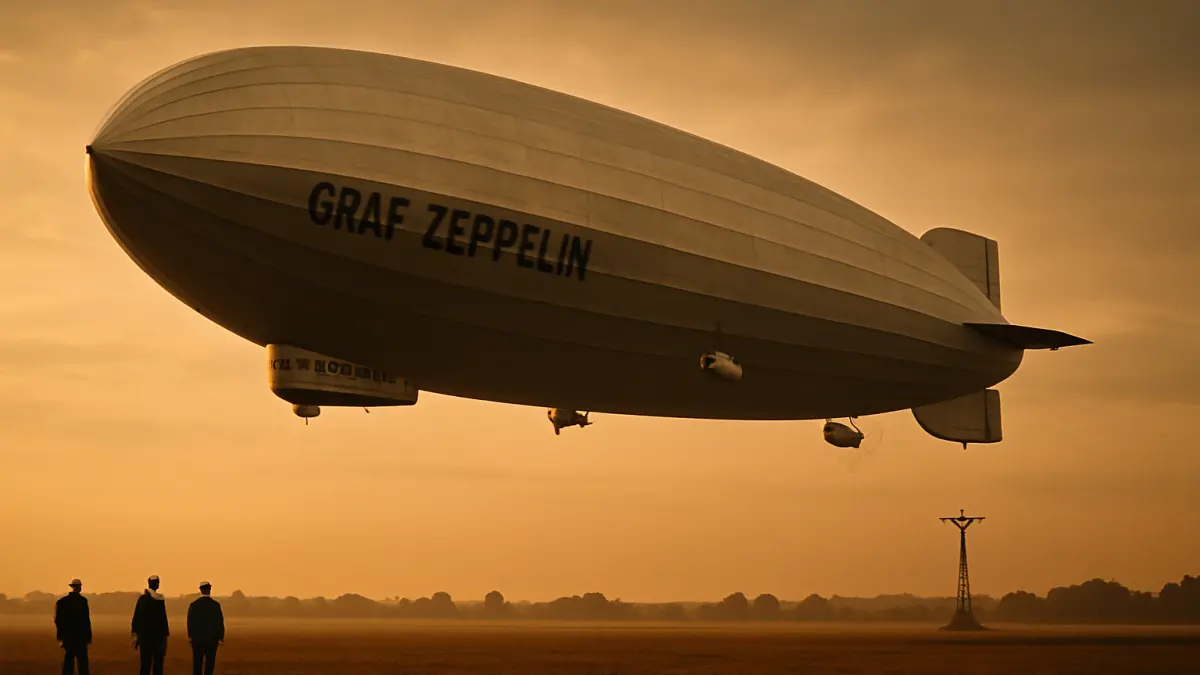

The roar of engines and the hum of innovation filled the skies on August 8, 1929, when the German airship Graf Zeppelin began its round-the-world flight. This wasn’t just a daring adventure; it was a high-altitude experiment in the limits of aviation technology and global connectivity.
The Graf Zeppelin round-the-world flight marked a bold chapter in aeronautical engineering. Airships had been around for decades, but this mission pushed the boundaries of endurance, navigation, and communications. The flight demonstrated that long-distance, controlled air travel was possible on a scale previously unimaginable.
At the time, the challenge was immense. The Graf Zeppelin had to maintain stability and safety over thousands of miles, crossing oceans, continents, and unpredictable weather. Its success was a testament to advancements in lightweight materials, engine reliability, and onboard systems that allowed for extended flight durations. The airship’s ability to carry passengers and mail around the globe also hinted at the future of global logistics and passenger air travel.
This flight changed the way engineers and the public thought about airships and aviation. It proved that air travel wasn’t confined to short hops or regional routes. The Graf Zeppelin’s journey laid the groundwork for more ambitious projects in aviation, influencing the design and operation of future long-range aircraft and airships. It also highlighted the importance of navigation technology and real-time communication, which remain critical in aviation today.
Why does the Graf Zeppelin’s flight still matter? It serves as a reminder that innovation often comes from pushing existing technology to its limits. The airship’s round-the-world journey was an early exploration of global connectivity in the skies, a concept that underpins today’s interconnected world. Modern aviation, satellite communications, and even global positioning systems owe a nod to these early experiments in long-distance flight.
Reflecting on this event reminds us that progress in technology is often incremental yet bold. The Graf Zeppelin didn’t just circle the globe; it circled the future of aviation, setting a precedent for endurance, precision, and ambition in flight.