
In the fall of 1979, a quiet but profound shift took place in personal computing. On October 19, the first production version of VisiCalc, widely recognized as the first commercially successful spreadsheet program for personal computers, was completed and packaged for shipment. Initially developed exclusively for the Apple II, VisiCalc would soon become one of the earliest examples of a killer app, software so useful that people purchased a computer specifically to run it.
Created by Dan Bricklin and Bob Frankston and published by Personal Software, VisiCalc introduced a practical business application at a time when personal computers were still largely associated with hobbyists, enthusiasts, and educational experimentation.
Its significance went beyond automating arithmetic. VisiCalc helped demonstrate that a relatively affordable personal computer could become a serious productivity tool.
Bringing the Electronic Spreadsheet to the Apple II
Before VisiCalc, financial planning and business analysis often relied on paper spreadsheets, calculators, and labor-intensive manual calculations. Changing a single assumption in a financial model could require recalculating numerous figures and rewriting entire sections.
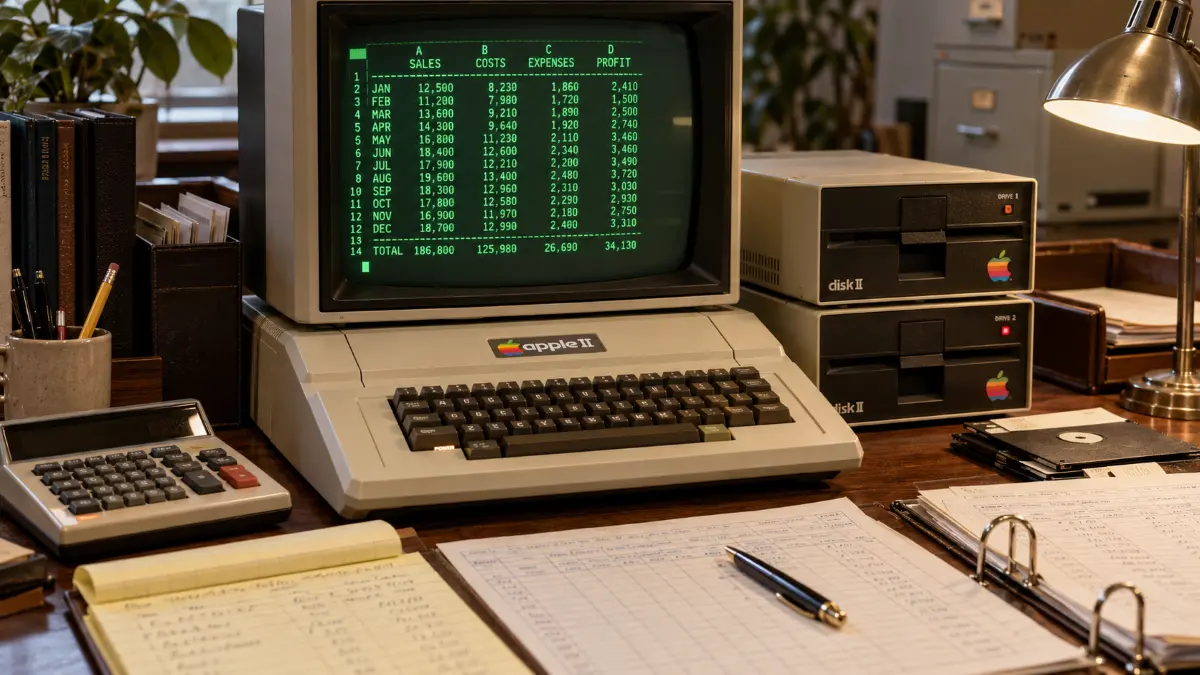
VisiCalc transformed that process by introducing an interactive electronic spreadsheet in which users could enter numbers and formulas into individual cells.
When a value changed, dependent calculations could update automatically, allowing users to explore financial scenarios without rebuilding their models from scratch.
The software was initially designed specifically for the Apple II, taking advantage of its capabilities to provide a practical, interactive spreadsheet experience.
This exclusivity is an important part of VisiCalc’s history. Although the program would eventually become available for other computer platforms, its original commercial release in 1979 was for Apple’s machine alone.
That relationship helped establish the Apple II as a credible option for business users.
The Software That Helped Sell Apple II Computers
When VisiCalc arrived, personal computers were still searching for applications that could justify their purchase in professional environments.
The Apple II had already attracted attention for its expandable architecture, color graphics, and accessibility compared with many earlier microcomputers. However, businesses needed compelling reasons to invest in computers beyond technical experimentation.
VisiCalc provided one.
Accountants, financial planners, managers, and entrepreneurs could use the software to prepare budgets, calculate projections, evaluate investments, and compare different business scenarios.
Instead of purchasing an Apple II simply because it was an interesting technological device, customers could justify the expense based on the work VisiCalc enabled them to perform.
The software became closely associated with the Apple II’s growing adoption in business settings and helped establish the concept of a killer application, a program capable of driving demand for the hardware on which it ran.
This was a turning point in the relationship between software and personal computers. The value of a machine increasingly depended not just on its technical specifications but on the practical applications available for it.
A New Way to Work With Numbers
VisiCalc’s most important innovation was making numerical models interactive.
Traditional spreadsheets were static documents. Even relatively simple changes could involve substantial manual work, particularly when calculations depended on one another.
VisiCalc allowed users to modify an assumption and immediately examine its effects throughout a spreadsheet.
For example, a business owner could change projected sales figures, operating expenses, or pricing assumptions and observe how those changes affected expected profits.
This capability made scenario planning more accessible and encouraged experimentation with financial models.
The software also introduced many personal computer users to concepts that remain fundamental to modern spreadsheets, including cell references, formulas, automatic recalculation, and structured numerical analysis.
Although spreadsheet concepts had existed in other computing environments, VisiCalc brought them to a commercially available personal computer in a form that ordinary business users could adopt.
From Apple II Exclusive to an Industry Standard
VisiCalc’s initial success on the Apple II demonstrated that business software could play a decisive role in the personal computer market.
Its popularity encouraged the development of versions for other computer systems, including the TRS-80 and later platforms.
As personal computing expanded during the early 1980s, competing spreadsheet programs emerged, building on the electronic spreadsheet model that VisiCalc had helped popularize.
Lotus 1-2-3 became a major force in the IBM PC market, while Microsoft Excel eventually established itself as one of the world’s most widely used productivity applications.
VisiCalc itself did not maintain its early market dominance, but its influence persisted through the spreadsheet applications that followed.
The transition also illustrated how rapidly the software industry could evolve. An application that helped define one generation of personal computers could inspire competitors that would dominate the next.
VisiCalc’s Lasting Influence on Computing
Today, electronic spreadsheets are essential tools across business, education, scientific research, accounting, and personal finance.
Modern applications provide capabilities far beyond those available in VisiCalc’s original Apple II release, including advanced visualization, complex functions, collaboration, automation, and cloud-based access.
Yet their underlying principles remain remarkably familiar.
Users still organize information into cells, create formulas, modify assumptions, and rely on automatic recalculation to explore relationships between numbers.
VisiCalc also helped establish a broader principle in the technology industry: software can be the primary reason people adopt new hardware.
That relationship continues to influence computing platforms, from desktop operating systems to smartphones and specialized professional devices.
Looking back at October 19, 1979, VisiCalc’s release represents more than the arrival of a new productivity application.
Dan Bricklin and Bob Frankston created a program that transformed the Apple II from a machine primarily associated with computing enthusiasts into a valuable business tool.
Its initial exclusivity to the Apple II was central to that early impact, helping drive demand for Apple’s hardware before spreadsheet software expanded to competing platforms.
VisiCalc showed that the personal computer’s greatest potential was not simply in what the machine could do, but in what people could accomplish with the right software.