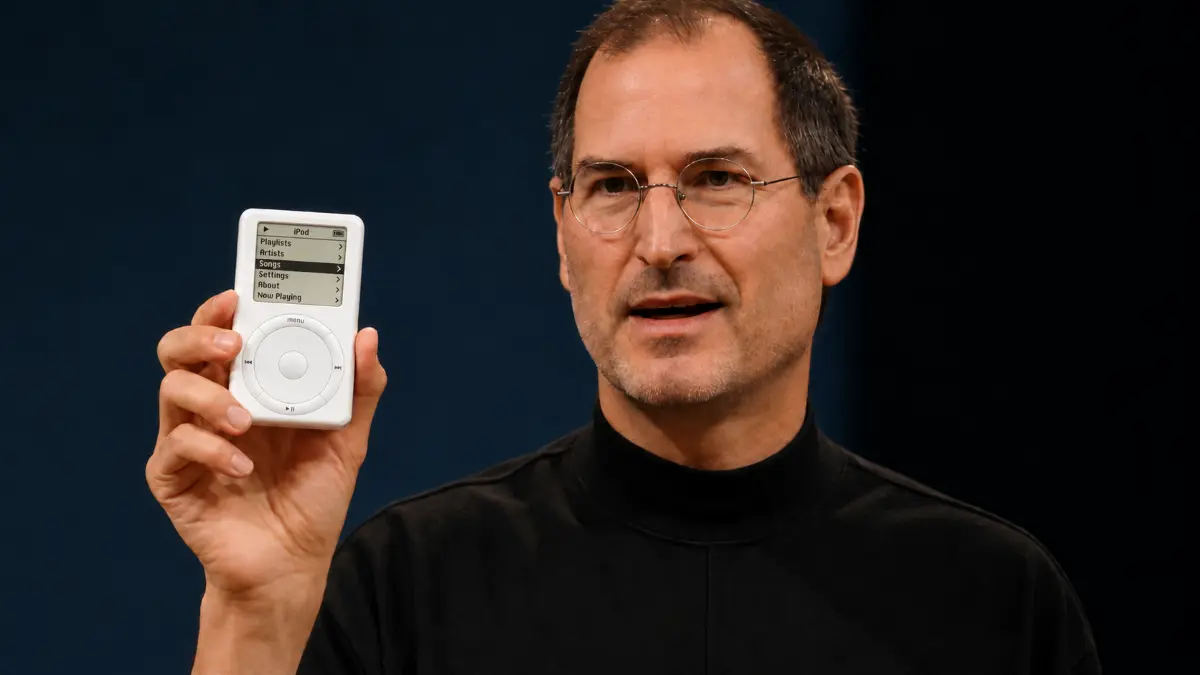

On October 23, 2001, Steve Jobs stepped onto a stage at Apple’s headquarters in Cupertino, California, and introduced a device with a remarkably simple promise: “1,000 songs in your pocket.” The original iPod was a compact digital music player that combined a 5 GB hard drive, a distinctive mechanical scroll wheel, and high-speed FireWire connectivity. At a time when portable music players often required compromises between storage capacity, size, and convenience, Apple presented a product designed to make carrying and managing an extensive music collection remarkably simple.
The iPod was not the first MP3 player, nor was it the first portable device to use a hard drive for music storage. Its significance came from combining existing technologies into a carefully integrated experience that addressed several frustrations of early digital music. Rather than competing solely on storage capacity or audio specifications, Apple focused on making a large music library easy to transfer, navigate, and enjoy. That approach would eventually help transform Apple from a computer manufacturer into one of the most influential companies in consumer electronics and digital entertainment.
The Engineering Behind 1,000 Songs in Your Pocket
The original iPod’s most important hardware component was its 5 GB hard drive, which used compact 1.8-inch disk technology supplied by Toshiba. At the time, many flash-based MP3 players could store only a relatively small number of songs, while some hard-drive-based competitors were considerably larger and heavier. Apple’s engineers selected a miniature hard drive that offered substantially greater capacity than typical flash players without requiring a bulky enclosure. The resulting iPod measured approximately 4 inches tall, 2.4 inches wide, and 0.78 inches thick, weighed about 6.5 ounces, and offered enough storage for roughly 1,000 songs encoded at Apple’s assumed compression settings.
Apple also designed the device around a rechargeable lithium-polymer battery rated for up to 10 hours of music playback, a monochrome LCD, and a mechanical scroll wheel that made navigating hundreds of albums and tracks relatively straightforward. Instead of forcing users to repeatedly press buttons to move through long lists, the wheel allowed rapid scrolling with a simple circular motion. The combination of substantial storage, compact dimensions, and intuitive navigation was particularly important because it made the iPod feel practical as an everyday music player rather than a technical accessory requiring constant management.
FireWire and iTunes Made the Difference
Storage capacity alone would not have made the iPod successful. One of the greatest frustrations of early digital music players was transferring songs from a computer, particularly when a device could hold hundreds or thousands of files. Many competing products relied on USB 1.1 connections, which could make filling a large music library a time-consuming process. Apple instead equipped the original iPod with FireWire, a high-speed connection already available on many Macintosh computers. FireWire supported data transfer rates of up to 400 Mbps, allowing large collections to synchronize far more quickly than they could through typical USB 1.1 connections, while also supplying power for charging.
Equally important was the integration with iTunes, Apple’s music management application introduced earlier in January 2001. The software provided a central location for importing CDs, organizing tracks, creating playlists, and transferring music to the iPod. This relationship between hardware and software made the experience more approachable for users who did not want to manage files manually. The iPod could automatically synchronize music with a Macintosh, creating a connection between a desktop music library and a portable player that felt unusually cohesive for its time. Apple’s achievement was not simply faster data transfer but a complete workflow that made digital music easier to manage.
A Macintosh Exclusive That Eventually Reached Windows
When the original iPod launched, it was compatible only with Macintosh computers running Mac OS 9.2.1 or Mac OS X 10.1, and it required a FireWire connection. That exclusivity reflected Apple’s initial strategy of strengthening the Macintosh ecosystem through tightly integrated hardware and software. However, it also limited the iPod’s potential audience because Windows-based computers represented the overwhelming majority of the personal computer market. Some technically inclined users experimented with unofficial methods to connect early iPods to Windows PCs, demonstrating demand beyond Apple’s existing customer base.
Apple began expanding that audience in July 2002 with the introduction of Windows-compatible iPod models, supported initially through MUSICMATCH Jukebox rather than iTunes for Windows. The following year, Apple released iTunes for Windows, bringing its integrated music management experience to a much larger market. This transition was critical to the iPod’s commercial growth because it allowed Apple to sell the device independently of Macintosh ownership. What began as an accessory for Apple’s computers gradually evolved into a mainstream consumer electronics product capable of attracting customers who had never previously purchased Apple hardware.
How the iPod Helped Transform the Music Industry
The original iPod arrived during a period of significant disruption in the recording industry. MP3 compression had made digital music files easy to store and distribute, while peer-to-peer services such as Napster had exposed the growing demand for downloadable music and intensified debates about copyright and digital distribution. Consumers increasingly wanted to organize and carry digital collections, but the legal music marketplace remained fragmented and inconvenient. The iPod offered an appealing way to listen to digital music, yet its early success still depended largely on music imported from CDs or obtained through other sources.
Apple addressed a major part of that problem in April 2003 with the launch of the iTunes Music Store, initially offering individual song purchases for 99 cents in the United States. The combination of a digital storefront, music management software, and portable hardware created a more accessible commercial ecosystem for purchasing, organizing, and listening to music. Although the shift away from physical media involved many companies, technologies, and changes in consumer behavior, the iPod and iTunes became central symbols of the digital download era. Their popularity helped establish Apple as an influential participant in the music business and demonstrated how consumer hardware could support a broader digital services ecosystem.
From the Click Wheel to the Smartphone Era
The original iPod’s design evolved substantially during the following years. Apple introduced models with greater storage capacity, smaller dimensions, color displays, video playback, and new navigation mechanisms. The mechanical scroll wheel of the first generation eventually gave way to the touch-sensitive controls and integrated click wheel associated with later iPods. The product family expanded to include the iPod mini, nano, shuffle, and touch, reaching different audiences through variations in size, price, storage, and functionality. By the mid-2000s, the iPod had become one of Apple’s most recognizable products and an important contributor to the company’s growth.
Its influence also extended into Apple’s development of the iPhone, introduced in 2007. The iPhone combined mobile communication, internet access, and music playback in a single device, gradually reducing the need for a dedicated portable music player. Over time, streaming services further changed how consumers accessed music, shifting the emphasis from storing purchased files locally to accessing extensive online catalogs. Apple eventually discontinued the final iPod model, the iPod touch, in 2022, bringing the product family’s commercial history to an end after more than two decades. Nevertheless, the iPod’s emphasis on intuitive navigation, integrated software, and a seamless relationship between devices and digital content remained influential throughout Apple’s later products.
The Legacy of a Pocket-Sized Music Revolution
Looking back at October 23, 2001, the original iPod stands out not because Apple invented portable digital music, but because it made an existing technology significantly more convenient and desirable. The combination of a compact high-capacity hard drive, fast FireWire synchronization, intuitive physical controls, and close integration with iTunes addressed practical problems that had limited the appeal of earlier players. Its success demonstrated that the user experience surrounding a technology could be just as important as the underlying hardware.
The iPod also helped establish a business model in which hardware, software, and digital services reinforced one another. That approach would become increasingly important as Apple expanded into smartphones, application distribution, cloud services, and subscription-based entertainment. Although dedicated music players have largely been replaced by multifunction devices, the expectations the iPod helped establish remain familiar: immediate access to personal content, simple navigation, and effortless synchronization across devices.
The original iPod’s lasting achievement was turning a large digital music collection into something people could comfortably carry and enjoy anywhere. Its promise of “1,000 songs in your pocket” captured a fundamental shift in personal technology, one that continues to shape how we access and experience digital media today.