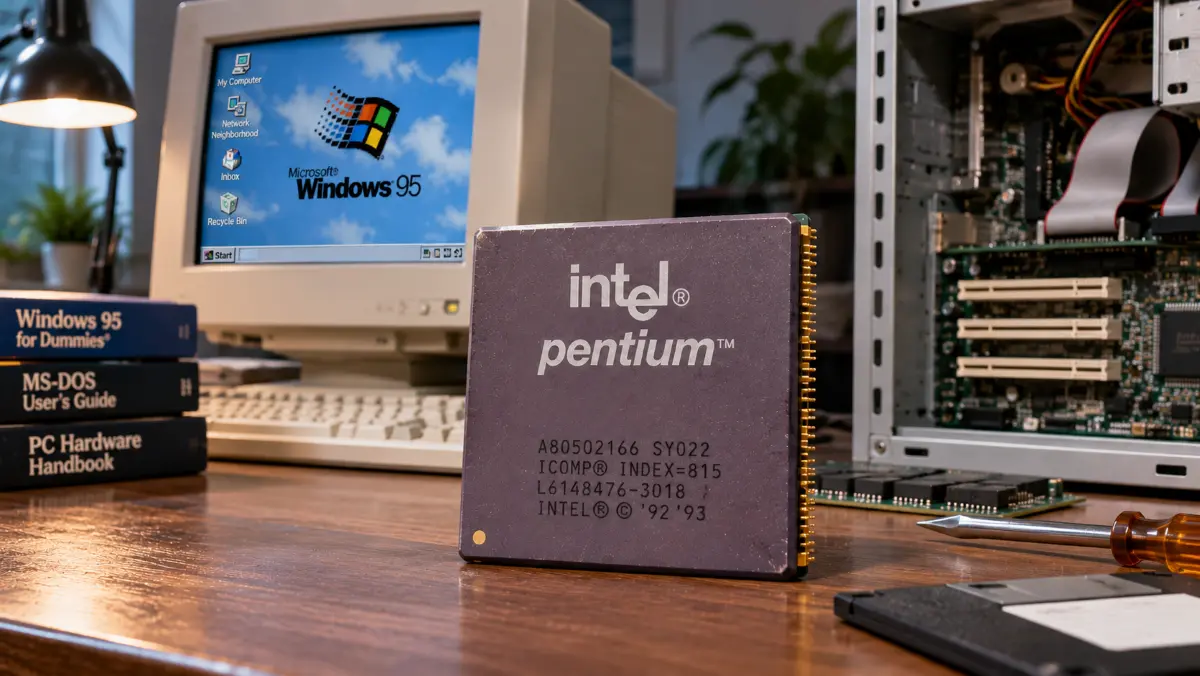

On November 14, 1997, Intel publicly announced a software-based workaround for a processor defect capable of freezing computers running certain Pentium CPUs. Known as the Pentium F00F bug, the flaw allowed a specially constructed machine instruction to cause an affected processor to stop responding, forcing users to restart their systems. Unlike an ordinary software crash, the problem occurred deep inside the processor’s instruction-handling logic, where even the operating system could not recover through its normal error-handling mechanisms.
The discovery raised an uncomfortable question for the personal computer industry: what happens when a processor encounters an instruction it should reject, but instead becomes completely unresponsive? Intel’s response involved collaborating with operating-system developers to implement a workaround that could prevent the failure without physically replacing affected processors. The incident became an important example of how hardware defects can create security risks and how software engineering can sometimes compensate for flaws embedded in silicon.
The Pentium Processor and Intel’s Growing Influence
By 1997, Intel’s Pentium processors had become familiar components in personal computers used by businesses, educational institutions, and households around the world. Introduced in 1993, the original Pentium family represented a major step forward in x86 computing performance, supporting increasingly sophisticated operating systems, productivity applications, and multimedia software.
However, the growing complexity of processors also introduced opportunities for subtle design errors. Modern CPUs were expected to recognize and execute large collections of machine instructions while handling exceptions, memory access, and interactions with the operating system. Even an unusual combination of instruction bytes could expose a flaw that had escaped testing during development.
Intel had already experienced a highly publicized processor problem with the Pentium FDIV bug in 1994, which affected the accuracy of certain floating-point division calculations and ultimately led to an expensive replacement program. The F00F bug was fundamentally different. Rather than producing an incorrect numerical result, it could stop the entire computer from functioning.
The affected products included original Pentium processors, Pentium models with MMX technology, and certain Pentium OverDrive processors. Intel’s Pentium Pro and Pentium II processors were not affected, nor were earlier i486 processors. This distinction was important because the flaw concerned a specific implementation of instruction handling in the affected Pentium architecture, rather than every processor capable of running x86 software.
What Was the Pentium F00F Bug?
The vulnerability was formally documented by Intel as the Invalid Operand with Locked CMPXCHG8B Instruction erratum, listed as erratum 81 in its Pentium processor documentation. Its commonly used name, F00F, came from the hexadecimal byte sequence at the beginning of the malformed instruction that triggered the problem.
The defect involved the CMPXCHG8B instruction, which performs an eight-byte compare-and-exchange operation. Under normal conditions, this instruction works with a memory operand and is useful for operations requiring carefully coordinated access to shared data. However, the x86 instruction set does not permit the same operation to use a processor register as its destination.
When software attempts to execute such an invalid instruction, the processor should generate an invalid-opcode exception. The operating system can then handle the exception, typically by terminating the offending application while allowing the rest of the computer to continue operating.
The Pentium bug appeared when this invalid form of CMPXCHG8B was combined with the LOCK instruction prefix, which normally coordinates certain memory operations. On affected processors, the combination interfered with the mechanism used to dispatch the invalid-opcode exception. Instead of transferring control to the operating system’s error handler, the processor could enter a state from which normal execution could not continue.
The result was a complete system hang. The computer would stop responding to ordinary input, and restarting or resetting the machine was generally necessary to restore operation. Intel stated that the defect did not inherently corrupt data already saved to disk or physically damage the processor, although unsaved work could still be lost when the system was restarted.
Why a Rare Instruction Became a Security Concern
The instruction sequence responsible for the F00F bug was not something ordinary application software would normally generate. Standard compilers and assemblers were designed to produce valid instructions, making accidental encounters with the malformed sequence highly unlikely during everyday computing.
However, rarity did not eliminate the security implications. A programmer could deliberately construct executable code containing the invalid instruction bytes. On an affected system without an appropriate workaround, executing that code could freeze the entire computer.
This created a denial-of-service vulnerability. A malicious program did not need to steal information or modify operating-system files to cause disruption. It only needed to execute the specially constructed instruction on a vulnerable processor.
The distinction between ordinary application privileges and processor-level failure was particularly troubling. Operating systems normally isolate applications so that an error in one program does not bring down the entire machine. The F00F bug undermined that protection because the processor could become unresponsive before the operating system had an opportunity to handle the invalid instruction.
For shared computers and servers, the implications were especially serious. An unprivileged user who could run native executable code might be able to interrupt services used by other people. The issue therefore highlighted how a defect in hardware exception handling could bypass software isolation mechanisms and affect system availability.
November 14, 1997: Intel Announces a Workaround
After the flaw became publicly known in November 1997, Intel worked with operating-system developers to identify a practical solution. On November 14, contemporary news reports described Intel’s announcement that the problem could be addressed through modifications to operating systems rather than by replacing affected processors.
The response was significant because the vulnerability originated in hardware. Once a processor has been manufactured, its internal circuitry cannot ordinarily be redesigned through a conventional software update. Engineers therefore needed to find a way to prevent the problematic behavior from occurring while allowing the existing processor to continue functioning.
Intel’s approach focused on the operating system’s exception-handling mechanisms. The objective was not simply to stop applications from using CMPXCHG8B, which was a legitimate instruction when used correctly. Instead, the workaround needed to ensure that the malformed instruction could be handled without triggering the processor hang.
The timing also deserves clarification. November 14 was not the date on which every vulnerable computer received a universal patch. Some operating-system developers had already begun testing workarounds earlier that week, while others continued developing and distributing their own implementations afterward.
For users, the availability of protection depended on the operating system and the vendor’s update process. The incident required coordination between Intel and multiple software companies because the underlying hardware problem affected different computing environments.
How Software Prevented a Hardware-Level Freeze
The technical workaround was particularly inventive because it used the processor’s memory-protection mechanisms to interrupt the failure before the CPU became permanently stuck.
Under normal circumstances, the operating system maintains an Interrupt Descriptor Table, or IDT, containing information about how different processor exceptions should be handled. When an invalid instruction is encountered, the processor consults this table to locate the appropriate exception handler.
The F00F defect interfered with this process. Intel’s documented workarounds modified how the relevant IDT entries were mapped or protected in memory, causing a page fault to occur before the defective bus-lock behavior could prevent further execution.
A page fault is normally associated with memory-access problems, but it can also be used as part of carefully designed operating-system protection mechanisms. In this case, the operating system could recognize the special condition, regain control, and correctly handle the original invalid instruction.
The workaround did not remove the defect from the processor. Instead, it changed the surrounding software environment so that the dangerous hardware condition could be avoided.
Implementing this protection required changes to low-level operating-system code, including exception handling and memory management. Different operating systems could use different implementations, and the approach was particularly relevant to protected-mode systems capable of controlling memory permissions.
The solution demonstrated an important principle: even when a hardware defect cannot be physically corrected, software may sometimes be able to alter execution conditions sufficiently to prevent the defect from causing a failure.
How Operating-System Developers Responded
The F00F incident unfolded during a period when Windows, Linux, and several Unix-like operating systems were competing across desktop and server environments. Because the processor defect existed beneath the operating-system layer, developers across these platforms had to consider whether their systems required protection.
The Linux community moved quickly. Archived kernel development discussions from November 1997 document efforts to implement and refine a workaround, including changes needed to ensure that multiprocessor systems handled the issue correctly. These discussions illustrate how open-source developers collaborated to address an urgent hardware problem while testing the consequences of modifying low-level kernel behavior.
Commercial Unix vendors also investigated the defect. BSD/OS developers were testing a software workaround by November 11, demonstrating that mitigation efforts were already underway before Intel’s November 14 public announcement.
Microsoft and other operating-system vendors likewise had to evaluate appropriate protections for their supported platforms. Because the issue involved processor exception handling, users could not assume that an ordinary application update would provide adequate protection.
The incident showed how processor manufacturers and operating-system developers depend on one another. Hardware vendors possess detailed knowledge of processor behavior, while operating-system developers control the software mechanisms responsible for memory protection, exception handling, and system stability.
Resolving the F00F bug required expertise from both sides.
A Different Kind of Pentium Controversy
The F00F bug was not Intel’s first widely discussed processor defect, but it raised different concerns from the earlier Pentium FDIV controversy.
The FDIV bug involved incorrect mathematical results under particular circumstances. Although the affected calculations were uncommon, the possibility of silent numerical errors created significant concerns for users who depended on accurate computations.
The F00F bug, by contrast, was primarily an availability problem. Its most direct consequence was a frozen computer, not incorrect calculations or automatic exposure of confidential information. Intel’s documentation stated that the defect did not inherently corrupt saved data or cause physical damage.
The two incidents nevertheless shared an important lesson. Processor errors can have consequences far beyond the small portion of circuitry or instruction logic where they originate. Once a processor architecture is widely deployed, even a narrowly defined defect can affect a large installed base.
The F00F incident also reinforced the importance of documenting processor errata. These technical notices allow operating-system developers, firmware engineers, and other software specialists to understand known hardware limitations and develop appropriate mitigations.
Why the F00F Bug Still Matters Today
Nearly three decades later, the Pentium F00F bug remains a useful case study in the relationship between hardware reliability and cybersecurity. It demonstrated that software isolation depends on processors correctly implementing fundamental operations, including instruction validation and exception handling.
Modern processor security research has revealed other situations in which subtle hardware behavior can undermine assumptions made by operating systems and applications. Vulnerabilities such as Spectre and Meltdown involve different mechanisms and consequences, but they similarly illustrate the importance of examining the boundary between processor design and software security.
The F00F workaround also provides an early example of coordinated mitigation across the hardware and operating-system ecosystem. Today, processor-related problems may be addressed through combinations of firmware updates, microcode revisions, operating-system patches, compiler changes, and application-level protections.
These approaches are not interchangeable, and not every hardware flaw can be corrected through software. However, the principle remains relevant: understanding the precise conditions that trigger a defect can sometimes reveal a practical way to reduce its impact without immediately replacing the hardware.
For engineers, the incident is a reminder that uncommon instruction sequences and exceptional conditions deserve careful attention. For security professionals, it illustrates how a flaw that seems irrelevant to normal workloads can become significant when an attacker deliberately seeks to trigger it.
The Legacy of Intel’s 1997 Pentium F00F Workaround
On November 14, 1997, Intel’s announcement of a software workaround helped turn a potentially disruptive processor defect into a problem that operating-system developers could address. The solution did not eliminate the underlying silicon flaw, but it provided a practical defense for affected systems and reduced the need for widespread hardware replacement.
The episode demonstrated the importance of cooperation between processor manufacturers, operating-system vendors, and independent developers. It also showed that security vulnerabilities do not always originate in network services, applications, or operating-system code. Sometimes, the weakest point lies in the processor’s handling of an instruction that should never have been executed successfully.
The Pentium F00F bug remains a reminder that even a few bytes of machine code can expose a fundamental hardware weakness. Its 1997 workaround showed how detailed technical understanding and coordinated software engineering could protect existing computers from a defect built into their processors, a lesson that continues to resonate in modern hardware security.