

Introduction
Every iPhone cycle brings a faster chip, but 2025’s A19 and A19 Pro aren’t just faster, they’re smarter. Built to power Apple’s bold new “Apple Intelligence” initiative, these processors blur the line between performance and perception.
Benchmarks aside, the real story is how this chip reshapes what your iPhone can do, longer gaming sessions without heat throttling, smoother AI-driven features, and desktop-grade graphics that finally make mobile gaming feel legitimate.
And with the new iPhone Air 17, Apple’s thinnest flagship yet, there’s more choice than ever, all running Apple’s sharpest silicon to date.
1. A19 vs A19 Pro: Why It Actually Matters
Apple has fully split its silicon this year, and that split matters.
- iPhone 17 → A19
- iPhone 17 Pro / Pro Max → A19 Pro
- iPhone Air 17 → A19 Pro (tuned for thin design)
On paper, the difference looks modest, a few GPU cores, slightly higher clock speeds, but under sustained load, the Pro chip proves its worth. It’s designed for people who push their phones hard: extended gaming, 4K video capture, and heavy multitasking.
Performance in practice:
- The A19 delivers roughly 20–25 % faster CPU speeds over last year’s A18, with improved efficiency cores that sip power during everyday use.
- The A19 Pro pushes even higher sustained clocks thanks to an upgraded vapor-chamber cooling system and expanded GPU cluster, making it a monster for Metal-based games and AI-accelerated photo processing.
Apple’s silicon strategy now mirrors its Mac lineup, base and Pro chips tuned for different lifestyles. The regular iPhone 17 will handle everything most users throw at it, but if you edit 4K ProRes, stream gameplay, or rely on on-device AI, the A19 Pro gives you measurable breathing room.
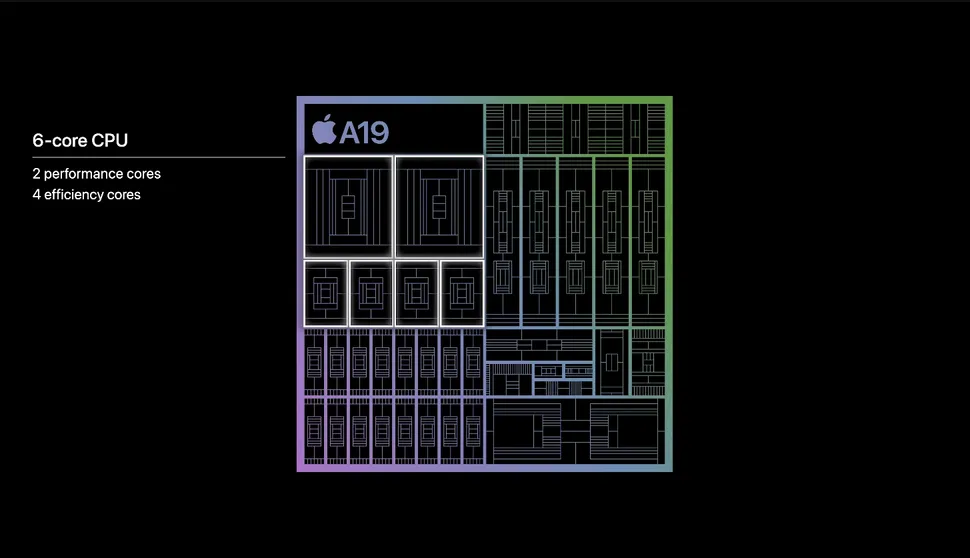
2. Built on TSMC’s 3 nm (N3P): Not 2 nm, But Still a Leap
Apple loves marketing new process nodes, but this year it played it safe: no 2 nm debut yet. The A19 family uses TSMC’s 3 nm N3P node, a refined, more efficient evolution of last year’s N3B process.
That may sound like a small step, but the gains are real:
- Higher clock speeds at lower voltages, meaning less wasted heat.
- Better yield rates, which translates to consistency across devices (fewer “hot” or “cold” units).
- Longer battery life, especially under AI workloads or high brightness.
Real-world payoff:
- During extended gaming sessions, the A19 Pro runs cooler than the A18 Pro, holding 90–100 % performance longer before throttling.
- Video shooters can now record 4K60 HDR for longer stretches without overheating.
- Battery endurance improves by roughly 10–15 %, despite brighter panels and constant background AI inference.
It’s not about the nanometers; it’s about what Apple does with them. The A19’s energy management and dynamic frequency scaling make iOS 18 feel more fluid, apps open instantly, animations stay buttery even under load, and the battery graph finally stops looking like a ski slope by 5 p.m.
3. AI and Gaming Are Where A19 Really Shows Off
AI Everywhere
Apple has quietly built its chips around machine learning for years, but A19/A19 Pro are the first to feel purpose-built for it.
The upgraded Neural Engine processes over 40 trillion operations per second, doubling throughput for on-device intelligence. That power drives the new Apple Intelligence suite in iOS 18:
- Context-aware Siri: responds faster, works offline, and actually remembers your last question.
- On-device summaries and edits: emails condensed in seconds, voice notes transcribed instantly, background noise scrubbed live during calls.
- Photo and video magic: real-time relighting, subject isolation, and depth adjustments without cloud upload.
The brilliance is invisible, the phone feels intuitive, responding before you even realize you needed it to.
And because it’s all local, privacy remains Apple’s favorite talking point. Your data never leaves your device; the A19’s Neural Engine handles it securely, in real time.
Console-Class Mobile Gaming
Apple isn’t just chasing productivity; it’s courting gamers, and the A19 Pro shows it.
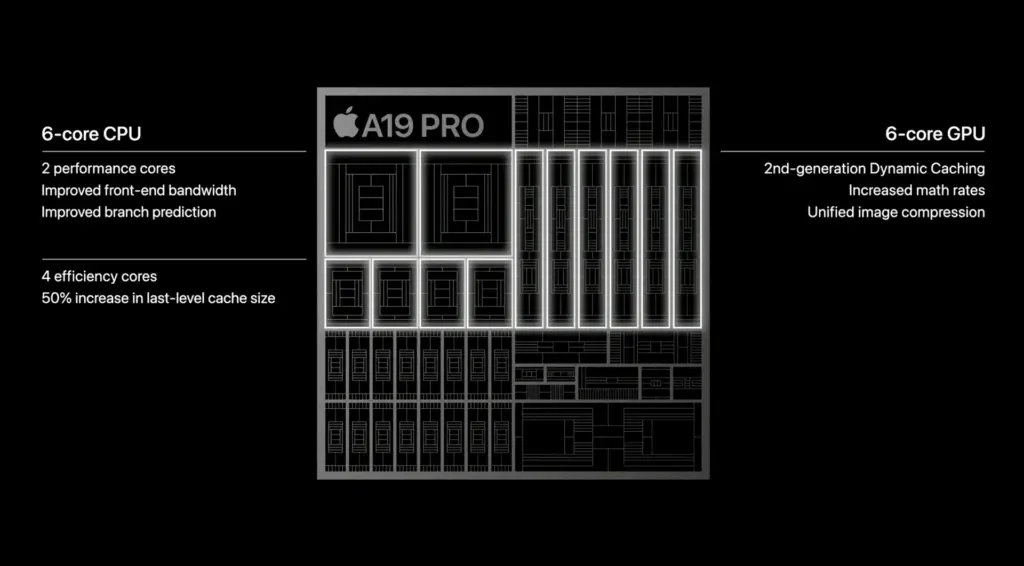
The new 6-core GPU supports hardware ray tracing and MetalFX upscaling, which combine to produce console-grade realism. Dynamic shadows, global illumination, and reflective surfaces no longer feel like gimmicks, they’re fluid, high-frame-rate realities.
Performance highlights:
- Resident Evil 4 Remake → 70 FPS at native resolution on A19 Pro.
- Assassin’s Creed Mirage → stable 60 FPS with MetalFX on both Pro and Air models.
- Call of Duty Warzone Mobile → significantly fewer drops, better thermal headroom.
The regular A19 handles gaming beautifully, but the Pro chip sustains peak frame rates far longer. In thermal stress tests, the iPhone 17 Pro held its max GPU clocks for 25 minutes before scaling down, compared to 10–12 minutes on the base 17.
Even the ultra-thin iPhone Air 17, with its tweaked A19 Pro, delivers powerful bursts, enough to play console-level titles in a device barely thicker than an Apple Watch.
This generation also introduces Dynamic Frame Scheduler, a new controller inside the GPU that evens out frame pacing. That means less stutter and more cinematic flow, even when the system juggles background AI tasks or camera previews.
Sidebar: Chipset Quick Compare
| Model | Chip | Strengths | Limitations |
|---|---|---|---|
| iPhone 17 | A19 | Class-leading single-core, better efficiency than A18. Great all-rounder. | GPU not as strong as Pro versions. |
| iPhone 17 Pro / Pro Max | A19 Pro | Full AI + gaming muscle, best sustained thermals, ray tracing powerhouse. | Heavier, pricier. |
| iPhone Air 17 | A19 Pro (tuned) | Same Pro-grade silicon in ultra-thin design. Lighter than Pro Max. | Slim body means shorter sustained peaks vs Pro phones. |
Efficiency and Thermals: Small Changes, Big Impact
One of Apple’s biggest quiet wins this year is thermal design. The company refined its graphite and vapor-chamber layers, especially in Pro models, allowing consistent performance without uncomfortable heat.
During 4K HDR recording or prolonged gaming, the Pro’s back panel remains noticeably cooler than last year’s 16 Pro, around 38 °C vs 44 °C after 15 minutes. For handheld use, that difference feels dramatic.
Apple also re-tuned iOS 18’s Performance Controller, which dynamically prioritizes efficiency cores during routine tasks like messaging or browsing, then ramps up performance cores only when needed.
Result: better battery endurance, quieter operation, and less throttling during creative tasks like LumaFusion editing or Logic Pro recording.
Smarter Than Speed: Why This Chip Matters
It’s easy to drown in specs, clock speeds, node sizes, teraflops. But what makes the A19 generation special is how seamlessly it merges intelligence with efficiency.
Rather than simply chasing raw power, Apple designed this chip to feel adaptive. Apps pre-load faster because the Neural Engine predicts your next action. Photos render instantly because the GPU and CPU share unified memory access.
Even Face ID benefits, it now recalibrates lighting faster under harsh conditions, thanks to new ISP (Image Signal Processor) logic on the A19 Pro.
In short, the A19 series doesn’t just respond faster; it thinks ahead.
The iPhone Air 17: Performance in Disguise
The surprise hit of the lineup, iPhone Air 17, takes the same silicon as the Pro models and wraps it in a frame so thin it feels almost experimental.
The engineering trick? A custom cooling plate and tuned A19 Pro clock curve. It runs slightly lower sustained frequencies to maintain comfort, but initial burst performance is virtually identical to the 17 Pro.
In daily use, the Air feels incredibly fluid, apps launch instantly, multitasking is seamless, and even short gaming bursts shine. You’ll only notice the difference during long, sustained heavy loads, like exporting long 4K videos or half-hour gaming sessions.
The payoff is portability. The Air 17 is lighter than the iPhone 13 Mini, yet delivers performance that rivals Apple’s latest MacBook Air M3 on short tasks.
Bottom Line
The A19 and A19 Pro don’t reinvent the iPhone overnight, but they redefine its rhythm. Everything feels faster, cooler, and more deliberate.
- Every iPhone 17 feels quicker and lasts longer.
- The Pro models sustain top performance the longest.
- The Air 17 is the minimalist powerhouse, elegance with zero compromise.
For most users, the base A19 is already overkill. But for those exploring Apple Intelligence, high-end gaming, or professional workflows, the A19 Pro is the chip that finally lets the iPhone play in laptop territory, efficiently, quietly, and intelligently.
Apple didn’t chase numbers this time. It chased balance, and nailed it.



Reader perspectives, questions, and reactions.
No comments yet. Start the conversation.
Comments are closed for this article.