

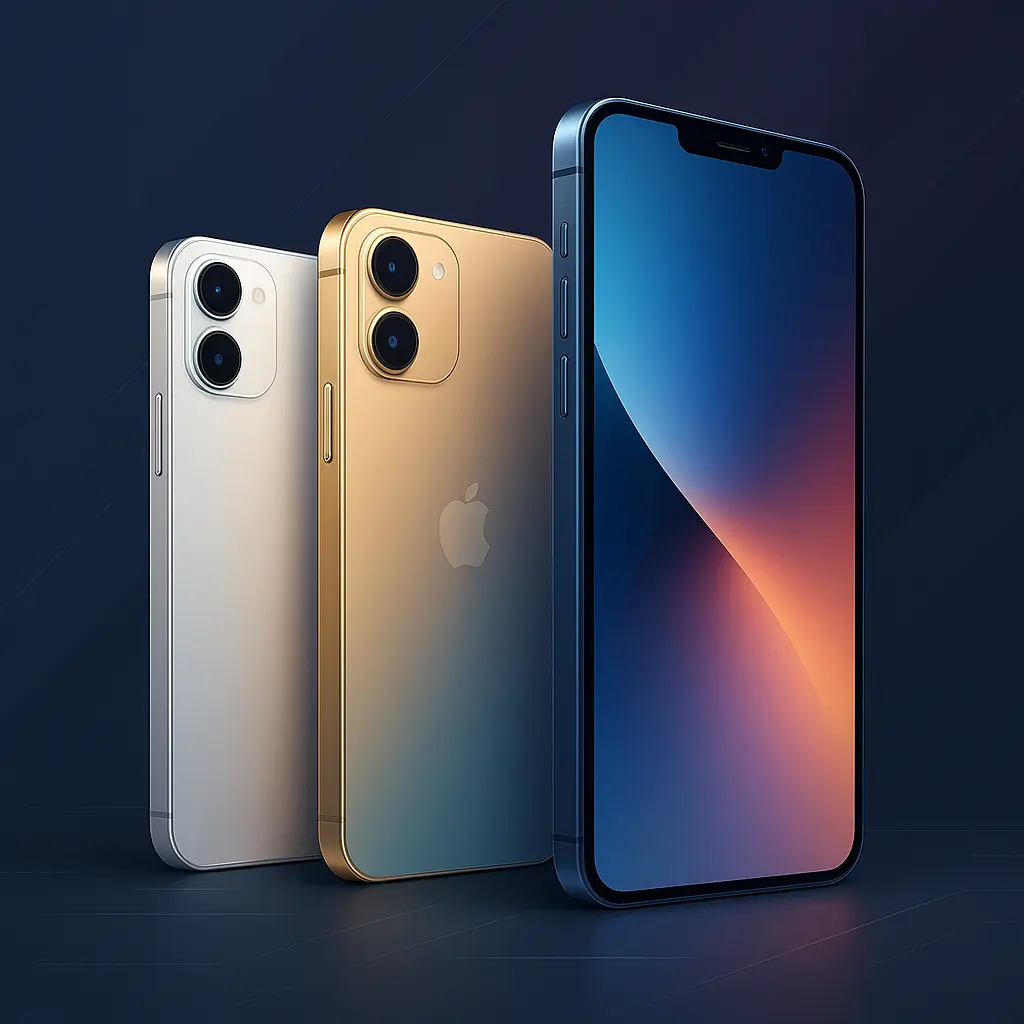
The 2025 iPhone release brought more than just annual upgrades. Apple refreshed its flagship family with four models: the thin new iPhone Air, the mainstream iPhone 17, and the camera‑centric iPhone 17 Pro and Pro Max. Each phone uses Apple’s latest A19‑series chips and 5G radios, features energy‑saving displays with ProMotion up to 120 Hz and Always‑On capability, and integrates Ceramic Shield 2 for improved scratch resistance. This article summarises the specs and differences so you can decide which is right for you.
Quick comparison
| Model | Display | Chip | Rear cameras | Battery (video playback) | Unique features |
|---|---|---|---|---|---|
| iPhone Air | 6.5‑inch Super Retina XDR OLED; ProMotion up to 120 Hz; Always‑On | A19 Pro, with N1 & C1X chips | 48 MP Fusion Main with optical‑quality 2× telephoto; 18 MP Center Stage front camera | Up to 27 h video playback | Thinnest iPhone (5.6 mm); grade‑5 titanium frame; Ceramic Shield 2 on both sides |
| iPhone 17 | 6.3‑inch Super Retina XDR OLED; ProMotion up to 120 Hz | A19 chip | 48 MP Dual Fusion system (Main + Ultra Wide) with optical‑quality 2× telephoto; 18 MP Center Stage front camera | Up to 30 h video playback | Aluminium design with Ceramic Shield 2 front; 256 GB starting storage |
| iPhone 17 Pro | 6.3‑inch Super Retina XDR OLED; ProMotion up to 120 Hz | A19 Pro chip | 48 MP Pro Fusion system: Main, Ultra Wide & Telephoto with 8× optical‑quality zoom; 18 MP Center Stage front camera | Up to 33 h video playback | Solid unibody with Ceramic Shield 2 front and back; N1 wireless chip enabling Wi‑Fi 7 and Bluetooth 6 |
| iPhone 17 Pro Max | 6.9‑inch Super Retina XDR OLED; ProMotion up to 120 Hz | A19 Pro chip | Same Pro Fusion system as Pro with larger sensor and battery | Up to 39 h video playback | Largest battery; improved thermals for sustained performance |
iPhone Air – Thin design, big performance
Apple introduced iPhone Air as a new model that fits between the standard and pro tiers. It is the thinnest iPhone ever at 5.6 mm thick and features a grade‑5 titanium frame with a mirrored finish. Both the front and back are protected by Ceramic Shield 2, offering three times better scratch resistance and improved anti‑reflection. Despite its thinness, Apple carved out a plateau on the back to house the cameras, speaker and silicon, freeing up more space for the battery.
The Air’s 6.5‑inch Super Retina XDR display supports ProMotion up to 120 Hz, Always‑On, and peaks at 3,000 nits outdoor. Under the hood, it packs three chips — A19 Pro, N1 and C1X — making it the most power‑efficient iPhone yet. The combination of the redesigned internal architecture and Apple’s software yields all‑day battery life.
On the back, the 48 MP Fusion Main camera provides four focal lengths (28 mm, 35 mm, 26 mm and 52 mm) thanks to the large sensor and in‑sensor cropping. It can capture high‑resolution 24 MP or 48 MP photos and offers optical‑quality 2× telephoto. The 18 MP Center Stage front camera uses a square sensor to automatically rotate between portrait and landscape and can record ultra‑stabilised 4K HDR video while simultaneously capturing from both front and rear cameras. Apple’s Photonic Engine and Smart HDR 5 combine to improve low‑light shots and portraits.
iPhone Air comes in space black, cloud white, light gold and sky blue and starts at 256 GB of storage. The launch price is positioned between iPhone 17 and the Pro models, making it attractive to users who want pro‑level performance in a featherweight design.
iPhone 17 – The mainstream flagship
The iPhone 17 keeps the familiar aluminum body but upgrades nearly every component. Its 6.3‑inch Super Retina XDR display supports ProMotion up to 120 Hz, Always‑On, a 2,000,000:1 contrast ratio, and peaks at 3,000 nits outdoors. Ceramic Shield 2 protects the front, while the back uses color‑infused glass. The phone now starts at 256 GB of storage, double last year’s entry capacity.
Inside, the A19 chip features a 6‑core CPU, 5‑core GPU and 16‑core Neural Engine, enabling hardware‑accelerated ray tracing. The Dual Fusion camera system pairs a 48 MP Main with a 48 MP Ultra Wide, both capable of 24 MP and 48 MP photos and an optical‑quality 2× telephoto crop. Enhanced Photonic Engine and Smart HDR 5 provide improved dynamic range and low‑light performance. The front features an 18 MP Center Stage camera that automatically rotates orientation and delivers ultra‑stabilised video.
Battery life is strong: Apple claims up to 30 hours of video playback and 27 hours when streaming, with fast‑charging reaching 50 % in 20 minutes using a 40 W USB‑C charger. iPhone 17 is IP68‑rated for water resistance and available in black, white, mist blue, sage and lavender finishes.
iPhone 17 Pro and Pro Max – For photographers and power users
The iPhone 17 Pro and Pro Max introduce a new brushed‑aluminum unibody with Ceramic Shield 2 on the front and back, along with a redesigned thermal architecture for sustained performance. Both models share a Super Retina XDR display with Dynamic Island, ProMotion up to 120 Hz and 3,000 nits peak brightness, but the Pro Max stretches the screen to 6.9 inches.
The A19 Pro chip uses a 6‑core CPU, 6‑core GPU and hardware‑accelerated ray tracing for console‑quality gaming. A new N1 wireless chip enables Wi‑Fi 7 and Bluetooth 6 connectivity.
Camera upgrades are substantial. The 48 MP Pro Fusion system combines four lenses on the Pro and Pro Max: Main, Ultra Wide, a 100 mm 4× Telephoto and a 200 mm 8× telephoto using a tetraprism design. Users get 8× optical‑quality zoom in and 16× optical‑quality zoom range, plus digital zoom up to 40×. Macro photography, next‑generation portraits with Focus Control, Spatial photos and ProRAW capture are all supported. Video features include 4K Dolby Vision at frame rates up to 120 fps, ProRes recording up to 4K at 120 fps and Spatial video recording.
The Pro models share the same 18 MP Center Stage front camera as the iPhone 17, with tap‑to‑zoom and rotation features. Battery life improves further: up to 33 hours of video playback for the Pro and 39 hours for the Pro Max, with fast‑charging reaching 50 % in 20 minutes.
Which iPhone should you choose?
All four phones run iOS 26 with Apple Intelligence features and support 5G, Wi‑Fi 7 and Bluetooth 6. The choice comes down to your priorities:
- Portability & design: If you want the lightest, thinnest iPhone with pro‑level power, iPhone Air is the most compelling. Its 5.6 mm body and titanium frame make it feel almost weightless, yet it still includes a powerful A19 Pro chip and a versatile Fusion camera.
- Mainstream users: iPhone 17 offers great performance and camera quality at a lower price. It retains ProMotion and an 18 MP Center Stage front camera but uses a dual‑camera system and an aluminium design, making it the best value.
- Photography & videography: iPhone 17 Pro and Pro Max add a third camera and support 4× and 8× optical telephoto zoom. Professionals and enthusiasts will appreciate the ProRAW/ProRes capabilities and improved thermal design. The Pro Max offers the largest display and longest battery life.
No matter which model you pick, the 2025 iPhone family pushes the envelope with enhanced displays, improved durability and powerful chips, making them ideal companions for work and play.



Reader perspectives, questions, and reactions.
No comments yet. Start the conversation.
Comments are closed for this article.