
Cloud gaming promises the convenience of playing high-quality games without powerful local hardware. However, latency remains a critical concern for gamers seeking responsive gameplay. Many assume that upgrading to a faster internet plan automatically reduces input lag. But is download speed really the deciding factor, or do server distance, network routing, and connection stability matter more?
Claim: Faster internet speeds always result in lower cloud gaming latency.
Quick answer: Cloud gaming latency depends more directly on network delay, server distance, routing efficiency, and connection stability than on raw internet speed. A fast connection alone cannot guarantee responsive gameplay.
Cloud gaming latency involves the delay between a player’s input and the resulting action appearing on screen. This delay includes network transmission, server processing, video encoding, decoding, and display response. While sufficient internet bandwidth is necessary for smooth streaming, low network latency, stable connections, and efficient routing are especially important for responsive gameplay.
Network Routing and Server Proximity Impact on Latency
Internet speed, often measured as bandwidth, determines how much data can be transmitted per second. While higher speeds help with smooth video streaming and reducing buffering, latency is more about how quickly data travels back and forth rather than how much data can be sent.
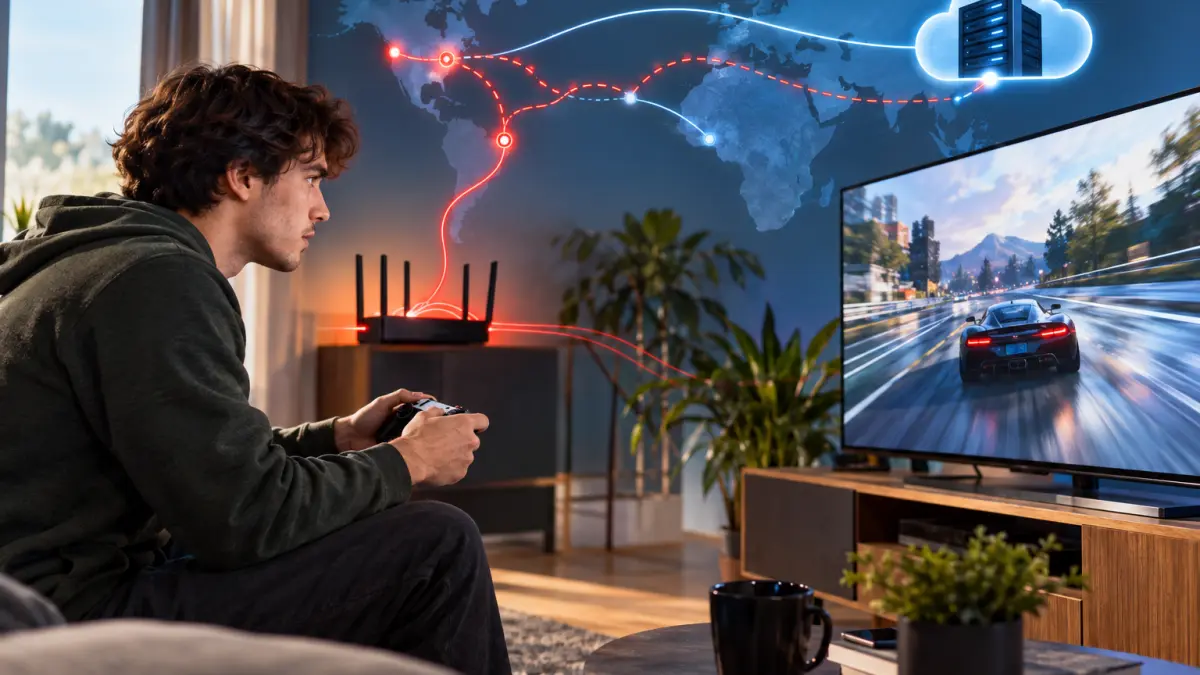
The physical distance to the cloud server affects latency because data must travel through multiple network nodes. The longer the distance, the more time it takes for data packets to reach the server and return. Even with a fast internet connection, a server located far away can introduce noticeable input lag.
Moreover, network routing plays a crucial role. Data packets might not take the most direct path due to routing policies, congestion, or infrastructure limitations, adding extra delays. This means even a nearby server could result in higher latency if the routing is inefficient.
Practical Implications for Gamers
When choosing a cloud gaming provider or setting up a connection, gamers should consider server locations relative to their own. Cloud gaming providers with nearby servers may offer lower latency, but network routing, congestion, and server processing also influence responsiveness.
Improving internet speed is beneficial but not sufficient on its own. Using wired connections instead of Wi-Fi, selecting servers with better routing paths, and opting for providers with local data centers can reduce input lag significantly.
In summary, faster internet speeds can support smoother cloud gaming streams, but they do not necessarily reduce input lag. Overall responsiveness depends on network latency, routing efficiency, connection stability, server processing, and video encoding and decoding. Choosing a provider with a nearby, well-connected server and using a stable network connection can help deliver a more responsive gaming experience.