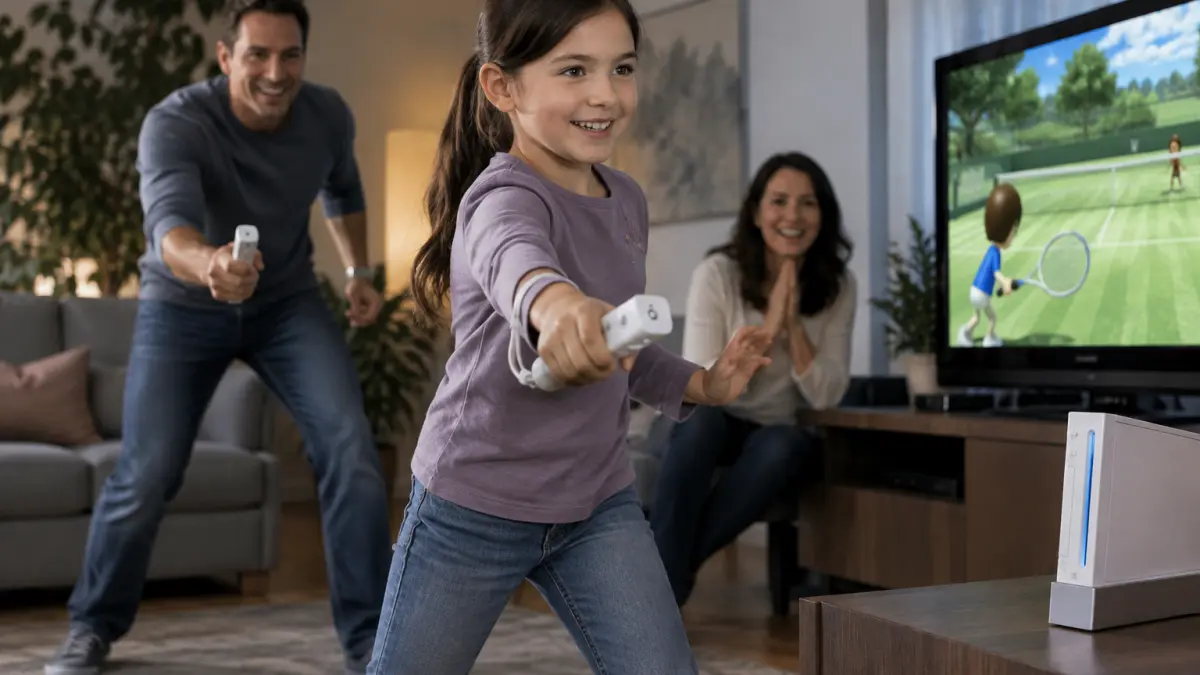

On November 19, 2006, Nintendo launched the Wii in North America, introducing a gaming console that challenged one of the industry’s biggest assumptions: that better graphics and more processing power were the keys to success. While Sony and Microsoft competed with increasingly sophisticated hardware, Nintendo focused on something different. The Wii invited players to stand up, swing their arms, and interact with games through physical movement. Its distinctive Wii Remote controller turned familiar activities such as bowling, tennis, and golf into experiences that almost anyone could understand. What followed was one of the most significant shifts in modern gaming history, demonstrating that accessibility, creativity, and intuitive interaction could be just as powerful as technical performance.
A Different Strategy in the Console Wars
By 2006, the video game industry was entering a new generation of hardware competition. Microsoft’s Xbox 360 had arrived in November 2005, while Sony’s PlayStation 3 launched in North America on November 17, 2006, just two days before the Wii. Both systems emphasized advanced graphics, high-definition gaming, and increasingly sophisticated multimedia capabilities. Nintendo, however, faced a different challenge. Its previous home console, the GameCube, had struggled to match the commercial success of Sony’s PlayStation 2, leaving the company searching for a way to distinguish itself in an increasingly competitive market.
Rather than attempt to outperform its rivals in raw computing power, Nintendo developed a console built around a different philosophy. The Wii used comparatively modest hardware, including an IBM-designed PowerPC-based processor and an ATI-developed graphics chip. It did not prioritize the high-definition output offered by competing systems. Instead, Nintendo concentrated on affordability, compact design, low power consumption, and a controller that could fundamentally change the relationship between players and their games. The approach was risky because it challenged the prevailing belief that each new console generation needed to deliver a dramatic graphical improvement. Nintendo was betting that millions of potential customers cared more about enjoyable experiences than technical specifications.
The Wii Remote: Making Movement Part of Gameplay
The defining feature of the Wii was its wireless motion-sensitive controller, officially called the Wii Remote and widely nicknamed the Wiimote. Unlike traditional controllers built around buttons, directional pads, and analog sticks, the Wii Remote allowed players to influence games through physical gestures. Accelerometers detected movement and changes in orientation, while an infrared camera inside the controller worked with the Wii Sensor Bar to determine where the player was pointing on the screen. Bluetooth provided wireless communication with the console, and the controller also included buttons, vibration feedback, and a built-in speaker.
This combination made interactions possible that were immediately understandable to people unfamiliar with conventional gaming controls. Players could swing the controller like a tennis racket, aim it at the television, or imitate the motion of throwing a bowling ball. The optional Nunchuk attachment added an analog stick, buttons, and additional motion sensing, allowing more complex games to combine traditional input with movement-based controls.
The technology was not without limitations. The original Wii Remote could detect acceleration and support infrared pointing, but it could not precisely track every movement or orientation in three-dimensional space. Nintendo later improved motion detection with the Wii MotionPlus accessory in 2009. Nevertheless, the original controller represented a major shift in console design. Instead of requiring players to learn an unfamiliar set of commands before enjoying a game, Nintendo made the act of playing feel closer to performing a recognizable physical action.
Wii Sports and the Power of Accessible Gaming
One of Nintendo’s most important decisions was including Wii Sports with the console in North America and several other markets. The collection featured five activities: tennis, baseball, bowling, golf, and boxing. Each was designed to demonstrate the Wii Remote’s capabilities without overwhelming newcomers with complicated controls. The games were visually simple compared with many contemporary releases, but that simplicity was part of their appeal. Players could understand the objective almost immediately, making Wii Sports an effective introduction to motion-controlled gaming.
The impact extended beyond individual gameplay. The Wii became a social centerpiece in living rooms, where parents, children, grandparents, and friends could participate together. Bowling competitions and tennis matches required little prior gaming experience, allowing people who had never owned a console to join in. Nintendo’s marketing reinforced this broader appeal, presenting the Wii as entertainment for households rather than exclusively for dedicated gamers.
This accessibility helped Nintendo reach audiences that traditional console marketing often overlooked. The Wii did not invent casual gaming or motion-sensitive controls, but it successfully brought both into the mainstream home-console experience on an unprecedented scale. It showed that the gaming market could expand by making participation easier, rather than simply competing for the attention of existing enthusiasts.
From Launch-Day Curiosity to Worldwide Success
The Wii quickly became one of the most sought-after consumer electronics products of its generation. Following its November 19 North American debut, Nintendo launched the console in Japan on December 2, Australia on December 7, and Europe on December 8, 2006. Strong demand led to shortages in many markets, with retailers struggling to maintain inventory during the holiday season and beyond.
The console’s popularity was supported by a growing library of games that combined Nintendo’s established franchises with new approaches to interaction. The Legend of Zelda: Twilight Princess, a launch title, incorporated motion-based sword controls and pointer-based aiming. Later releases such as Super Mario Galaxy, Mario Kart Wii, and Wii Fit demonstrated how the system could support traditional adventures, family competition, and fitness-oriented experiences. Wii Fit, released in Japan in 2007 and internationally in 2008, introduced the Wii Balance Board, extending Nintendo’s emphasis on physical interaction beyond the handheld controller.
The commercial results validated Nintendo’s unconventional strategy. According to Nintendo’s reported lifetime hardware figures, the Wii sold approximately 101.63 million units worldwide, becoming the company’s best-selling home console at the time and surpassing the lifetime sales of both the Xbox 360 and PlayStation 3. Its success demonstrated that a console did not need the most advanced processor or graphics system to become a market leader.
How the Wii Influenced the Gaming Industry
The Wii’s success forced competitors to take alternative input methods more seriously. Sony expanded its motion-control offerings with PlayStation Move in 2010, while Microsoft introduced Kinect for the Xbox 360 that same year. Although these technologies differed considerably in their implementation, they reflected a broader industry interest in making gameplay more physical and accessible. Motion-controlled interaction became a major area of experimentation, influencing game design, accessibility discussions, and the development of new entertainment experiences.
The Wii also demonstrated the importance of designing hardware and software together around a clear user experience. Its controller was not merely an accessory added to an otherwise conventional console. It was central to Nintendo’s overall strategy, shaping everything from launch titles and marketing to the types of players the company hoped to attract.
Not every experiment succeeded. Motion controls sometimes lacked precision, and certain games relied on repetitive gestures that offered little improvement over traditional buttons. As the novelty faded, developers and players became more selective about when physical movement genuinely enhanced gameplay. Nevertheless, the Wii established a lasting principle: alternative control methods could create meaningful new experiences when designed around the strengths of the technology.
The Wii’s Legacy in Modern Gaming
Two decades after its introduction, the Wii remains an important example of innovation driven by user experience rather than hardware specifications. Its influence can be seen in Nintendo’s continued experimentation with motion-sensitive controllers, including the Joy-Con controllers introduced with the Nintendo Switch in 2017. More broadly, its success helped establish the commercial value of intuitive interfaces, social gameplay, and experiences designed for people with different levels of gaming familiarity.
The Wii did not directly create modern virtual reality or smartphone motion sensors, technologies that developed through their own research and engineering histories. However, it helped popularize the idea that physical gestures could be a compelling way to interact with digital entertainment. Its commercial success also demonstrated that expanding an audience can be as important as satisfying an established one.
Looking back at November 19, 2006, the Wii’s most important achievement was not simply selling more than 100 million consoles. It changed the conversation about what a video game system should be. While its competitors pursued increasingly powerful machines, Nintendo showed that rethinking the controller could transform the entire experience. The Wii made gaming feel less like operating a computer and more like participating in an activity, proving that sometimes the most influential technological breakthroughs begin by making technology easier for everyone to enjoy.