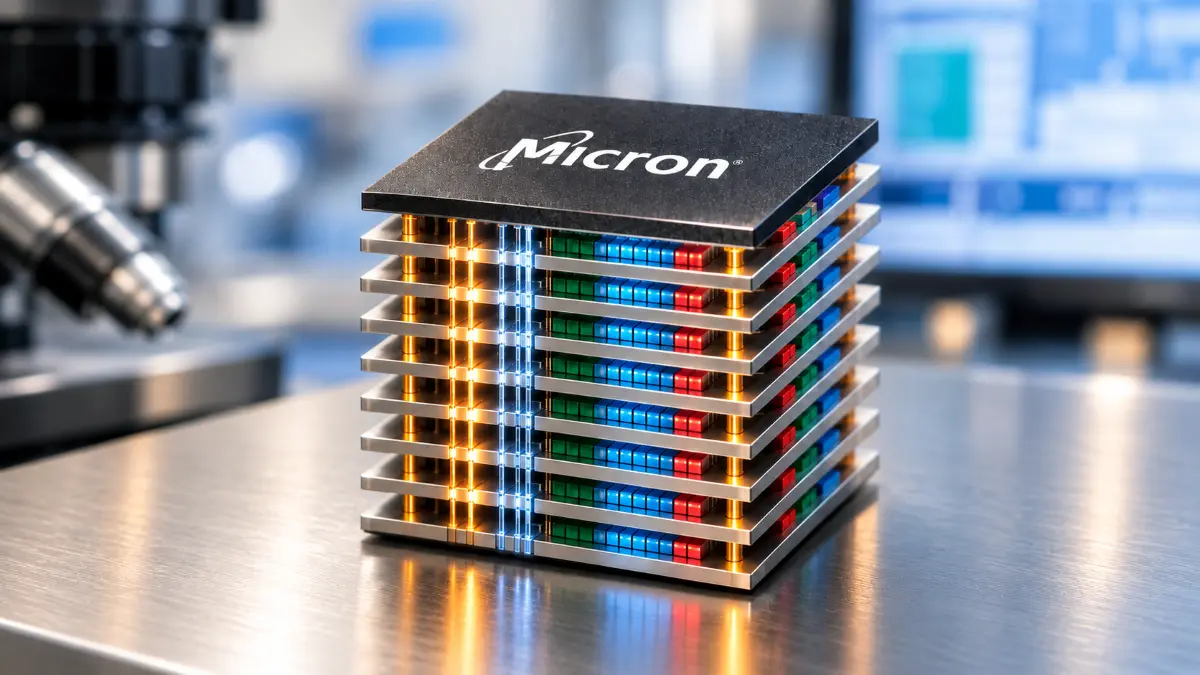

Micron Technology has unveiled its next-generation G11 3D NAND flash memory, marking a significant advancement in storage technology. Scheduled to enter mass production in the second half of 2027, the G11 NAND is set to revolutionize data storage with its unprecedented layer count and performance metrics.
Doubling Storage Density with Over 400 Layers
The G11 NAND architecture introduces a substantial increase in storage density by stacking more than 400 layers of memory cells. This design effectively doubles the bit density compared to Micron’s previous G9 generation, which utilized 276 layers. The enhanced density is achieved through wafer-on-wafer bonding technology, allowing for independent optimization of memory arrays and peripheral logic, thereby maximizing capacity and performance.
Enhanced Performance and Energy Efficiency
In addition to increased density, the G11 NAND boasts a 50% improvement in input/output (I/O) speeds over the G9 generation. This translates to data transfer rates of up to 5,400 megatransfers per second (MT/s), positioning Micron ahead of competitors like Kioxia’s BiCS10 at 4,800 MT/s and Samsung’s V10 at 5,600 MT/s. Furthermore, the G11 NAND reduces data transfer energy consumption per bit by more than 25%, addressing the growing demand for energy-efficient storage solutions in data centers and mobile devices.
Strategic Implications and Market Positioning
By skipping the anticipated G10 generation, Micron demonstrates its commitment to rapid innovation in the NAND flash memory market. The G11 NAND’s advanced features are particularly well-suited for high-capacity solid-state drives (SSDs) used in data centers, AI applications, and consumer electronics. The increased density and performance enhancements are expected to drive demand for next-generation storage solutions, positioning Micron as a leader in the evolving storage landscape.
Future Outlook and Industry Impact
Looking ahead, Micron plans to further advance NAND technology by introducing high-mobility materials and ultra-dense cell architectures. These innovations aim to extend 3D NAND scaling beyond the G11 generation, ensuring continued progress in storage density and performance. As the industry moves towards more complex and data-intensive applications, Micron’s G11 NAND is poised to play a pivotal role in meeting the escalating storage demands of the future.
In summary, Micron’s G11 3D NAND represents a significant leap in storage technology, offering doubled bit density, enhanced performance, and improved energy efficiency. With mass production slated for late 2027, the G11 NAND is set to redefine the standards for high-capacity, high-performance storage solutions in the coming years.