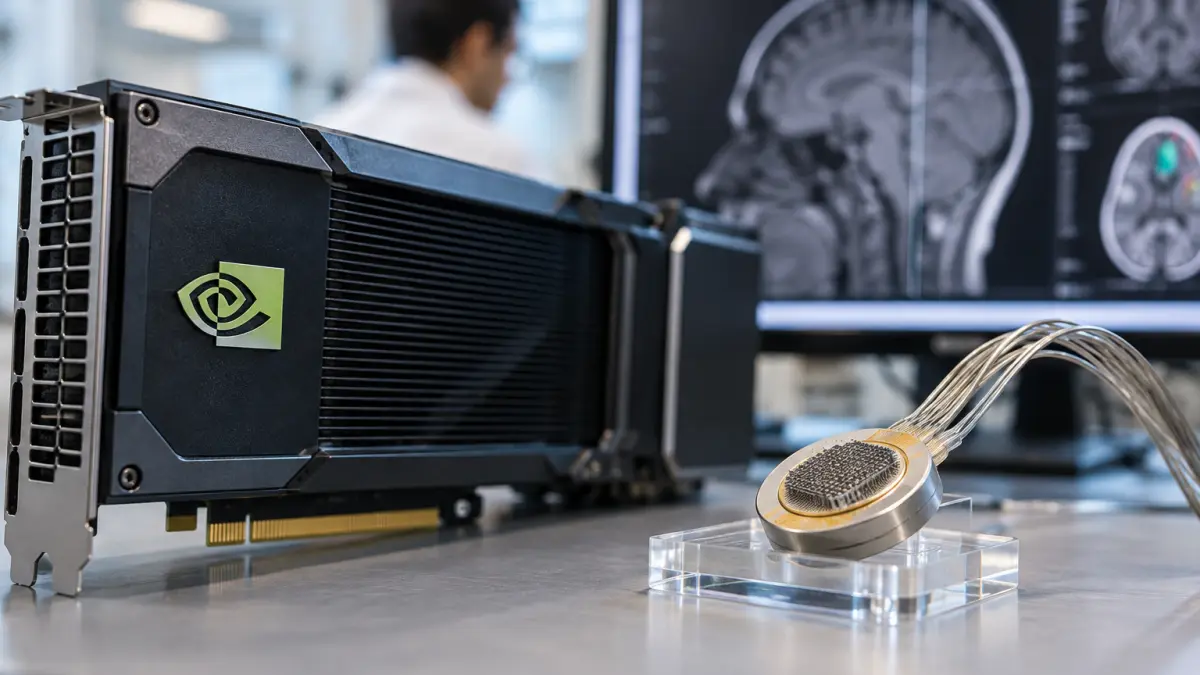

Nvidia is bringing its AI computing technology into the emerging field of brain-computer interfaces through a partnership with Paradromics, a neurotechnology company developing implants that translate neural activity into speech and computer commands. The collaboration aims to reduce the size of the external hardware required to process brain signals, potentially making communication systems more practical for people living with paralysis, motor neuron diseases, and other conditions that severely impair speech.
The partnership will bring Nvidia’s Jetson edge computing platform and Holoscan sensor-processing software into Paradromics’ development efforts. Rather than relying on large external computing setups, the companies envision compact systems capable of interpreting neural signals close to the user, with lower latency and less dependence on fixed equipment. The announcement represents another step toward making experimental brain-computer interfaces suitable for everyday environments, although significant engineering and clinical challenges remain.
How Paradromics Turns Brain Activity Into Speech
Paradromics is developing the Connexus brain-computer interface, an implantable system designed to record electrical activity from neurons involved in intended movement and speech. Its implant uses hundreds of electrodes to capture high-resolution neural signals, which are then transmitted to external processing equipment. When a person attempts to speak, areas of the brain associated with speech production generate patterns of neural activity, even when paralysis prevents the muscles required for speaking from functioning normally. Machine-learning models can be trained to recognize relationships between these patterns and intended speech, converting neural signals into text or synthesized audio. This process does not involve reading arbitrary thoughts. Instead, the system learns to interpret specific neural activity associated with intended communication, using individualized training and decoding methods.
The technical challenge is substantial. Neural recordings produce complex streams of data that must be filtered, interpreted, and converted into useful output quickly enough to support conversation. Processing delays can interrupt communication, while inaccurate decoding can produce unintended words or require repeated corrections. Paradromics reported in September 2026 that a participant in its Connect-One study used the Connexus system to generate her own words, answer open-ended questions, and communicate with family members through synthesized speech. That achievement represented an important clinical milestone, but it did not mean the technology was ready for widespread use. The system remains investigational, and its long-term safety, reliability, and practical performance are still being evaluated.
Why Nvidia’s Jetson Platform Matters
A major obstacle to everyday brain-computer interface use is the computing equipment required outside the body. Paradromics’ research configuration has relied on a substantial external electronics setup to receive and process neural data. Although the implant itself is small, the surrounding hardware can restrict mobility and make the system less convenient outside controlled environments. Nvidia’s Jetson platform is designed to run AI workloads on compact, power-efficient computing modules, commonly used in robotics, industrial automation, and other applications requiring sophisticated computation without large servers. For Paradromics, Jetson could provide the computing performance needed to run neural decoding models in a significantly smaller external device.
Instead of transporting neural data to a large workstation, a future system could process signals using a module integrated into a wheelchair, portable communication device, or other personal equipment. This approach, known as edge computing, processes information close to its source rather than continuously sending it to a remote server. For brain-computer interfaces, local processing could reduce dependence on network connectivity, minimize delays associated with remote computation, and provide greater control over sensitive neural information. However, achieving these benefits requires more than replacing a large computer with a smaller processor. Developers must also manage power consumption, heat generation, wireless communication, and the computational demands of continuously running neural decoding models.
Holoscan Could Improve Real-Time Neural Processing
Alongside Jetson hardware, Nvidia’s Holoscan platform is expected to play an important role in the collaboration. Holoscan is designed for applications that process high-volume sensor data in real time, particularly in medical technology, robotics, and advanced sensing environments. In a brain-computer interface, neural signals must pass through several processing stages before becoming meaningful output, including signal acquisition, filtering, feature extraction, neural decoding, and conversion into speech or computer commands. Each stage introduces computational requirements and potentially adds delay. Holoscan could help developers organize these operations into efficient processing pipelines that take advantage of Nvidia’s accelerated computing architecture.
The technology could also support the integration of additional inputs, such as microphones or cameras, where appropriate. Combining neural signals with contextual information may eventually help communication systems interpret user intent more effectively, although such capabilities would require careful development and validation. The ultimate objective is not simply faster computation but making the complete interaction feel more natural, allowing users to communicate without lengthy pauses between intending a word and hearing it spoken.
From Laboratory Equipment to Everyday Mobility
Portability is one of the most important goals of the partnership. A brain-computer interface may demonstrate impressive decoding performance in a laboratory, but its usefulness can remain limited if the user must stay near a large computer, specialized electronics, or a fixed power source. For someone with severe motor impairment, communication needs extend far beyond scheduled clinical sessions. Conversations happen at home, during medical appointments, while traveling, and in everyday interactions with family and friends. A compact processing system could make these situations easier to support.
For example, a future BCI processor mounted on a wheelchair might allow a user to communicate while moving between rooms or participating in activities outside the home. Integration with personal computing devices could also provide access to messaging, web browsing, and other digital services. Paradromics announced in August 2026 that the FDA had approved an expansion of its investigational study protocol to support compatible personal computing devices, including laptops, tablets, and smartphones, following required deployment and testing procedures. That authorization concerns the company’s clinical study and should not be confused with approval for general commercial use. The Nvidia collaboration could complement this work by reducing the computing infrastructure needed to support the underlying neural decoding system.
Could AI Make Synthesized Speech More Natural?
Beyond hardware miniaturization, Nvidia’s AI expertise could potentially improve how decoded neural information is converted into spoken language. Current speech-generating systems face a challenge that extends beyond identifying individual words. Natural communication also involves timing, rhythm, emphasis, and emotional expression. A synthesized voice that produces the correct words but lacks natural variation may still make conversation feel mechanical. Advanced AI models could help improve the fluency and expressiveness of generated speech, provided they remain faithful to the user’s intended message.
This distinction is especially important for assistive communication technology. Language models can generate plausible sentences, but a BCI must avoid introducing words or meanings that the user did not intend. Future systems will therefore need to balance language-model assistance with accuracy, user control, and clear mechanisms for correcting errors. The companies have identified more capable AI processing as a development opportunity, but the partnership does not establish that a finished portable system can already deliver natural, expressive speech across everyday situations.
Privacy, Reliability, and Medical Safety Remain Critical
Processing neural signals locally could offer privacy advantages, particularly if sensitive recordings do not need to be transmitted continuously to external cloud infrastructure. However, local processing does not automatically guarantee privacy or security. Brain-computer interfaces involve highly sensitive physiological data, and their supporting systems may include wireless connections, software updates, storage components, and interfaces with other digital devices. Manufacturers must consider how neural information is protected, who can access it, how long it is retained, and whether it is used to improve AI models.
Reliable operation is equally important. A communication device intended for daily use must remain dependable across changing environments, battery conditions, and extended operating periods. For implantable systems, these requirements exist alongside the medical risks associated with surgery, long-term implantation, and maintaining stable neural recordings. Nvidia’s computing technology may help address some external processing challenges, but it does not eliminate the need for clinical validation or regulatory oversight.
Nvidia Expands Its Role in Medical AI
The partnership also reflects Nvidia’s growing presence in medical technology beyond traditional GPU-powered research and data centers. Its computing platforms are used in applications involving medical imaging, surgical systems, robotics, and real-time sensor analysis. Brain-computer interfaces represent another potential market for hardware and software capable of handling demanding AI workloads close to their source. For Paradromics, the collaboration provides access to an established accelerated computing ecosystem rather than requiring every component of its processing infrastructure to be developed independently.
This could help the company concentrate more of its engineering resources on neural interfaces, decoding algorithms, clinical performance, and the overall user experience. The arrangement also illustrates how medical device innovation increasingly depends on cooperation between specialized healthcare developers and companies supplying general-purpose AI computing technology.
What Happens Next?
The next challenge is translating the proposed architecture into a compact, reliable system that performs consistently under realistic operating conditions. Important developments will include demonstrations of smaller processing hardware, measured improvements in decoding latency, battery-powered operation, and evidence that the system can maintain communication performance outside a laboratory setting. Clinical testing will remain essential as Paradromics evaluates the safety and effectiveness of its Connexus platform while determining how changes to external hardware and software affect the complete medical system.
Regulatory requirements will depend on the specific modifications and their relationship to the investigational device. A new computing configuration cannot automatically be assumed to be covered by previous authorizations, and the companies have not established a public delivery date for a finished portable product.
A Step Toward More Practical Brain-Computer Interfaces
The Nvidia and Paradromics partnership highlights an important transition in neurotechnology. Researchers are moving beyond demonstrating that neural signals can be decoded and toward making those capabilities practical for people who could benefit from them every day. Paradromics has reported that its investigational implant can support real-time communication in a clinical setting, while Nvidia’s contribution could help address a different obstacle: the size, efficiency, and complexity of the computing systems required to make that communication possible.
The greatest potential benefit is not simply a smaller device. It is greater independence for people whose ability to communicate has been severely restricted. If the companies can combine reliable neural decoding with compact, efficient processing, brain-computer interfaces could move closer to becoming practical communication tools rather than technologies primarily demonstrated in specialized research environments.