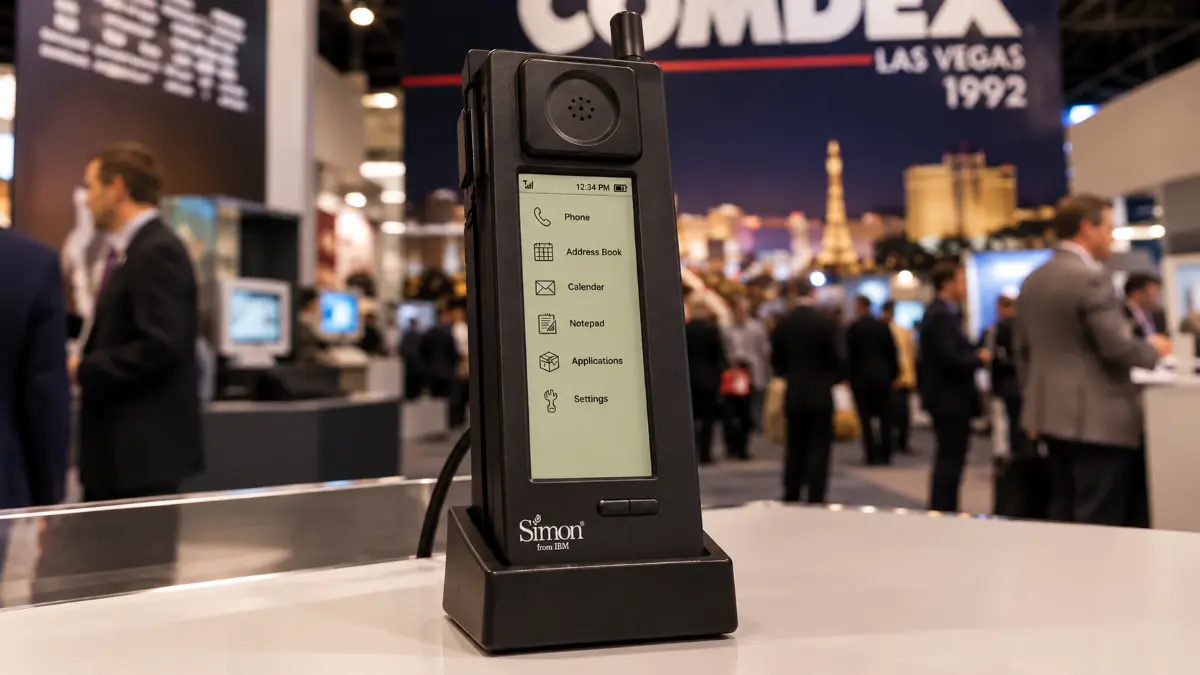

On November 23, 1992, visitors attending the COMDEX technology exhibition in Las Vegas witnessed an unusual device that challenged conventional ideas about mobile communication. Developed by IBM, the prototype combined the functions of a cellular telephone with those of a personal digital assistant, allowing users to make calls, manage information, and interact with applications through a touchscreen. The device would eventually become the IBM Simon Personal Communicator, widely recognized as the first commercially available smartphone.
At a time when most mobile phones were designed primarily for voice communication, IBM’s demonstration offered a glimpse of a different future. The prototype suggested that a single handheld device could serve as both a telephone and a portable computer, bringing communication, productivity, and personal information management together. Although the finished Simon would not reach consumers until 1994, its appearance at COMDEX represented an important milestone in the evolution of mobile technology.
The IBM Engineer Behind the First Smartphone Concept
The origins of Simon can be traced to IBM’s Advanced Technology group in Boca Raton, Florida, where engineer Frank Canova began exploring the possibility of combining cellular communications with computing capabilities. By the early 1990s, improvements in microprocessors, memory, and wireless technology were making increasingly sophisticated handheld electronics possible. Personal digital assistants were emerging as a new product category, but most remained separate from mobile telephones.
Canova recognized an opportunity to combine these technologies into a single device. Rather than treating the cellular phone as an accessory to a portable computer, IBM’s concept placed communication at the center of the experience while incorporating useful computing functions. The goal was to create a personal communicator capable of handling both voice and data through an interface that ordinary users could understand.
In July 1992, Canova demonstrated an early concept to IBM management using a touchscreen connected to a personal computer. The demonstration illustrated how familiar telephone controls could appear directly on a display, eliminating the need for a conventional physical keypad. IBM subsequently assembled a small engineering team to develop a working prototype for the upcoming COMDEX exhibition.
The project moved rapidly. Within approximately 15 weeks, the team produced a functioning demonstration device known internally as Sweetspot. When it appeared at COMDEX on November 23, 1992, the prototype attracted considerable attention from attendees and the technology press. At that stage, it was described as a personal communicator rather than a smartphone, a term that had not yet become established in the mobile industry.
The concept was ambitious because it attempted to combine technologies that manufacturers had largely treated as separate product categories. IBM was demonstrating not merely a more advanced telephone, but a new approach to personal computing built around mobility and communication. <Cite refs={[“turn212876search0″,”turn212876search6”]}/>
From the COMDEX Prototype to the IBM Simon
The device displayed in November 1992 was not the finished commercial IBM Simon. Following the positive response at COMDEX, IBM continued development under the project codename Angler, transforming the experimental concept into a product that could be manufactured, supported, and sold to consumers.
BellSouth Cellular became an important partner in the project, recognizing the potential for a mobile device that offered more than conventional telephone services. IBM was responsible for the computing architecture and software development, while Mitsubishi Electric manufactured the finished hardware.
The commercial product was formally announced on November 2, 1993, under the name Simon Personal Communicator. However, turning the prototype into a reliable consumer device proved challenging. Software development and integration difficulties contributed to delays, pushing its commercial availability into the following year.
On August 16, 1994, BellSouth began selling Simon in the United States. The device initially cost approximately $899 with a two-year cellular service agreement, positioning it as a premium product aimed largely at business professionals and technology enthusiasts. Without a service contract, the price was approximately $1,099.
This distinction between the 1992 demonstration and the 1994 release is essential to understanding Simon’s history. November 23 marks the public debut of the concept that became the IBM Simon, while August 1994 marks the arrival of the commercially available product. <Cite refs={[“turn212876search1″,”turn212876search2″,”turn212876search21”]}/>
A Touchscreen Phone That Could Do Much More Than Make Calls
The finished IBM Simon introduced a combination of capabilities that would become familiar to smartphone users more than a decade later. Alongside ordinary cellular telephone functions, it provided an address book, calendar, appointment scheduler, calculator, notepad, and electronic communication tools. Users could send and receive faxes and email, manage contacts, and organize everyday tasks without carrying a separate handheld computer.
Its most distinctive feature was a monochrome LCD touchscreen that served as the primary interface. Instead of relying on a conventional telephone keypad, users interacted with graphical controls displayed on the screen, using a stylus to select functions and enter information. An on-screen keyboard provided a way to compose messages and input data, anticipating the software-based keyboards that would eventually become standard on modern smartphones.
Internally, Simon used a 16 MHz x86-compatible processor and approximately 1 MB of RAM. Its software environment was based on DOS technology and provided an integrated interface for the device’s communication and productivity applications. A PCMCIA expansion slot also supported additional functionality, including third-party software.
One example was DispatchIt, an aftermarket application designed to support remote work and information exchange. Although Simon’s software ecosystem was extremely limited compared with modern app stores, the ability to extend its functionality demonstrated that a cellular phone could operate as a programmable computing platform rather than a fixed-function appliance.
The hardware was substantial by today’s standards. Weighing approximately 510 grams, or 1.1 pounds, Simon was much heavier than most modern smartphones and far less convenient to carry. Its battery life was also limited, particularly when using cellular communication features. Nevertheless, the device successfully brought together capabilities that had previously required multiple pieces of equipment. <Cite refs={[“turn212876search10″,”turn212876search11″,”turn212876search8”]}/>
Why Simon Was Ahead of Its Time
The technological achievement behind Simon was not that IBM invented every individual feature it contained. Touchscreens, electronic organizers, portable computers, and cellular telephones already existed. What made Simon significant was the integration of these capabilities into a single commercially available handheld product.
In the early 1990s, mobile networks were primarily optimized for voice communication. Wireless data services were relatively slow, expensive, and limited in availability. Sending an email or fax from a mobile device was therefore a much more complicated experience than it would become with later generations of cellular networks.
Simon also arrived before the widespread adoption of mobile Internet services, modern web browsers, and downloadable application marketplaces. Its users could perform useful communication and productivity tasks, but they could not access anything resembling the enormous collection of connected services available on contemporary smartphones.
The device consequently faced a difficult commercial environment. Its price was high, its battery life was short, and the supporting wireless infrastructure was still developing. Many consumers did not yet have a compelling reason to replace a conventional mobile phone with a larger and more expensive personal communicator.
Despite these limitations, Simon demonstrated that the underlying concept was technically achievable. A handheld device could combine computing, communication, and a graphical interface without depending on a separate desktop computer for every task.
Why the First Smartphone Did Not Become a Commercial Success
Although Simon attracted considerable attention, its commercial life was brief. BellSouth sold approximately 50,000 units during the device’s roughly six months on the market, a modest figure compared with the mass-market smartphone sales that would emerge in later decades.
Several factors limited its appeal. The device’s relatively large size and weight made it less convenient than ordinary cellular telephones, while its battery performance restricted how long users could rely on its more advanced functions. The high purchase price and cellular service costs also made Simon difficult to justify for customers who primarily wanted to make telephone calls.
The wireless networks of the period imposed additional constraints. Without fast, widely available mobile data connections, features such as email and remote information access could not provide the seamless experience that users now associate with smartphones.
IBM’s early entry into the category also meant that Simon lacked the mature software ecosystem, developer support, and consumer familiarity that later mobile platforms would enjoy. The technology demonstrated considerable potential, but the market was not yet ready to support it at scale.
Simon was discontinued in 1995, leaving behind a relatively small installed base and a distinctive place in computing history. Its commercial performance showed that technological innovation alone was not enough to establish a new product category. Supporting infrastructure, affordability, battery technology, software availability, and consumer demand were equally important.
How IBM Simon Anticipated the Modern Smartphone
The ideas demonstrated by Simon became increasingly relevant as mobile technology advanced through the late 1990s and early 2000s. Devices from Nokia, Ericsson, Palm, and other manufacturers continued exploring combinations of cellular communication and personal computing, gradually improving portability, battery life, wireless connectivity, and software capabilities.
The BlackBerry family later demonstrated the commercial value of mobile email and business productivity, while increasingly capable mobile operating systems expanded the possibilities for third-party applications. In 2007, Apple’s iPhone popularized a new generation of touchscreen-centered smartphone design, followed by the expansion of Android devices beginning in 2008.
These later products did not simply descend from Simon through a single direct line of development. The smartphone emerged through contributions from numerous companies, researchers, and engineering disciplines. Nevertheless, Simon provided an early commercial demonstration of the integrated device concept that would eventually define the category.
Several features that now appear ordinary were already present in recognizable form: touchscreen interaction, software-based controls, personal information management, electronic messaging, and the ability to add functionality through applications.
The difference was the surrounding technology. Modern smartphones benefit from powerful system-on-chip processors, high-resolution displays, advanced batteries, broadband cellular networks, and extensive software ecosystems. These advances transformed a concept that was expensive and limited in 1994 into an essential everyday device for billions of people.
The Legacy of IBM Simon’s 1992 Debut
Looking back at November 23, 1992, the importance of IBM’s COMDEX demonstration lies in its vision of mobile computing. At a time when telephones and personal computers were largely separate products, Frank Canova and his engineering team showed that their capabilities could coexist in a single handheld device.
The IBM Simon Personal Communicator did not become a mainstream commercial success, nor did it immediately transform the mobile industry. Its significance was more fundamental. It demonstrated the feasibility of a new product category before the technology and market conditions existed to support widespread adoption.
The story also illustrates how major technological transitions often begin with imperfect prototypes. Simon was bulky, expensive, and constrained by the wireless networks of its time, but its combination of communication and computing anticipated a future that would become reality years later.
On November 23, 1992, IBM offered the world an early glimpse of the smartphone era. The device that emerged from that demonstration was not the smartphone we know today, but it helped establish the idea that a mobile phone could become a powerful personal computing platform.