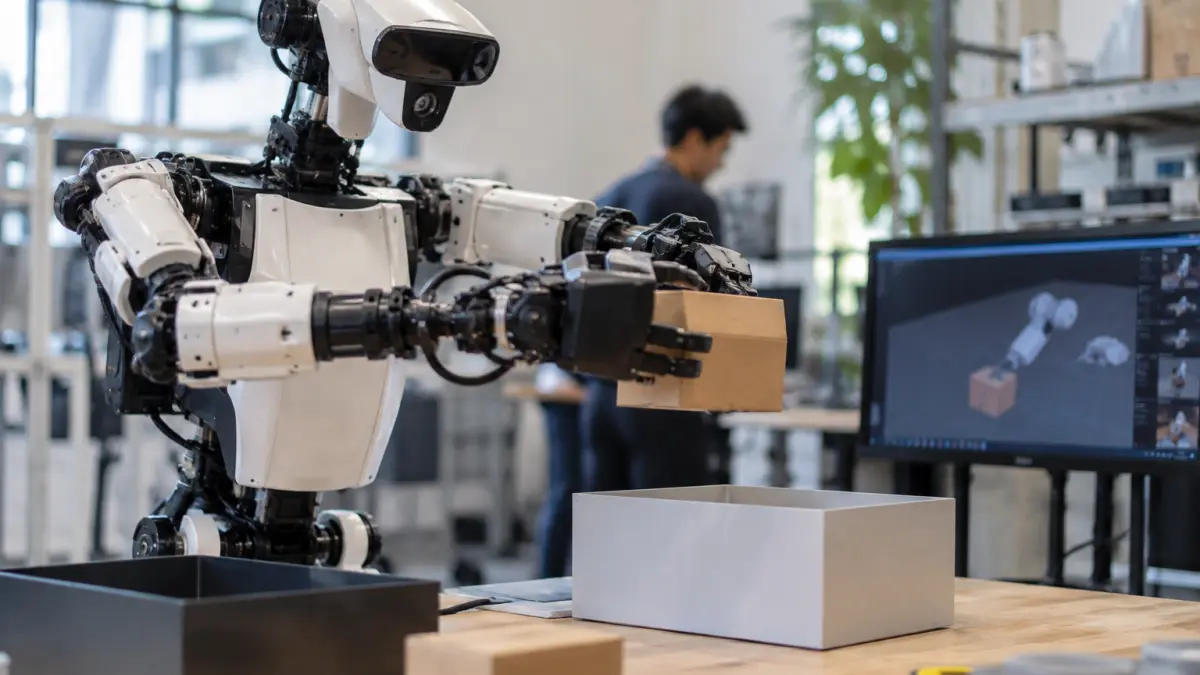

Physicl, a startup focused on enhancing robotics training through realistic simulations, has secured $10 million in seed funding led by Inovia Capital. This investment aims to address the longstanding challenge in robotics known as the “sim-to-real gap,” where robots trained in virtual environments often struggle to perform accurately in the physical world.
Addressing the Sim-to-Real Challenge
The sim-to-real gap has been a persistent issue in robotics, hindering the deployment of AI models in real-world scenarios. Traditional training methods often fall short due to discrepancies between simulated and actual environments. Physicl’s approach leverages its expertise in 3D modeling to create high-fidelity digital representations that closely mimic real-world physics and interactions. By generating synthetic data that accurately reflects real-world conditions, Physicl aims to improve the reliability and efficiency of robot training processes.
Studio: A Tool for Targeted Training Data
Physicl’s flagship product, Studio, offers a comprehensive suite of 10,000 3D environments and over 100,000 object assets. This extensive library enables researchers and developers to generate customized training scenarios tailored to specific challenges faced by robots. For instance, Studio can simulate complex situations such as a robot identifying a cup amidst cluttered surroundings or under varying lighting conditions. By providing precise ground-truth data, Studio facilitates targeted post-training, allowing models to be refined and tested against real-world edge cases.
Collaboration with SpAItial
An early adopter of Physicl’s technology is SpAItial, a company specializing in world models that generate explorable 3D environments. SpAItial utilized Physicl’s synthetic data to enhance the fidelity of its Echo-3 model, resulting in a significant reduction in reconstruction errors. Matthias Niessner, CEO of SpAItial and a professor at the Technical University of Munich, highlighted the efficiency of Physicl’s platform in generating training data on demand, addressing specific gaps identified during model training.
Implications for Robotics Development
The successful application of Physicl’s technology has broader implications for the robotics industry. By bridging the sim-to-real gap, Physicl’s solutions can accelerate the deployment of robots in various sectors, including manufacturing, logistics, and healthcare. The ability to generate accurate and diverse training data reduces the reliance on costly and time-consuming real-world data collection, streamlining the development process. As the robotics field continues to evolve, tools like Studio are poised to play a crucial role in advancing AI capabilities and operational reliability.
Future Outlook
With the recent funding, Physicl plans to expand its team and further develop its platform to meet the growing demands of the robotics industry. The company’s innovative approach to simulation-based training positions it as a key player in addressing one of the most critical challenges in AI and robotics. As more organizations adopt Physicl’s solutions, the potential for widespread improvements in robot performance and deployment efficiency becomes increasingly attainable.