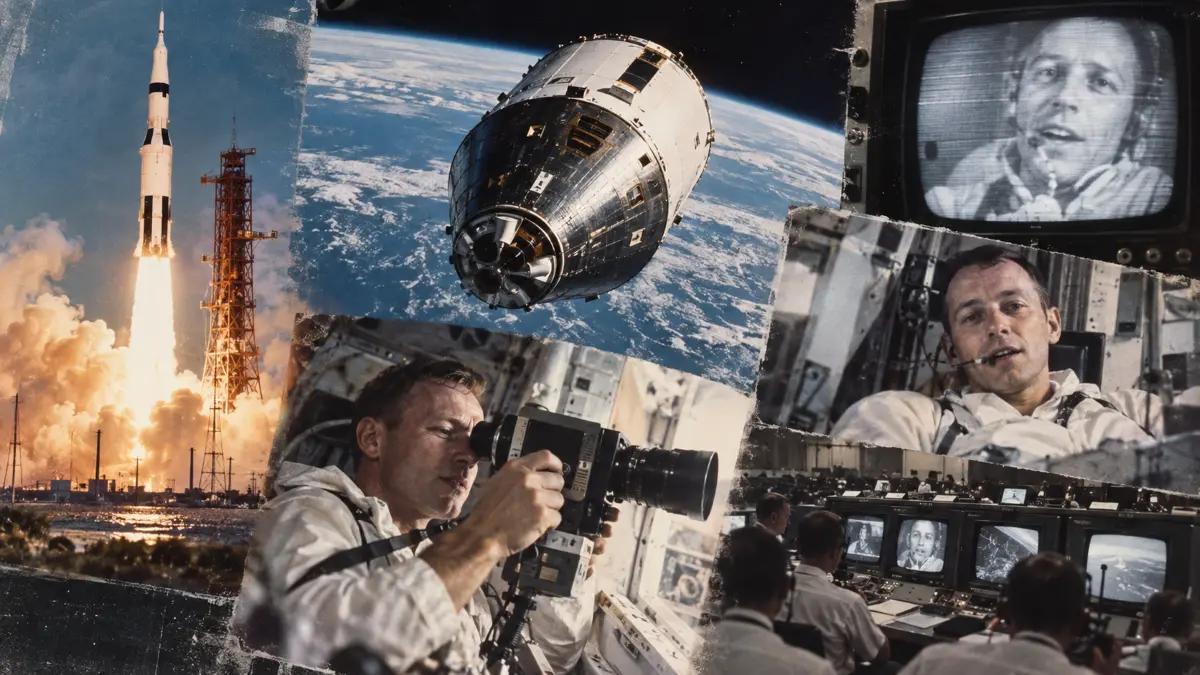

Imagine floating 118 miles above Earth, capturing the awe of space in real time. On October 14, 1968, the Apollo 7 crew performed the first live television broadcast by American astronauts in orbit. This was not just a technical stunt; it was a breakthrough in how humans could share the experience of spaceflight beyond written reports or delayed radio transmissions.
Apollo 7’s live television broadcast marked a new chapter in space exploration communication. Before this, astronauts’ accounts were confined to voice transmissions and photographs sent back after the fact. The ability to beam live images from orbit brought a new immediacy and intimacy to space missions. For the first time, people on Earth could witness astronauts’ activities and the Earth’s curvature in real time, creating a shared experience that was previously impossible.
At the time, this broadcast solved a critical problem: how to engage the public and stakeholders with the realities of spaceflight. NASA was under pressure to justify the enormous costs of the Apollo program. Live TV from orbit turned abstract missions into vivid, relatable events. It also tested the limits of space communication technology, pushing engineers to develop reliable video transmission systems that could operate under the harsh conditions of space.
The technical challenges were immense. Transmitting live video required stable communication links, bandwidth management, and equipment that could survive launch stresses and operate in zero gravity. The success of Apollo 7’s broadcast proved that these hurdles could be overcome. This achievement laid the groundwork for subsequent missions to include live video feeds, which became a staple of space exploration and public engagement.
What changed because of this broadcast was more than just the addition of a camera. It shifted how space missions were documented and perceived. Live video feeds became a tool for transparency and education, allowing scientists, engineers, and the public to observe and analyze missions as they unfolded. This real-time visibility also enhanced mission safety by enabling ground control to monitor astronauts’ conditions and activities closely.
Today, the legacy of Apollo 7’s live television broadcast is evident in how space agencies and private companies share their missions. From the International Space Station’s continuous live streams to high-definition broadcasts of lunar landings and Mars rover operations, the principle remains the same: real-time visual connection bridges the vast distance between Earth and space. It fosters a global sense of participation and inspiration that fuels ongoing interest and investment in space exploration.
The broadcast also anticipated the broader cultural shift toward live streaming and instant media consumption. Apollo 7 showed that technology could bring distant, complex endeavors into everyday life, setting a precedent for how we document and share critical events across all fields.
Reflecting on this moment, it’s clear that the Apollo 7 crew did more than orbit Earth. They opened a window to space that remains wide open today. Their live television broadcast was a technical milestone and a human one, reminding us that exploration is not just about discovery but also about connection.