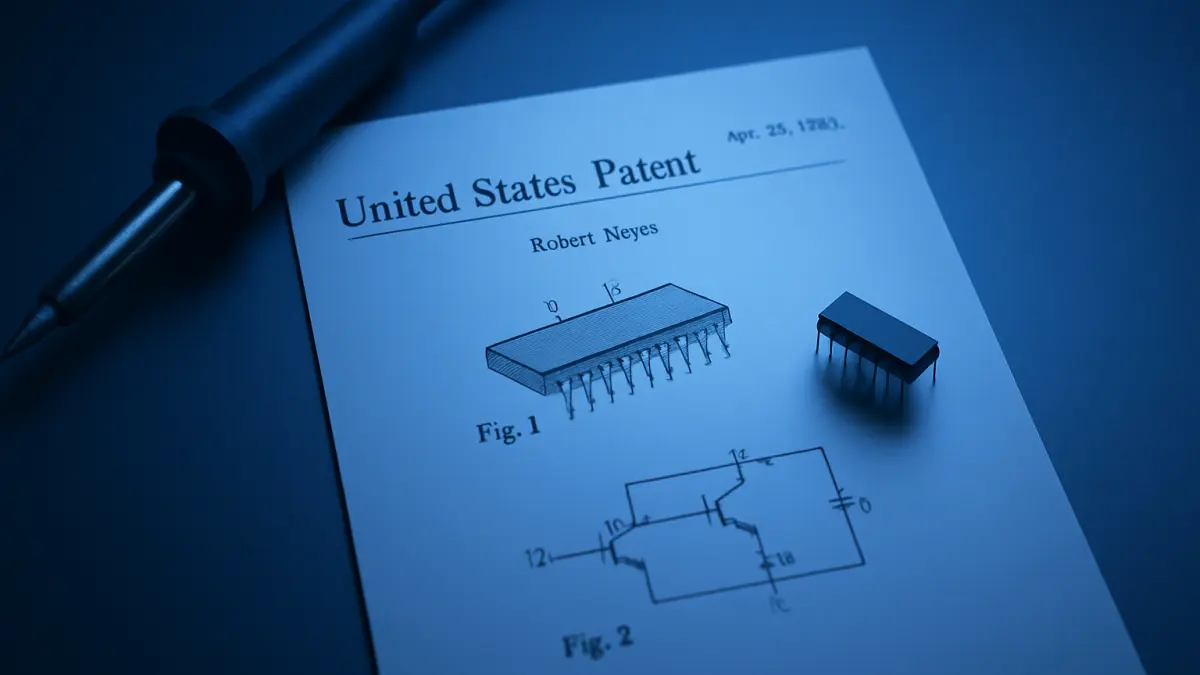

The integrated circuit patent granted to Robert Noyce on April 25, 1961, marked a turning point in the evolution of electronics. This patent was not just a legal formality; it was the blueprint for a technology that would redefine how electronic devices were built and scaled.
Robert Noyce’s integrated circuit patent introduced a method to fabricate multiple electronic components—transistors, resistors, and capacitors—on a single piece of semiconductor material. Before this, circuits relied on bulky, discrete components wired together, which limited complexity and reliability. The integrated circuit patent addressed these challenges by enabling miniaturization and mass production.
At the time, this technology mattered because it solved the problem of size, cost, and durability in electronic systems. By embedding multiple components into one chip, Noyce’s invention drastically reduced the physical footprint of circuits and improved performance consistency. This made it feasible to develop more sophisticated devices without exponentially increasing their size or failure rates.
The ripple effects of the integrated circuit patent reshaped the electronics industry. It paved the way for compact, affordable computers and consumer electronics, accelerating innovation cycles. Manufacturing processes evolved to support high-volume chip production, which became the backbone of modern digital technology.
Today, the impact of Noyce’s integrated circuit patent is still felt in virtually every digital device. From smartphones to data centers, the principles established by this patent underpin the semiconductor industry’s ability to deliver ever more powerful and efficient chips. The patent’s legacy continues as engineers push the boundaries of integration and performance on silicon wafers.
Reflecting on this milestone reminds us how a single patent can unlock decades of technological progress and reshape entire industries.