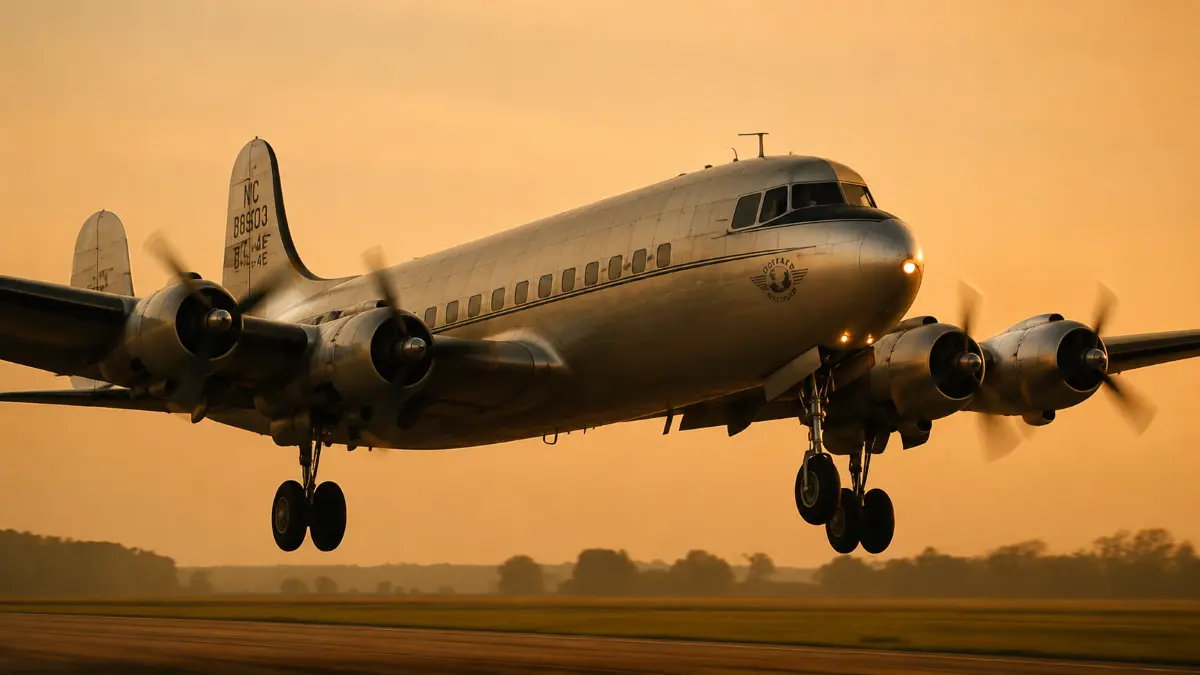

June 7, 1938, marked a defining moment in aviation technology when the Douglas DC-4E made its first test flight. The event was not just about a new aircraft taking to the skies; it was a bold experiment in pushing the boundaries of what commercial airplanes could achieve. The DC-4E represented a leap forward in complexity, capacity, and design philosophy that challenged the norms of its time.
At the heart of the DC-4E’s innovation was a focus on improving passenger comfort, operational efficiency, and performance. It was one of the earliest attempts to create a large, four-engine airliner capable of carrying more passengers over longer distances with greater reliability. This aircraft introduced features such as a pressurized cabin concept, advanced aerodynamics, and a more sophisticated control system. These technological choices addressed key problems in aviation: limited range, passenger discomfort at high altitudes, and inefficient fuel use.
The DC-4E’s test flight was a proving ground for these ideas. Although the aircraft itself was complex and faced challenges that eventually led to its redesign, the lessons learned were invaluable. It exposed the limits of existing technology and highlighted the need for better materials, more reliable engines, and streamlined production techniques. The experience gained directly influenced the development of the subsequent Douglas DC-4, which became one of the most successful airliners of its era.
What changed because of the DC-4E’s test flight was a shift in how aircraft manufacturers approached design and engineering. It was a clear signal that commercial aviation was moving toward larger, more capable aircraft that could serve the expanding global passenger market. The DC-4E’s ambitious design pushed the industry to innovate in areas like cabin pressurization and multi-engine reliability, setting new standards for safety and comfort.
Today, the impact of the DC-4E first test flight still resonates. Modern commercial aircraft owe much to the groundwork laid by early pioneers like the DC-4E. Its emphasis on passenger experience and operational efficiency continues to guide aircraft design. The challenges it faced also serve as a reminder of the iterative nature of technological progress—how early prototypes, even when imperfect, pave the way for breakthroughs that define entire industries.
Reflecting on the DC-4E’s test flight is to acknowledge a moment when aviation technology dared to think bigger. It was a step toward the interconnected world we live in now, where air travel is routine and essential. The DC-4E may not have been the final product, but it was a crucial experiment that shaped the future of flight.