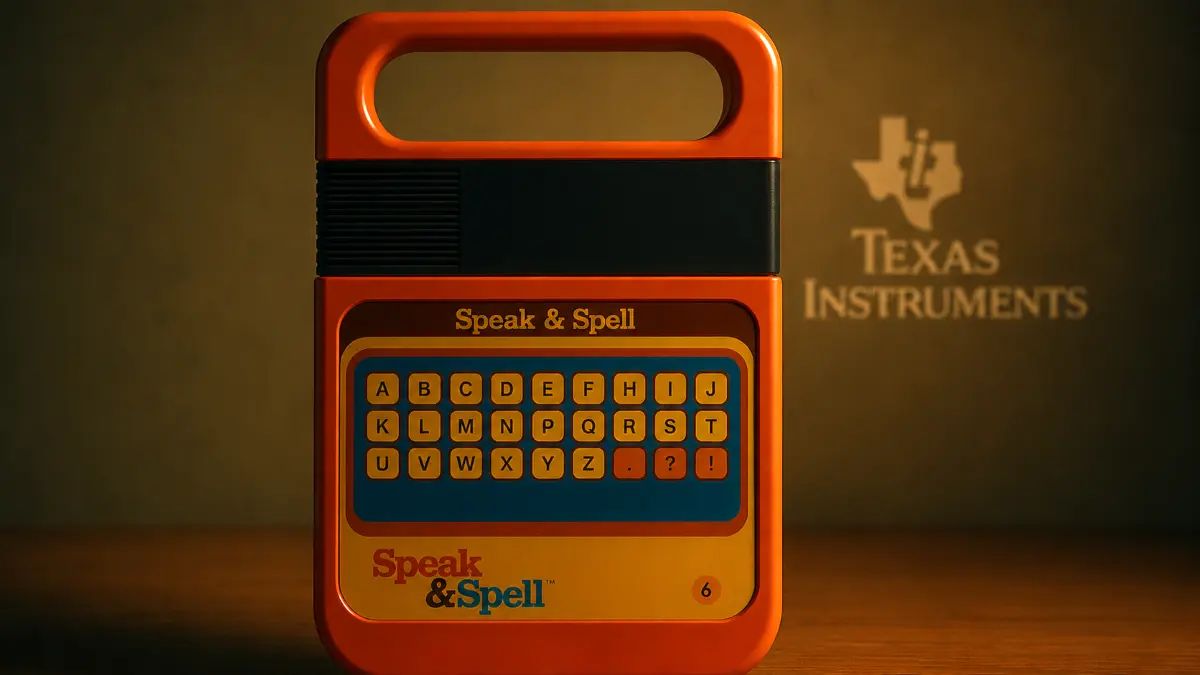

The hum of a silicon chip speaking words was once science fiction. On June 11, 1978, Texas Instruments Inc. introduced the Speak & Spell, a talking educational toy for children that brought synthetic speech out of the lab and into homes. This wasn’t just a toy launch; it was the first time electronic duplication of the human voice was achieved on a single chip of silicon, marking a new era in digital speech technology.
The Speak & Spell’s innovation lay in its ability to transform digital information through a filter into synthetic speech. It could store over 100 seconds of linguistic sounds, a feat that compressed human speech into a compact, affordable device. This breakthrough solved a fundamental problem: how to reproduce natural-sounding voice digitally in a way that was practical for consumer electronics.
At the time, speech synthesis was bulky, expensive, and limited to specialized equipment. By integrating the technology onto a single silicon chip, Texas Instruments made digital speech accessible and portable. This leap forward demonstrated the potential of digital signal processing in everyday devices, influencing not only educational toys but also the broader field of human-computer interaction.
The Speak & Spell’s impact extended far beyond its playful exterior. It laid the groundwork for voice interfaces that are now ubiquitous in smartphones, smart speakers, and assistive technologies. The single-chip speech synthesis approach showcased how complex audio data could be efficiently encoded, stored, and reproduced, a principle that underpins modern voice assistants and text-to-speech systems.
Today, the Speak & Spell is more than a nostalgic artifact. It represents a foundational step in the evolution of voice technology, highlighting early solutions to challenges in digital audio processing and storage. The device’s design philosophy—combining compact hardware with sophisticated software algorithms—remains relevant as engineers continue to push the boundaries of voice recognition and synthesis.
Reflecting on this event reminds us that the path to seamless voice interaction started with a simple educational toy. The Speak & Spell’s legacy is a testament to how focused innovation in one niche can ripple through decades of technological progress, shaping how we communicate with machines today.