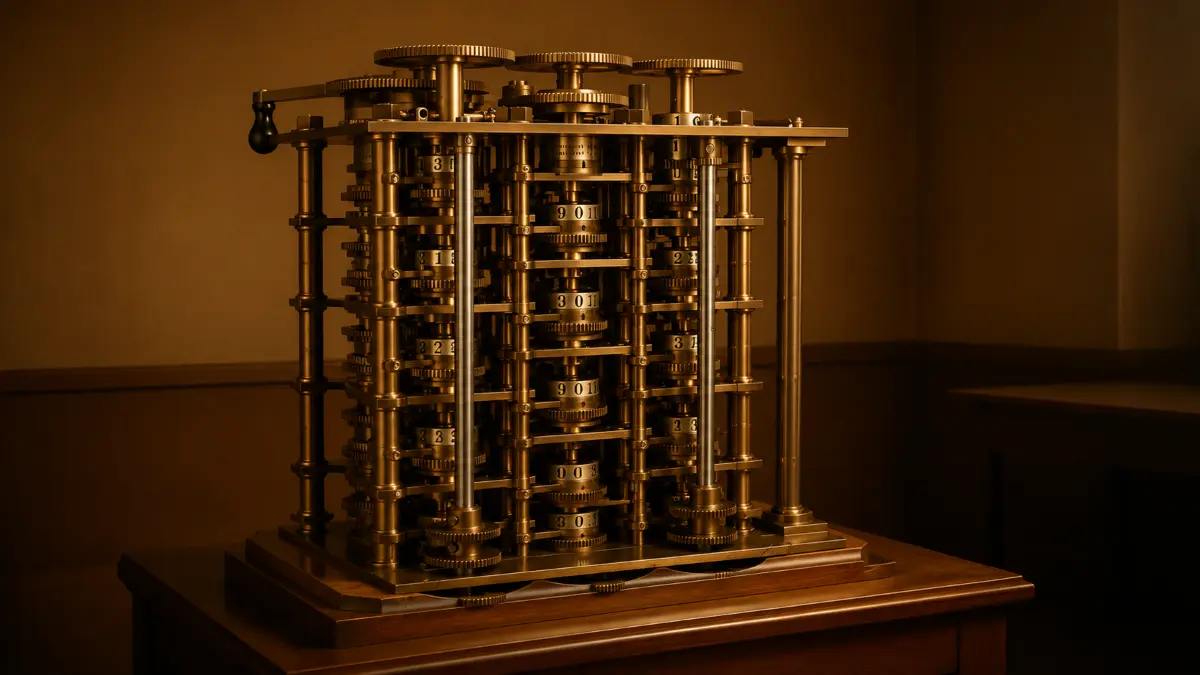

The story of computing didn’t start with silicon chips or digital displays. It began with gears, levers, and mechanical precision. On June 14, 1822, Charles Babbage presented his design for the Difference Engine to the Royal Astronomical Society, marking the first serious attempt to automate complex calculations through machinery. The Difference Engine was not just a curiosity; it was a blueprint for what would eventually become the foundation of modern computing.
Babbage’s Difference Engine was designed to compute polynomial functions using the method of finite differences, a mathematical technique that allowed for the calculation of tables of values without the need for multiplication or division. At a time when human error in manual calculations could lead to costly mistakes in navigation, engineering, and finance, this mechanical calculator promised unprecedented accuracy and reliability. The British government recognized the potential and funded the construction of the machine, although Babbage himself never completed it.
Why did this matter? The Difference Engine tackled a fundamental problem: how to reduce human error and speed up the calculation of mathematical tables. Before this, computations were painstakingly done by hand, often by teams of “computers” who were prone to fatigue and mistakes. Babbage’s machine introduced the concept of automating arithmetic processes mechanically, a radical departure from manual labor. It was a glimpse into a future where machines could handle complex tasks with precision and consistency.
What changed because of this design was less about the immediate impact, since the original Difference Engine was never finished, and more about the ideas it seeded. Babbage’s work inspired the development of the Analytical Engine, a more ambitious design that incorporated programmability, memory, and conditional branching. These concepts prefigured the architecture of modern computers. The Difference Engine itself became a symbol of the potential for mechanical computation, influencing engineers and mathematicians long after Babbage’s time.
The proof of Babbage’s vision came much later. In 1991, a working Difference Engine was constructed using his original plans, demonstrating that his design was not only theoretically sound but practically feasible. This validation underscored the ingenuity of Babbage’s approach and cemented his place as a pioneer of computing technology. The Difference Engine’s legacy is not just in the machine itself but in the idea that complex calculations could be mechanized, a principle that underpins every computer today.
Today, the Difference Engine remains a powerful reminder of how early computing was rooted in mechanical innovation. It shows that the quest to automate and improve calculation has deep historical roots, stretching back to the 19th century. Understanding Babbage’s design helps us appreciate the evolution from mechanical gears to electronic circuits and software algorithms. The Difference Engine still matters because it embodies the spirit of engineering creativity and problem-solving that drives technological progress.
Reflecting on this event, it’s clear that Babbage’s Difference Engine was more than a machine; it was a conceptual leap. It challenged the limits of technology in its era and laid the groundwork for the digital age. The Difference Engine teaches us that innovation often begins with bold ideas that may take decades to realize but ultimately shape the future of technology.