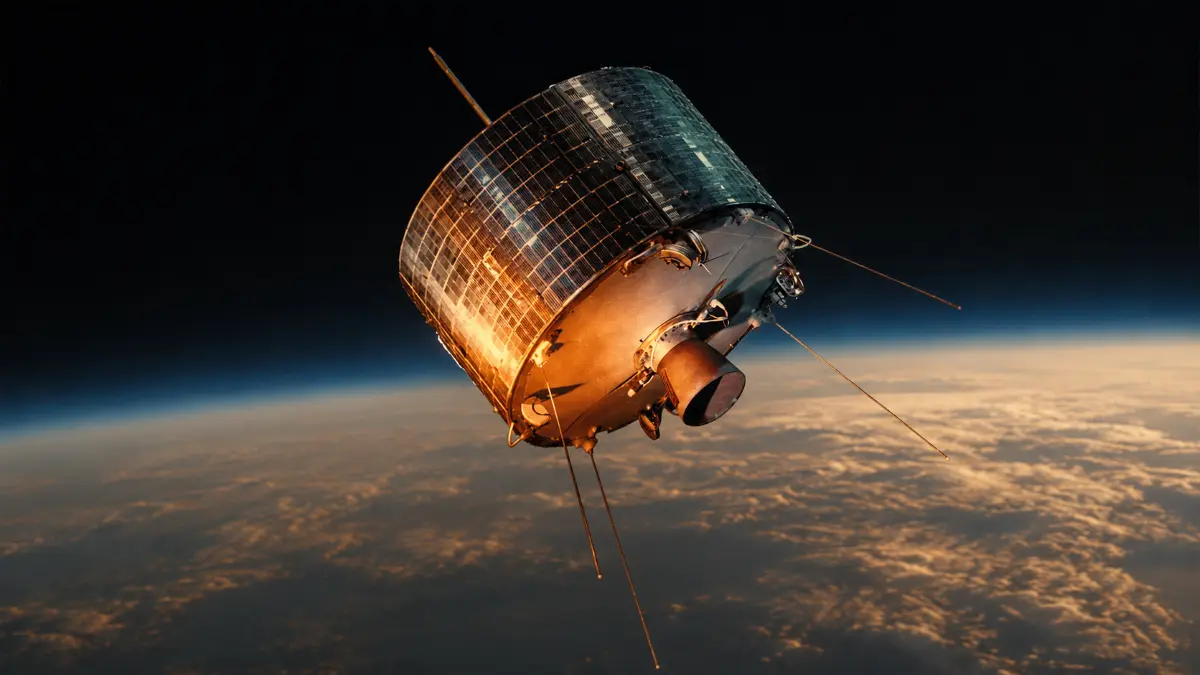

The sky was no longer the limit on June 28, 1965, when Intelsat I, famously nicknamed Early Bird, was activated for service. This wasn’t just another satellite launch. It was the birth of commercial satellite communications, a technology that would reshape how the world connected across continents.
Intelsat I was the first commercial communications satellite, and it quickly proved its worth by carrying the first commercial telephone call between America and Europe. This was a breakthrough in overcoming the physical limitations of undersea cables and radio transmissions. Suddenly, voice communication could be relayed more reliably and with greater clarity across the Atlantic.
Beyond telephone calls, Early Bird also played a critical role in broadcasting. It helped provide television coverage of the Gemini 6 splashdown, bringing live images from space back to Earth in near real-time. This was a glimpse of what satellite technology could do for media, news, and global events.
At the time, the challenge was clear: traditional communication methods were limited by geography, infrastructure, and signal degradation. Intelsat I addressed these problems by orbiting the Earth and relaying signals directly between distant points. This eliminated many of the delays and losses inherent in terrestrial networks.
The satellite’s success laid the groundwork for a global communications network. It demonstrated that satellites could be commercially viable, not just scientific curiosities or military tools. This opened the door for a host of services that rely on satellite technology today, from international phone calls to global broadcasting and data transmission.
What changed because of Early Bird was more than just technology; it was the concept of global connectivity. Businesses could communicate instantly across continents, news could be broadcast live worldwide, and the idea of a connected planet moved from science fiction to reality.
Today, the impact of Intelsat I is still felt. Modern satellite communications underpin everything from internet access in remote areas to GPS navigation and global media distribution. The principles Early Bird proved, reliable, long-distance signal relay via satellite, remain foundational.
Reflecting on this event, Early Bird was more than a satellite; it was a catalyst that expanded the possibilities of communication technology. It showed that the Earth’s orbit could be a platform for connecting people, ideas, and information on a scale never before possible.