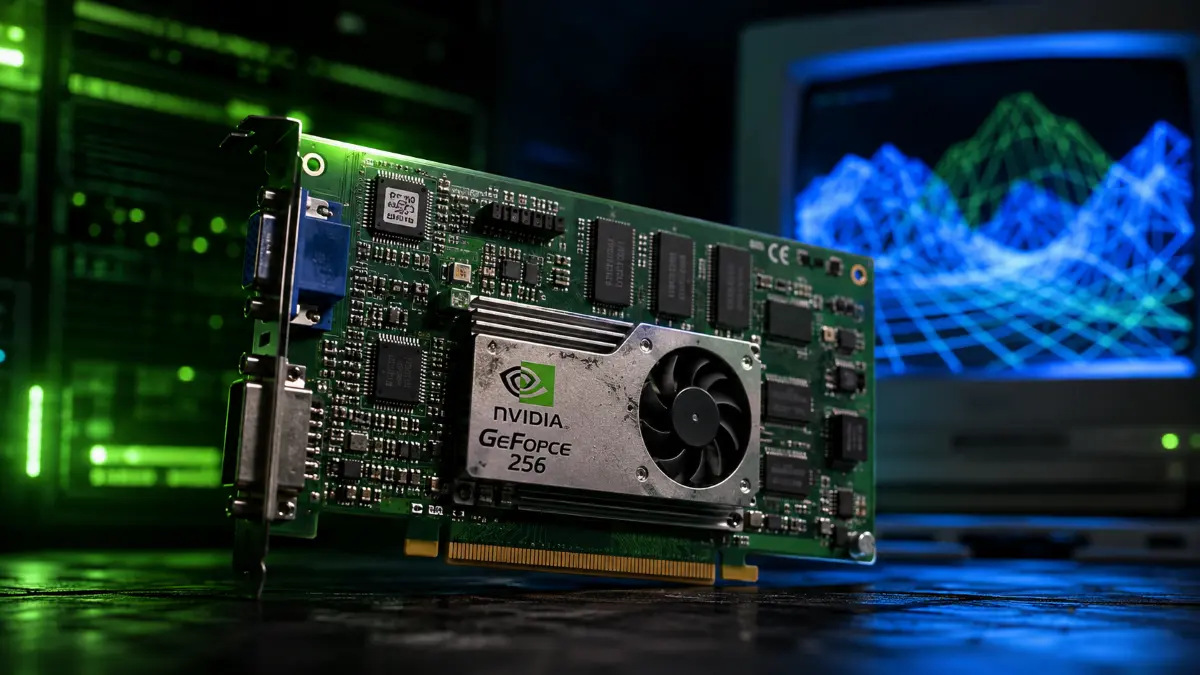

The moment NVIDIA unveiled the GeForce 256 on August 31, 1999, the landscape of computer graphics quietly shifted beneath our feet. This wasn’t just another graphics card release. It was the birth of the GPU as we know it today.
NVIDIA introduced the GeForce 256 and released it on October 11, 1999. Marketed as the world’s first graphics processing unit, the GeForce 256 was designed to handle the complex math tasks that had previously bogged down the computer’s main processor.
Before this, CPUs were tasked with both general computing and graphics calculations, leading to bottlenecks and limited graphical performance. The GeForce 256 changed that by taking over the heavy lifting of transforming and lighting 3D graphics. This offloading allowed computers to render richer visuals and smoother animations without sacrificing overall system speed.
At the time, this was a game-changer for PC gaming and professional graphics work. Suddenly, developers could push the boundaries of visual fidelity, creating more immersive and detailed environments. The GeForce 256 set a new standard, defining what a GPU should do: accelerate graphics through dedicated hardware.
The release of the GeForce 256 also laid the foundation for the modern GPU architecture. It introduced hardware transform and lighting (T&L), a feature that became a baseline for future graphics cards. This innovation enabled graphics cards to handle vertex transformations and lighting calculations independently, tasks that were previously done by the CPU. The result was a significant boost in rendering speed and efficiency.
This shift didn’t just improve gaming. It opened doors for advanced graphics applications in design, simulation, and eventually machine learning. The GPU’s ability to perform parallel processing on large data sets became crucial beyond visuals, influencing fields like AI and scientific computing.
Today, the legacy of the GeForce 256 is clear. Every modern GPU traces its roots back to this chip that first separated graphics processing from general computing. The concept of a dedicated processor for graphics has evolved into a cornerstone of computing hardware, powering everything from high-end gaming rigs to data centers running AI workloads.
The GeForce 256’s introduction is a reminder that sometimes, the most transformative tech innovations come from redefining how a specific task is handled inside a computer. By isolating graphics processing, NVIDIA not only solved a performance problem but also unlocked new possibilities for software and hardware development.
Looking back, the GeForce 256 was more than a product launch; it was a shift in computing strategy. It showed the power of specialization within hardware, a principle that continues to drive innovation across the tech industry today.