
On November 10, 1983, Microsoft unveiled Windows, an ambitious graphical computing environment designed to make IBM-compatible personal computers easier to use. Presented by Microsoft co-founder Bill Gates, the announcement introduced a vision of computing in which users could interact with programs through windows, menus, icons, and a mouse rather than relying entirely on typed commands. Although Windows would not reach consumers until November 20, 1985, the announcement marked the beginning of a software family that would eventually transform desktop computing.
At the time, Microsoft was best known for MS-DOS and programming languages, while graphical user interfaces were still relatively uncommon on mainstream IBM-compatible computers. Systems developed by Xerox and Apple had already demonstrated the possibilities of visual interaction, but Microsoft saw an opportunity to bring similar concepts to the growing market for DOS-based PCs. The challenge was considerable: early personal computers had limited memory, modest processing power, and hardware configurations that varied between manufacturers. Windows would need to operate within those constraints while remaining compatible with the software environment businesses were already adopting.
The November 1983 announcement therefore represented more than the introduction of a new interface. It signaled Microsoft’s intention to expand beyond operating-system commands and programming tools into the way people interacted with computers, establishing a direction that would shape the company’s software strategy for decades.
The Personal Computer Landscape in 1983
By 1983, IBM’s original Personal Computer, introduced in 1981, had helped establish a rapidly expanding market for business-oriented computing. MS-DOS provided a practical operating system for these machines, allowing users to organize files, execute applications, and manage storage devices through typed commands. While effective for experienced users, this approach required familiarity with command syntax and offered limited visual guidance.
Graphical interfaces were not entirely new. Researchers at Xerox PARC had developed influential concepts involving windows, icons, pointing devices, and interactive displays during the 1970s. The Xerox Star, introduced in 1981, brought many of these ideas into a commercial workstation environment, while Apple’s Lisa, released in January 1983, offered a graphical interface with overlapping windows and mouse-driven interaction.
However, these systems were relatively expensive and did not establish graphical computing as the standard experience for the broader IBM-compatible PC market. Most businesses adopting DOS computers continued to rely on command-line environments, even as software developers experimented with more accessible ways to organize and operate applications.
Microsoft recognized that graphical interfaces could eventually become an important part of personal computing. Rather than requiring customers to abandon their existing DOS-based systems, the company planned a graphical environment that would work alongside the software and hardware already becoming established in offices.
What Microsoft Announced on November 10, 1983
Microsoft initially presented Windows as an operating environment for MS-DOS computers. Its purpose was to provide a visual interface through which users could launch applications, organize information, and switch between programs using a mouse and graphical controls.
The announcement emphasized the possibility of running multiple applications within a graphical workspace, an attractive concept at a time when many PC users worked with one primary application at a time. Microsoft also promoted the idea that Windows could provide a more consistent interface across different software products, reducing the need to learn completely different commands for each application.
Windows was designed to support existing DOS-based computing rather than replace MS-DOS outright. This distinction was important because businesses had already invested in software, peripherals, and computer systems built around the DOS environment. Microsoft needed to introduce graphical interaction without making those investments obsolete.
The company initially anticipated a much earlier release, but turning the announcement into a reliable commercial product proved more difficult than expected. Windows faced challenges involving performance, memory requirements, application development, and compatibility with the diverse hardware configurations of the emerging PC-compatible market.
The gap between announcement and release became one of the defining characteristics of the product’s early history.
Why Windows 1.0 Took Two Years to Reach Consumers
When Windows 1.0 finally became commercially available on November 20, 1985, it reflected the technical compromises required to deliver a graphical environment on mid-1980s personal computers.
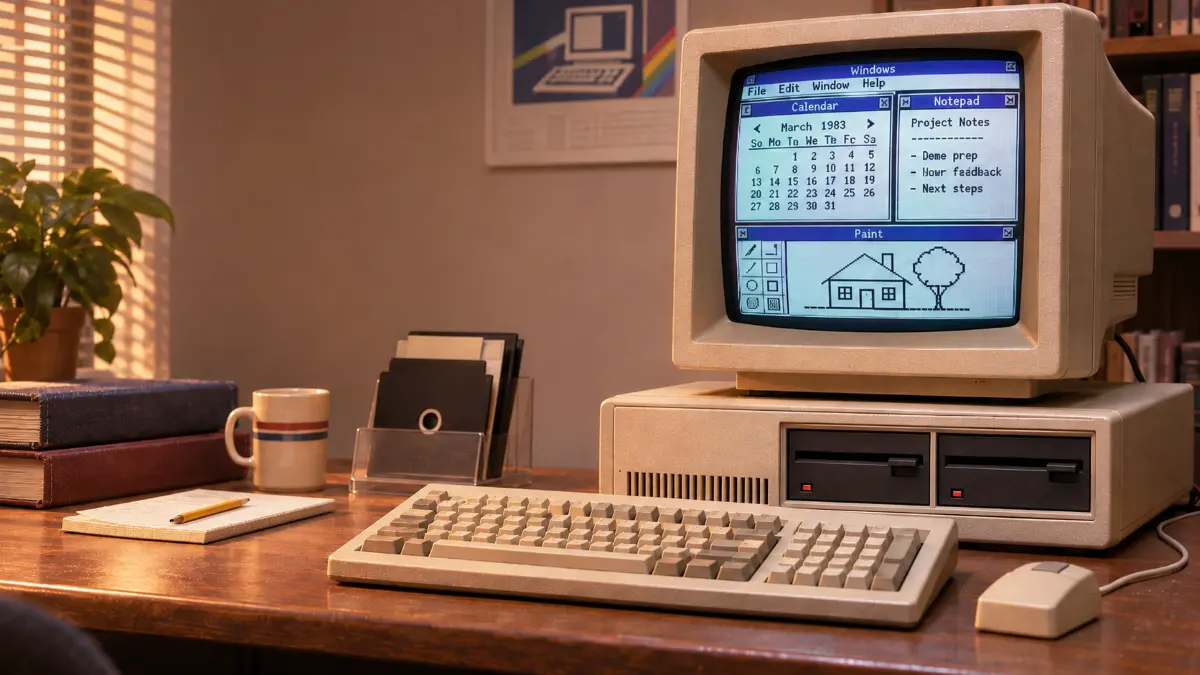
The software operated on top of MS-DOS and used a graphical interface featuring menus, dialog boxes, scroll bars, icons, and mouse-driven controls. Users could open multiple applications and arrange their windows within the available screen space. However, ordinary application windows were primarily tiled rather than freely overlapping, a limitation that distinguished Windows 1.0 from some competing graphical systems.
The environment also included applications such as Calculator, Calendar, Clock, Notepad, Paint, and Write. These programs demonstrated how common computing tasks could be performed through graphical controls, offering a glimpse of the integrated desktop experience that later Windows versions would develop.
Performance remained a challenge. The processors, memory capacities, and graphics hardware available on many personal computers imposed significant limitations on the responsiveness and complexity of graphical software. Mouse adoption was also far from universal, meaning Windows required users to embrace an input device that was not yet standard equipment for many PC owners.
Despite these constraints, Windows 1.0 established an important technical foundation. It provided Microsoft with a platform for developing graphical applications, improving multitasking capabilities, and refining the relationship between the user interface and the underlying operating system.
A Difficult Beginning for a Future Industry Standard
Windows 1.0 was not an immediate commercial breakthrough. Its limited software ecosystem, hardware demands, and unfamiliar interface prevented it from rapidly replacing conventional DOS applications. Many users continued working directly in MS-DOS, while businesses remained cautious about adopting graphical software that required additional resources without always providing clear productivity advantages.
Microsoft continued refining the platform. Windows 2.0, released in 1987, introduced improvements including support for overlapping application windows, while later versions expanded memory management, graphical capabilities, and application compatibility.
The major turning point arrived with Windows 3.0 in 1990, which delivered substantial improvements in usability, performance, and application support. Windows 3.1 followed in 1992, further strengthening the platform’s position in business and home computing.
By the time Windows 95 arrived, graphical computing had become a mainstream expectation for personal computers. Its Start menu, taskbar, and more integrated desktop environment represented a significant evolution from the comparatively limited interface Microsoft had announced in 1983.
This progression illustrates why the original Windows announcement matters. The significance of November 10 was not that Microsoft immediately transformed computing, but that it committed to a technological direction that required years of refinement before achieving widespread adoption.
How Windows Helped Redefine Software Development
As Windows matured, its influence extended beyond the appearance of the desktop. The platform provided developers with graphical programming interfaces and increasingly standardized methods for building applications that could interact with windows, menus, input devices, and system services.
This encouraged software companies to create applications that shared familiar interaction patterns, reducing the learning curve for users moving between different programs. Instead of every application requiring its own approach to screen management and user interaction, developers could increasingly rely on common platform capabilities.
Windows also contributed to the growth of the graphical software ecosystem. Word processors, spreadsheets, database tools, design applications, and eventually internet browsers became closely associated with the Windows desktop. The increasing availability of applications reinforced the platform’s popularity, while the growing installed base encouraged additional developers to support it.
However, Windows did not establish graphical interface principles on its own. Many concepts associated with modern desktop computing originated in earlier research and commercial systems. Microsoft’s contribution was to develop and commercialize those ideas within the expanding IBM-compatible PC ecosystem, helping graphical interaction become a familiar experience for millions of users.
The broader industry continued evolving through competition among Microsoft, Apple, and other software developers, with each platform introducing capabilities that influenced subsequent interface design.
The Legacy of the Original Windows Announcement
More than four decades after Microsoft’s November 1983 announcement, the principles behind graphical desktop computing remain visible in modern operating systems. Windows, icons, menus, pointers, application switching, and visual file management continue to shape how people interact with computers, even as touchscreens, voice assistants, and artificial intelligence introduce additional methods of interaction.
The Windows software family itself has undergone major architectural transformations. Early consumer versions depended heavily on MS-DOS, while modern Windows systems are based on the Windows NT architecture, which developed along a separate technical path. Despite these changes, the broader objective of making complex computing capabilities accessible through a consistent interface remains central to the platform.
The original announcement also provides a useful reminder that influential technologies rarely achieve their full impact immediately. Windows required years of engineering, commercial development, and software ecosystem growth before becoming a dominant desktop platform.
What began as a graphical extension to DOS eventually became one of the most recognizable software families in computing history, influencing how businesses operate, how developers create applications, and how users interact with digital information.
The Announcement That Started a New Chapter for Microsoft
Looking back at November 10, 1983, Microsoft’s Windows announcement stands as an important milestone in the evolution of personal computing. The company did not invent graphical interfaces, nor did it immediately replace the command line. Instead, it identified an opportunity to make graphical interaction available across the growing market for IBM-compatible computers.
The first commercial release arrived two years later, and several more years passed before Windows achieved widespread success. Nevertheless, the original announcement established a strategic direction that would transform Microsoft’s business and influence the broader software industry.
On November 10, 1983, Microsoft introduced a vision of personal computing built around visual interaction rather than typed commands alone. It would take years for that vision to mature, but the announcement marked the beginning of a journey that helped make graphical desktop computing an everyday experience.