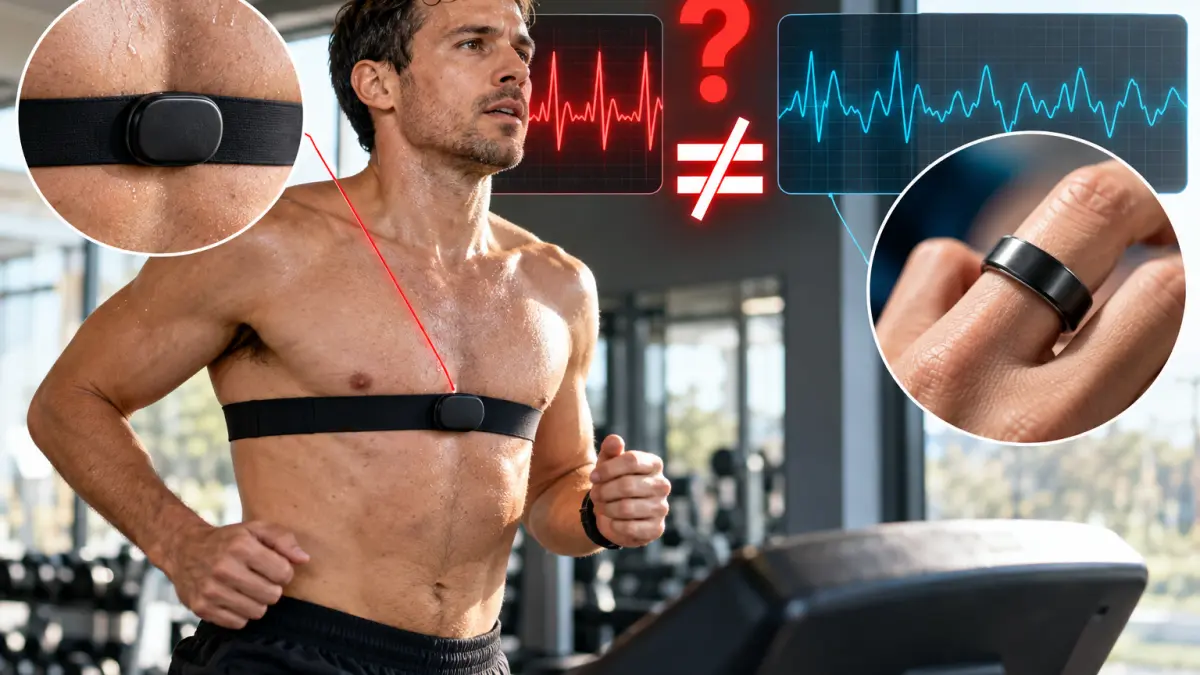

Heart rate variability (HRV) is a valuable metric for fitness enthusiasts and athletes, offering insights into recovery, stress, and overall cardiovascular health. With the rise of wearable technology, smart rings have become popular for their convenience and continuous monitoring capabilities. But can these rings measure HRV as accurately as traditional chest strap monitors during exercise?
Claim: Smart rings can measure heart rate variability as accurately as chest strap monitors during exercise.
Quick answer: Smart rings using PPG sensors generally do not match the accuracy of ECG-based chest strap monitors for heart rate variability during exercise.
Chest strap monitors typically use electrocardiogram (ECG) sensors to detect the electrical signals generated by the heart. This method captures precise timing of heartbeats, which is critical for accurate HRV measurement. In contrast, smart rings rely on photoplethysmography (PPG) sensors that use light to detect blood volume changes in the finger. While PPG sensors have improved significantly, their accuracy can be influenced by motion, skin contact, and ambient light, especially during physical activity.
Comparing PPG Sensors in Smart Rings and ECG Chest Straps
ECG chest straps are considered the gold standard for HRV monitoring during exercise due to their direct measurement of cardiac electrical activity. This allows for high-resolution detection of beat-to-beat intervals, which is essential for reliable HRV analysis. PPG sensors in smart rings, however, infer heartbeats indirectly by measuring blood flow changes, which introduces potential delays and noise.
During intense or dynamic exercise, motion artifacts and variable pressure on the sensor can degrade PPG signal quality. This often leads to less consistent HRV readings compared to ECG-based chest straps. Additionally, the finger’s peripheral circulation can be more susceptible to changes in temperature and movement, further complicating accurate measurement.
Why This Matters for Fitness Enthusiasts
For those relying on HRV to guide training intensity and recovery, data accuracy is crucial. While smart rings offer comfort and 24/7 wearability, their HRV readings during exercise may not provide the level of precision needed for detailed training decisions. Chest strap monitors, despite being less convenient, deliver more reliable HRV data during workouts.
That said, smart rings remain useful for tracking HRV trends at rest or during low-intensity activities, where motion artifacts are minimal. Users should consider the context in which they want to measure HRV and choose devices accordingly.
Practical Takeaway
If your primary goal is accurate HRV measurement during exercise, ECG-based chest strap monitors are the preferred choice. Smart rings can complement this by providing convenient daily monitoring but may not replace chest straps for workout-specific HRV data. Understanding the strengths and limitations of each sensor type helps fitness enthusiasts select the right device for their needs.