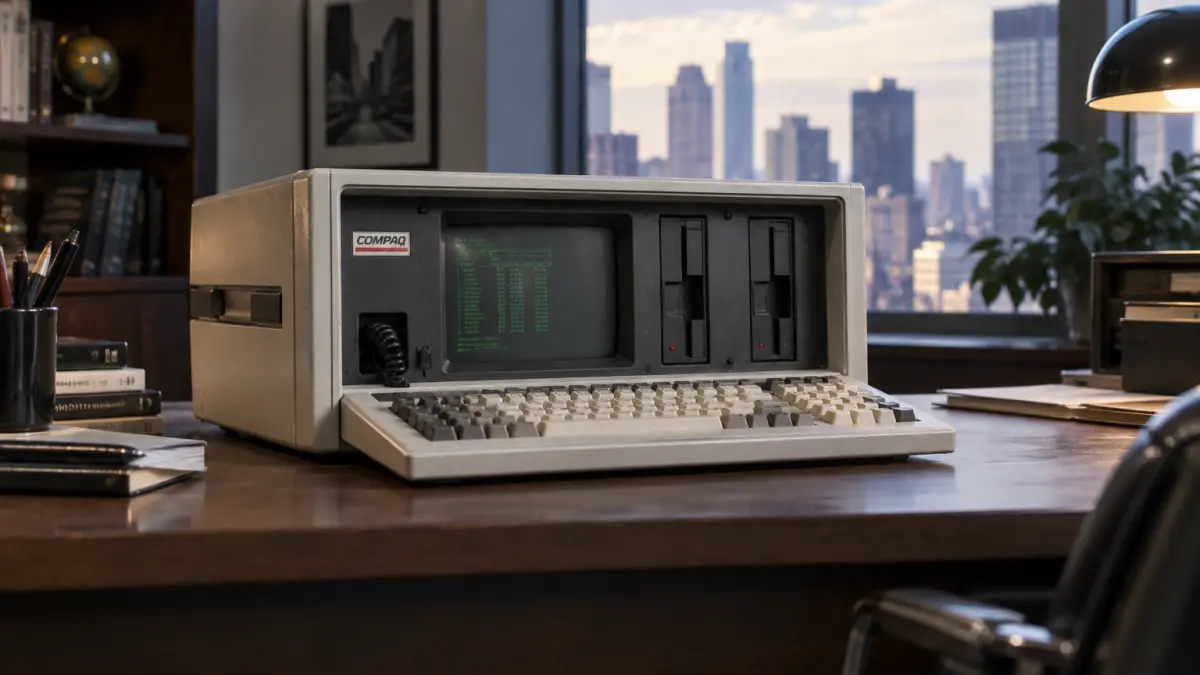

On November 4, 1982, Compaq Computer Corporation announced the Compaq Portable, a groundbreaking machine that would become the world’s first commercially successful portable IBM PC-compatible clone. At a time when IBM dominated the emerging business computing market, the young Texas company demonstrated that another manufacturer could build a computer capable of running IBM PC software without copying IBM’s proprietary BIOS code.
The announcement marked a turning point in personal computing. Although portable computers already existed, Compaq combined transportability with an independently developed, highly compatible BIOS, allowing businesses to use familiar applications on hardware from a competing manufacturer. When the machine reached customers in March 1983, its commercial success helped accelerate the rise of the IBM-compatible PC industry.
A New Company Takes on IBM
Compaq was founded in 1982 by Rod Canion, Jim Harris, and Bill Murto, three former Texas Instruments employees who recognized an opportunity in the emerging personal computer market. Their company’s name reflected two guiding principles: compatibility and quality. Rather than attempting to introduce an entirely new computing platform, the founders wanted to build a machine that could participate in the rapidly expanding ecosystem surrounding IBM’s Personal Computer.
IBM had introduced its original PC in August 1981, bringing the company’s established reputation into a market previously dominated by smaller computer manufacturers. Its architecture used widely available components, including Intel’s 8088 processor, while Microsoft supplied the PC DOS operating system. This approach encouraged independent developers to create software and expansion hardware for the platform, helping make IBM compatibility increasingly valuable to businesses.
However, building a computer with similar components and an operating system from Microsoft did not automatically guarantee that IBM PC software would work correctly. Many applications interacted directly with hardware or relied on specific BIOS functions. Even relatively small differences could cause programs to malfunction, making reliable compatibility a significant technical challenge for competing manufacturers.
Compaq recognized that businesses were not simply purchasing computers. They were investing in software, employee training, and established workflows. A compatible alternative could offer customers greater flexibility without forcing them to abandon those investments.
The Clean-Room BIOS Breakthrough
The most important engineering challenge involved the Basic Input/Output System, or BIOS. This firmware provided low-level services for starting the computer and communicating with essential hardware. IBM’s BIOS implementation was protected by copyright, meaning competitors could not simply copy its program code into their own machines.
Compaq addressed the problem through clean-room reverse engineering, a development approach designed to reproduce the necessary behavior of a system without copying its protected implementation. Engineers analyzed the functions and behavior expected by IBM-compatible software, while separate developers produced original code implementing those requirements. The objective was to achieve compatibility through independently written software rather than unauthorized duplication.
The effort reportedly cost approximately $1 million, a substantial investment for a newly established company. But the expense addressed a problem that went far beyond one product. A computer capable of reliably executing IBM PC applications could compete on hardware design, pricing, support, and other features while preserving customers’ existing software investments.
Compaq also licensed Microsoft’s MS-DOS operating system, allowing its machine to run the DOS-based applications becoming central to business computing. Together, the licensed operating system, compatible hardware, and independently developed BIOS made the Portable a credible alternative to IBM’s own machines.
The distinction was legally important. Copyright protected IBM’s original BIOS code, but that did not automatically give IBM exclusive control over every independently developed computer capable of performing equivalent functions. Compaq’s approach demonstrated a practical route toward compatibility while respecting the intellectual property embodied in IBM’s implementation.
A Portable Computer Built for Business
When the Compaq Portable reached customers in March 1983, it offered a distinctive combination of transportability and familiar PC functionality. Weighing approximately 28 pounds (12.7 kilograms), the machine was hardly portable by modern standards. Its suitcase-like enclosure incorporated a carrying handle, while the keyboard detached from the front to reveal a built-in monitor and floppy disk drive.
Inside was an Intel 8088 processor operating at 4.77 MHz, the same clock speed used by the original IBM PC. The base configuration included 128 KB of RAM, expandable to 640 KB, and a 9-inch monochrome CRT display. Customers could purchase a single-drive configuration for $2,995, while a more expensive version offered two floppy disk drives.
The computer required an external electrical outlet and did not operate like a modern battery-powered laptop. Its portability meant that users could move a complete computer between locations without transporting a separate monitor, keyboard, and desktop system unit. For business professionals, consultants, and organizations needing computing capabilities outside a fixed office, this represented a meaningful advantage.
The Compaq Portable was not the first transportable personal computer. The Osborne 1, introduced in 1981, had already demonstrated demand for self-contained machines that could be carried between locations. Compaq’s distinguishing feature was its compatibility with the IBM PC ecosystem, enabling customers to use familiar business applications on a computer designed for easier transportation.
That compatibility gave the product a practical purpose beyond its unusual physical design. Users could move between IBM desktop computers and Compaq systems while retaining access to much of the same software environment, an important consideration when businesses were beginning to standardize their computing operations.
The Commercial Success That Validated PC Compatibility
The market response demonstrated the value of Compaq’s strategy. During 1983, the company sold approximately 53,000 computers and generated around $111 million in revenue, an extraordinary first-year performance for a newly established technology manufacturer. The Compaq Portable became one of the earliest major commercial successes among IBM-compatible personal computers. <Cite refs={[“turn581466search0″,”turn581466search4″,”turn581466search13”]}/>
Its success showed that customers were willing to purchase IBM-compatible systems from companies other than IBM, provided those machines delivered dependable performance and access to existing software. This helped change the competitive dynamics of personal computing. Instead of relying on a single manufacturer, buyers could increasingly evaluate computers based on price, reliability, design, service, and performance.
Other companies had already explored IBM compatibility, and Compaq was not the first manufacturer to produce an IBM-compatible machine. Nevertheless, its combination of strong compatibility, professional engineering, and commercial execution helped establish the viability of the broader clone market.
As additional manufacturers entered the industry, the IBM PC architecture gradually evolved into a de facto standard supported by numerous independent hardware vendors. The growing market also benefited Microsoft, Intel, software developers, and peripheral manufacturers, whose products could reach customers across an expanding range of compatible systems.
Ironically, the success of IBM’s original PC architecture helped create a competitive environment in which IBM would eventually lose much of its control over the platform it had popularized.
How Compaq Helped Transform the PC Industry
The long-term importance of the Compaq Portable extended well beyond transportable computing. Its success reinforced a business model in which different manufacturers could build systems around a shared software and hardware ecosystem. This encouraged competition and helped accelerate improvements in processing power, memory capacity, storage, graphics, and system design.
Compaq continued developing IBM-compatible computers throughout the 1980s, eventually becoming one of the industry’s leading manufacturers. In 1986, the company introduced the Deskpro 386, bringing Intel’s 80386 processor to a commercially available PC before IBM introduced its own 386-based personal computer. The achievement demonstrated how the balance of innovation had shifted: compatible manufacturers were no longer limited to following IBM’s product decisions.
The expanding PC-compatible market also influenced the software industry. Developers increasingly targeted the broader IBM-compatible ecosystem rather than a single manufacturer’s machines. This encouraged software portability across competing hardware brands and contributed to the growth of standardized business computing environments.
The system was not open in every sense. The emerging PC ecosystem still depended on proprietary software, licensed technologies, and manufacturer-specific components. Its significance was that compatibility became achievable across competing products, allowing the market to develop beyond IBM’s direct control.
This distinction remains important today. Technical interoperability does not necessarily require every component of a platform to be open source or freely licensed. It can also emerge through documented interfaces, common standards, licensed technologies, and independently developed compatible implementations.
The Legacy of a Computer That Challenged the Standard
More than four decades after its announcement, the Compaq Portable remains an important milestone in the history of personal computing. Its bulky enclosure, monochrome display, and floppy disk storage now belong to another technological era, but the engineering problem it addressed remains familiar: how can a new product work reliably within an established ecosystem without simply reproducing another company’s protected technology?
That question continues to influence discussions about software compatibility, interoperability, platform competition, and reverse engineering. From alternative operating systems and compatible file formats to replacement hardware and independently developed software implementations, the ability to work within an existing technological environment can determine whether new competitors succeed.
Compaq’s story also illustrates why technical progress is not always defined by inventing an entirely new category of device. Sometimes the breakthrough comes from removing a barrier that prevents existing technologies from working together. The Compaq Portable made the IBM PC ecosystem more competitive by demonstrating that compatibility could be engineered independently and delivered in a commercially successful product.
On November 4, 1982, Compaq announced more than a portable computer. It introduced a product that helped loosen IBM’s grip on the emerging PC standard, proving that compatibility could become a foundation for competition rather than a barrier to it. The result helped shape the diverse personal computer industry that followed.