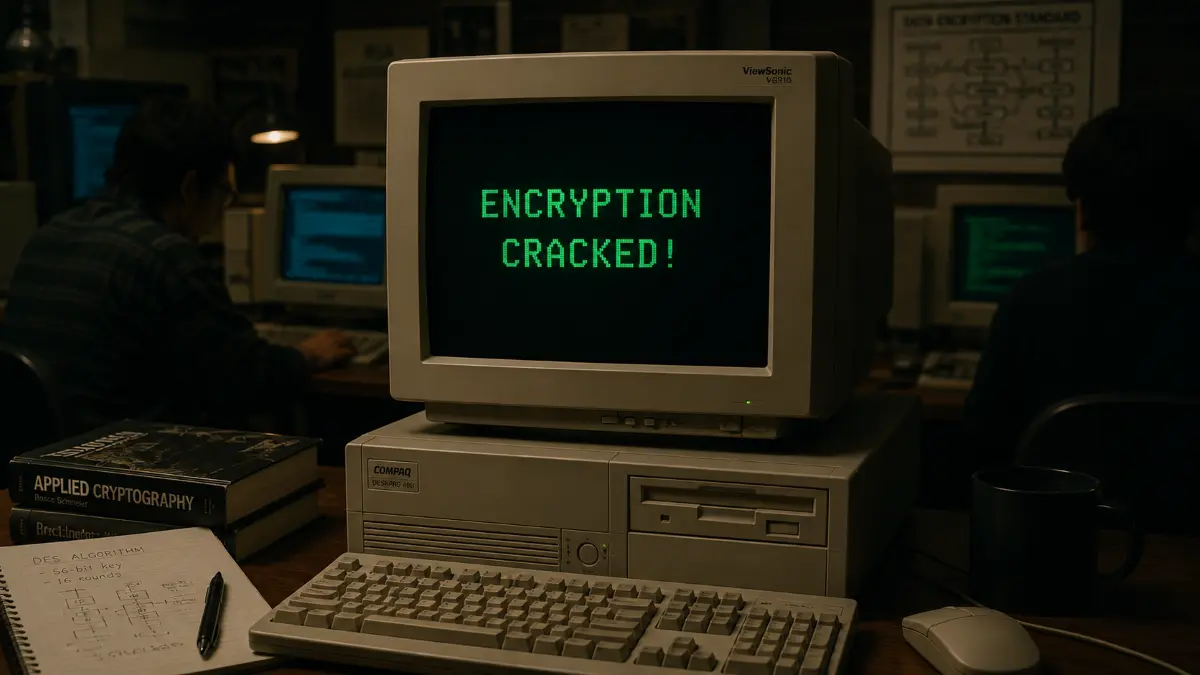

The quiet hum of early internet forums gave way to a defining moment in digital security on June 17, 1997. A group of users, collaborating across the web, cracked the Data Encryption Standard (DES). This wasn’t just a technical feat; it was a direct challenge to the United States’ approach to encryption regulation and a signal flare for the future of cryptography.
At the time, DES was the strongest encryption software legally exportable from the US. It was the gold standard for securing digital communications, financial transactions, and sensitive data. But behind the scenes, the US government restricted the export of stronger encryption tools, fearing they could aid terrorists or hostile actors. This led to a paradox: while American companies were forced to use weaker encryption abroad, foreign nations had access to far more robust systems. The 1997 cracking of DES exposed the vulnerability of these restrictions and questioned the real security DES could provide.
The group’s success came after just five months of coordinated effort, demonstrating that DES’s 56-bit key length was no longer sufficient to withstand determined attacks. This was not merely a win for cryptographers; it was a wake-up call. The event underscored the growing power of distributed computing and the internet’s ability to mobilize resources and expertise at scale. It showed that encryption could no longer be a secret guarded by governments, it was a global concern subject to public scrutiny and rapid technological evolution.
What changed after the DES cracking was profound. The US government had to reconsider its stance on encryption export controls, eventually relaxing some restrictions. This shift allowed stronger encryption technologies to spread more freely, enabling better security for global commerce and communication. More importantly, the event accelerated the development and adoption of more secure encryption standards, like the Advanced Encryption Standard (AES), which replaced DES as the new benchmark.
The implications of this event still ripple through today’s digital landscape. The debate over encryption controls continues, with governments balancing national security concerns against privacy and commercial needs. The 1997 DES crack remains a case study in how technological capability can outpace regulation, forcing policy to catch up. It also highlights the importance of transparency and collaboration in cryptography, as public scrutiny drives stronger, more resilient security measures.
In a world where data breaches and cyber threats are daily headlines, the lessons from cracking DES resonate clearly. It reminds us that no encryption standard is invincible and that security must evolve continuously. The event also exemplifies the power of collective intelligence and the internet as a platform for innovation and challenge.
Looking back, the cracking of DES was not just about breaking a code. It was about breaking assumptions, about control, security, and the future of digital trust. It set the stage for a more open, dynamic conversation about encryption that shapes how we protect information in an increasingly connected world.