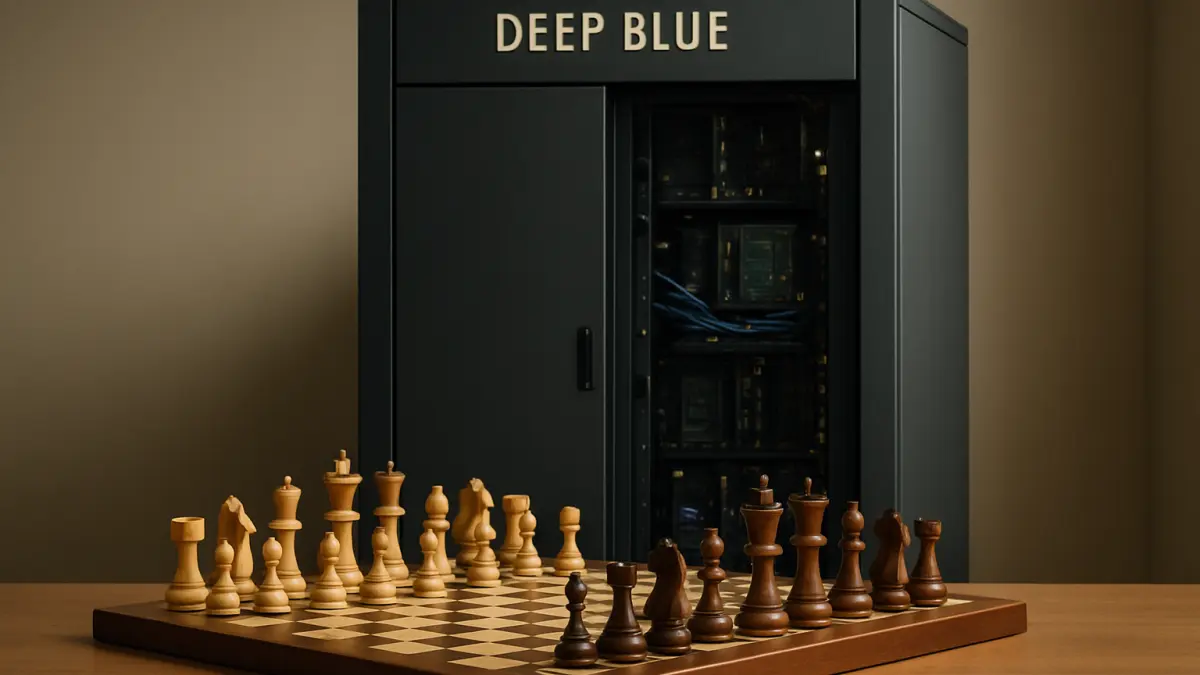

The clash between man and machine reached a new level on May 11, 1997, when Deep Blue, a chess-playing supercomputer, defeated Garry Kasparov in the last game of their rematch. This was not just another match; it was the first time a computer bested a reigning world chess champion in a classic match format. The event was a defining moment in computing history, signaling a shift in what machines could achieve in complex strategic thinking.
Deep Blue’s victory mattered because it shattered long-held assumptions about artificial intelligence and human intellect. Chess, with its nearly infinite possibilities and reliance on intuition and foresight, was considered a domain where humans held a clear advantage. By overcoming Kasparov, Deep Blue demonstrated that brute computational power combined with sophisticated algorithms could rival and surpass expert human decision-making in real time.
At the time, Deep Blue’s success was a breakthrough in parallel processing and heuristic evaluation. The supercomputer evaluated up to 200 million positions per second, a feat impossible for human players. This raw processing speed, paired with advanced search algorithms, allowed Deep Blue to anticipate and counter Kasparov’s strategies with unprecedented precision. It was a practical showcase of how specialized hardware and software could tackle problems that required deep analysis and foresight.
The impact of this event extended far beyond chess. It accelerated research into AI, machine learning, and high-performance computing. Deep Blue’s architecture influenced how future systems were designed to handle complex decision trees and pattern recognition tasks. The match also sparked debates about the role of AI in society and the boundaries between human and machine intelligence. It forced technologists and ethicists alike to reconsider the potential and limitations of AI.
Today, Deep Blue’s victory still matters as a foundational case study in AI development. It laid the groundwork for modern AI systems that now assist in everything from medical diagnostics to autonomous vehicles. While current AI models rely more on neural networks than brute-force computation, the principles demonstrated by Deep Blue, combining raw power with strategic heuristics, remain relevant. The event is a reminder that AI’s evolution is a layered process, building on past innovations to tackle increasingly complex challenges.
Reflecting on this moment, it’s clear that Deep Blue’s win was not just about chess. It was about expanding the frontier of what machines could do and how they could augment human capabilities. The match symbolized a turning point where technology crossed a threshold, moving from simple automation to genuine cognitive competition. That legacy continues to shape the digital landscape we navigate today.