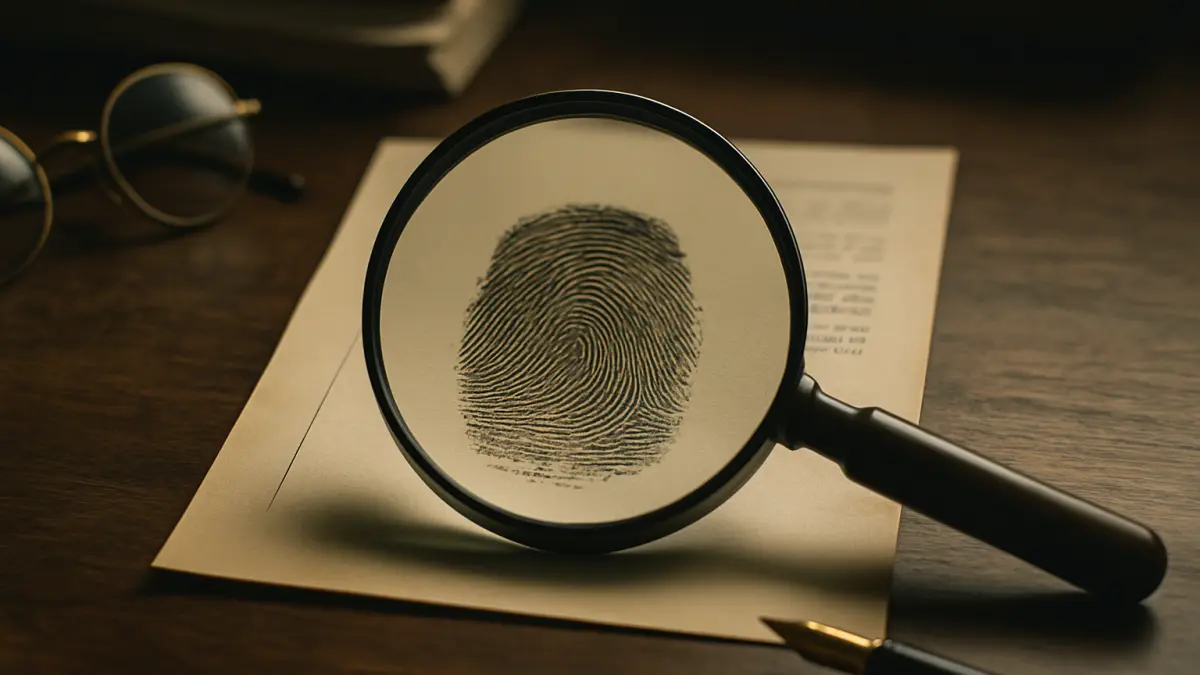

Imagine a courtroom in London, 1905, where the fate of two men hinged not on eyewitness accounts or circumstantial evidence, but on the unique patterns etched into their fingertips. On May 5, 1905, the Stratton Brothers case began its trial, marking the first time fingerprint evidence was used to secure a conviction for murder. This moment wasn’t just a legal milestone; it was a turning point in forensic technology.
Before this trial, fingerprinting was largely a tool for identification in administrative contexts, like police records or immigration. But the Stratton Brothers case proved fingerprints could serve as hard evidence in court, directly linking suspects to a crime scene. This was a seismic shift in how evidence was evaluated, moving the needle from subjective testimony to objective, scientific proof.
Why did this matter so much at the time? The criminal justice system was grappling with the limits of traditional evidence. Eyewitnesses could be unreliable, alibis fabricated, and physical evidence often ambiguous. Fingerprint evidence introduced a new standard of certainty. It solved a critical problem: how to uniquely and irrefutably connect a person to a crime scene without relying on fallible human memory or testimony.
The implications were immediate and profound. The successful use of fingerprint evidence in the Stratton Brothers trial paved the way for forensic science to become a cornerstone of modern law enforcement. Police departments worldwide began investing in fingerprint databases and training officers in fingerprint collection and analysis. The technology also spurred advancements in crime scene investigation techniques, encouraging a more rigorous and scientific approach to evidence gathering.
What changed because of this trial is still felt today. Fingerprint evidence remains a fundamental tool in criminal investigations and courtrooms around the globe. It set the stage for the broader adoption of forensic science disciplines, from DNA analysis to digital forensics. The principle behind fingerprinting, that unique biological markers can identify individuals with near certainty, underpins many modern biometric systems used in security and personal identification.
Even as technology evolves, the 1905 Stratton Brothers case reminds us of the power of scientific evidence to reshape justice. It underscores the importance of developing reliable, objective tools to support legal processes. In an era where digital data and AI increasingly influence investigations, the fingerprint trial stands as an early example of technology enhancing truth and accountability.
Reflecting on this event, it’s clear that the introduction of fingerprint evidence was not just about solving one murder. It was about building trust in the justice system through science. It showed that technology, when applied rigorously, can elevate the standards of proof and fairness in society. That legacy continues to guide forensic innovation today.