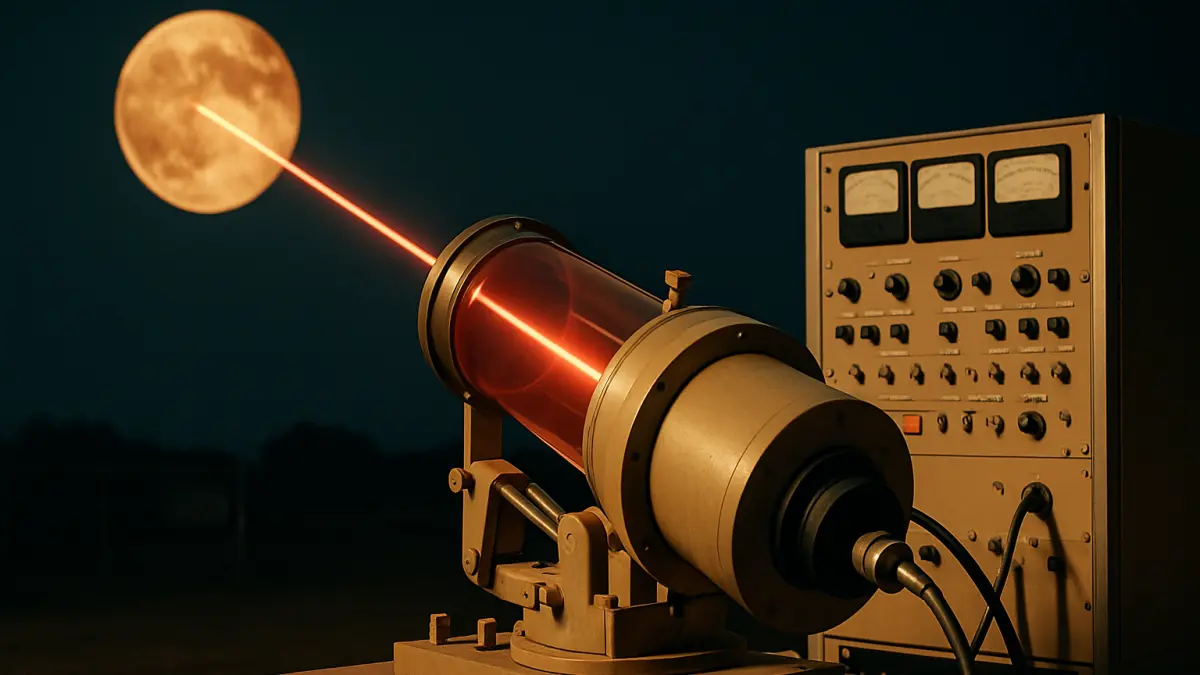

Imagine a beam of light traveling nearly 240,000 miles, striking the Moon, and returning to Earth. That’s exactly what happened on May 9, 1962, when MIT researchers led by Louis Smullin and Giorgio Fiocco successfully bounced a laser beam off the Moon for the first time. This was not just a dazzling scientific stunt, it was a breakthrough that pushed the boundaries of precision measurement and space communication.
At the time, radar was the dominant technology for measuring distances in space, but it had its limits. Radar signals are relatively long-wavelength and scatter easily, which restricted accuracy. The laser beam bounced off the Moon represented a leap forward. Lasers produce coherent, monochromatic light, which means the beam stays tight and focused over vast distances. This property allowed for much higher precision in measuring the distance to the Moon, a problem that had challenged scientists for decades.
The immediate impact was profound. By timing the round-trip travel of the laser pulse, researchers could calculate the Earth-Moon distance with unprecedented accuracy. This refined data improved our understanding of lunar orbit dynamics and gravitational interactions. It also laid the groundwork for laser ranging experiments that would later test fundamental physics principles, such as Einstein’s theory of general relativity.
Beyond the Moon, this experiment was a proof of concept for laser communication and remote sensing technologies. The ability to send and receive laser signals over such a distance showed that laser-based communication could be viable for space missions. This was a crucial insight for future satellite communication systems and deep-space probes, where bandwidth and signal clarity are critical.
Today, the legacy of that 1962 achievement remains relevant. Lunar laser ranging is still used to monitor the Moon’s orbit with millimeter precision, providing data for geophysics, lunar science, and even climate studies. The experiment also inspired the development of laser altimeters and LIDAR systems, which have become essential in mapping planetary surfaces and Earth’s terrain with high resolution.
Moreover, the principle demonstrated by bouncing a laser beam off the Moon underpins modern optical communication networks. Fiber-optic cables, which rely on laser light to transmit data over long distances with minimal loss, owe much to the early understanding of laser propagation and reflection. The experiment also hinted at the potential for laser-based communication links in space, a field that continues to evolve with projects aiming to replace radio waves with lasers for faster, more secure data transfer.
Reflecting on this event, it’s clear that the MIT researchers did more than just bounce light off a celestial body. They opened a door to a new era of precision measurement and optical communication. Their work remains a cornerstone in the ongoing quest to connect and understand our universe with ever greater clarity.