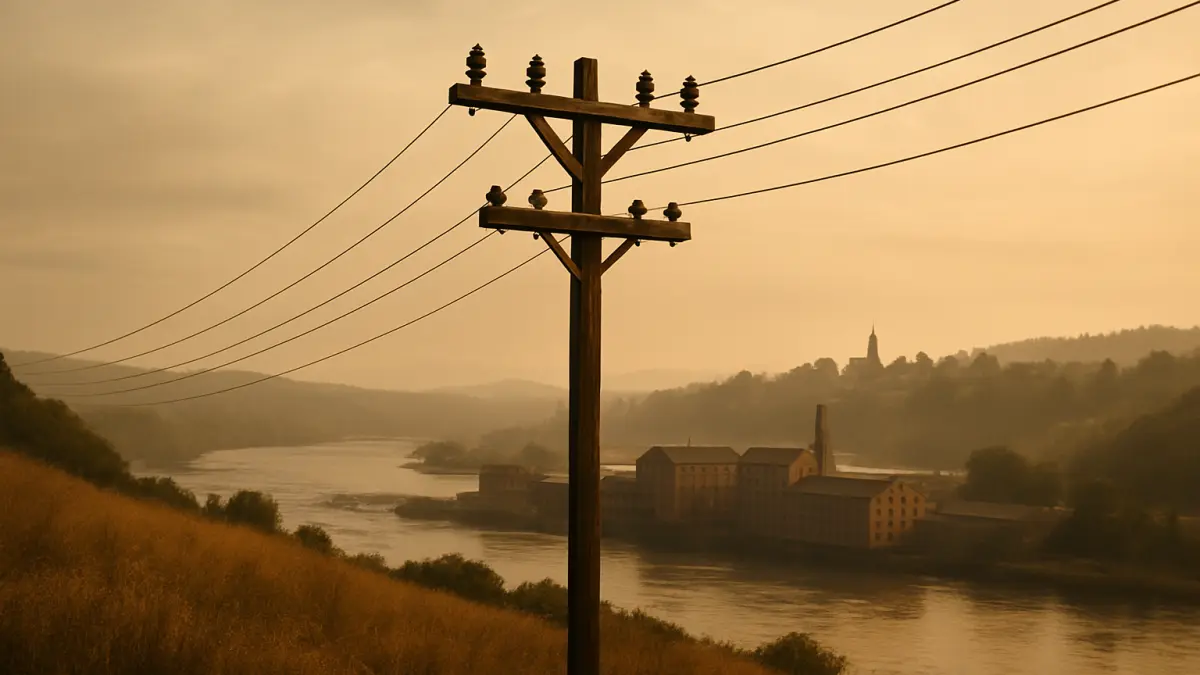

Power doesn’t just happen. It travels, and how it travels shapes everything from industry to daily life. On June 3, 1889, the United States saw its first long-distance electric power transmission line completed, stretching 14 miles from a generator at Willamette Falls to downtown Portland, Oregon. This wasn’t just a new cable in the ground; it was a technical leap that redefined how electricity could be harnessed and distributed.
Before this event, electric power was largely local. Generators powered nearby factories or neighborhoods, limited by the inefficiencies and losses that come with transmitting electricity over distance. The Willamette Falls project shattered that boundary, proving that electricity could be generated remotely and delivered reliably across miles. This was a crucial step in moving power generation away from urban centers and toward more optimal natural resources like waterfalls or coal fields.
The technical challenge was significant. Electrical resistance in wires causes power loss, and early systems struggled to maintain voltage over distance. The Willamette Falls line demonstrated that with proper engineering, careful voltage regulation, conductor materials, and system design, electricity could be transmitted efficiently enough to be commercially viable. This project tackled the problem of distance head-on, setting a precedent for future grids.
At the time, this transmission line was more than infrastructure; it was a proof of concept that expanded the possibilities of electric power. It enabled Portland to tap into a renewable energy source, hydropower from Willamette Falls, without the need for local generation plants. This separation of generation and consumption sites laid the groundwork for the modern electric grid, where power plants feed electricity into a vast network that spans regions and states.
The ripple effects were immediate and lasting. This project influenced how utilities planned their networks, encouraging the development of centralized generation facilities located near abundant energy sources. It also accelerated the adoption of alternating current (AC) systems, which are better suited for long-distance transmission than direct current (DC). The Willamette Falls line was a stepping stone toward the complex, interconnected grids that power cities today.
Why does this still matter? Today’s energy challenges, integrating renewable sources, managing grid stability, and reducing transmission losses, trace their roots back to these early experiments in long-distance power delivery. The principles proven by the 1889 line remain relevant as we build smarter grids and expand clean energy infrastructure. Understanding this event helps us appreciate the engineering feats behind our modern power systems and the ongoing quest to deliver electricity efficiently and sustainably.
Looking back at June 3, 1889, it’s clear this was not just a local achievement but a foundational moment in electrical engineering. It marked the beginning of a new era where distance was no longer a barrier to power access. The Willamette Falls transmission line was the first chapter in a story that continues to evolve as technology pushes the boundaries of what’s possible in energy delivery.