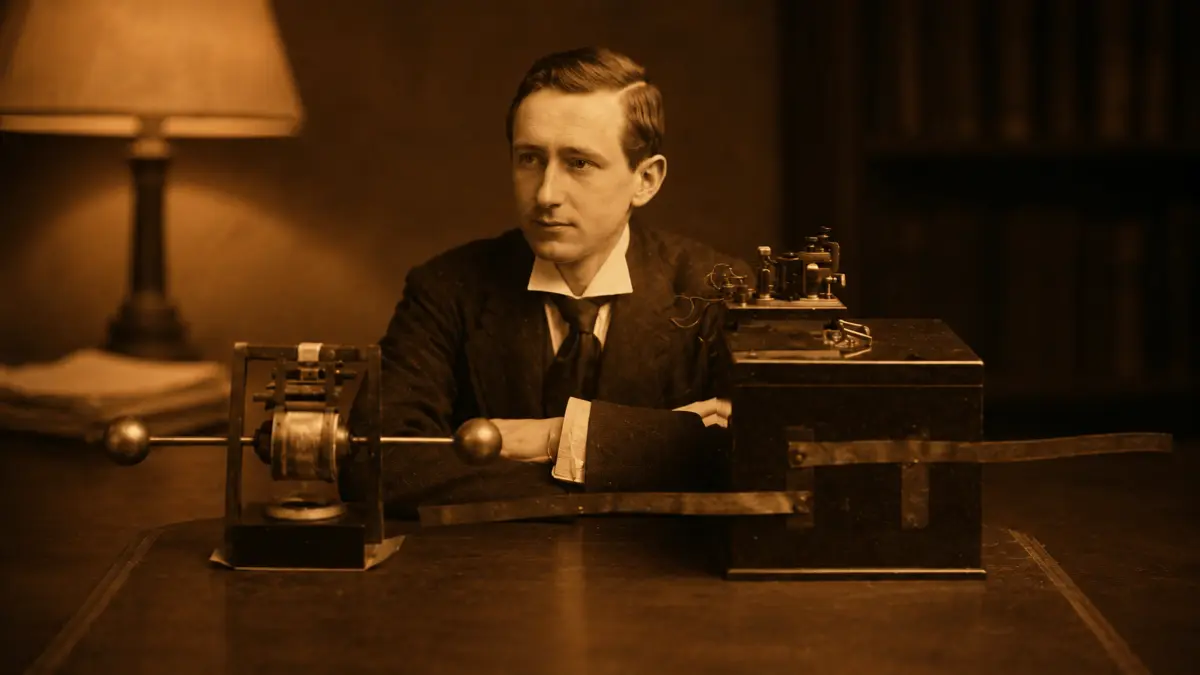

The airwaves that carry our digital lives today trace their roots back to a single moment in 1896. On June 2 of that year, Guglielmo Marconi applied for a patent for his wireless telegraph. This wasn’t just a technical filing; it was a bold step toward untethering communication from physical wires and cables.
Marconi’s wireless telegraph patent marked a fundamental shift in how information could be transmitted. Before this, telegraphy was confined to wired networks, limiting range and flexibility. Marconi’s innovation introduced the possibility of sending signals through the air, using radio waves, which meant communication could reach beyond the constraints of geography and infrastructure.
At the time, the wireless telegraph solved a critical problem: how to maintain communication across vast distances without relying on fragile and expensive wired connections. This was especially important for maritime communication, where ships at sea needed reliable contact with land and other vessels. Marconi’s system allowed messages to be sent over the horizon, dramatically improving safety and operational coordination.
The impact of this patent extended far beyond maritime use. It laid the technical foundation for all wireless communication that followed, radio broadcasting, emergency services, military communications, and eventually the wireless internet. The patent itself codified the use of electromagnetic waves for telegraphy, a concept rooted in Maxwell’s equations but made practical and scalable by Marconi’s work.
What changed because of this was not just the technology but the very concept of connectivity. The wireless telegraph demonstrated that information could be liberated from physical cables, setting the stage for the wireless age. It also introduced new challenges in signal modulation, interference management, and spectrum allocation, which continue to shape telecommunications engineering.
Today, the principles behind Marconi’s wireless telegraph patent still resonate. Modern wireless communication, from Wi-Fi to 5G, relies on the same fundamental idea of transmitting data through electromagnetic waves. The patent’s legacy is visible in every smartphone call, every streaming video, and every IoT device connected wirelessly. It reminds us that the leap from wired to wireless was not just about convenience but about expanding the very reach of human communication.
Reflecting on this event, it’s clear that Marconi’s patent was more than a legal document. It was a blueprint for a connected world, one that continues to evolve as new wireless technologies emerge. The wireless telegraph patent stands as a testament to the power of innovation to break barriers and redefine how we share information.