

Why Network Encryption Matters
A medical team stands across the world from the patient they’re treating. A surgeon wields robotic instruments from a console while a nurse monitors real‑time vital signs. Every command, every reading, every image flows across networks that are intrinsically hostile to secrets. Without robust encryption, an attacker could intercept the feed and alter commands, putting lives at risk. That kind of scenario isn’t confined to science fiction, our work, health care, banking and social lives hinge on the integrity and privacy of data in motion. Understanding how encryption secures modern networks is therefore not just a matter for engineers but a civic necessity.
At its most basic, encryption is the mathematical transformation of readable data into an unintelligible form (ciphertext) using a secret key. Only those possessing the corresponding key can decrypt the ciphertext and recover the original message. Modern encryption grew out of centuries-old ciphers but now underpins the trust model of the internet. For a broader explanation of how encryption protects data in everyday digital communication, see our foundational guide. Encryption at rest protects data stored on devices, while encryption in transit focuses on securing information as it flows across networks. End-to-end encryption combines both, encrypting data from origin to destination so intermediaries cannot read it. Network encryption refers to the set of protocols and technologies that provide confidentiality, integrity and authentication for data travelling between devices.
Table of Contents
Confidentiality, Integrity and Trust
Encryption isn’t a single capability; it bundles together confidentiality, integrity and authentication. Confidentiality ensures that only authorized parties can read the data. Integrity ensures that data hasn’t been tampered with in transit. Authentication verifies the identities of communicating parties. Transport Layer Security (TLS), for example, is a cryptographic protocol that provides end‑to‑end security for data transmitted over a network. It protects information from being accessed, altered or forged during transmission and forms the backbone of secure web browsing and remote access. When users see the padlock next to a website’s URL, they’re witnessing TLS in action.
The benefits of network encryption span privacy, integrity, authentication and compliance. TLS leverages strong symmetric encryption (often AES) and message authentication codes to ensure data privacy and integrity. Digital certificates authenticate the server (and optionally the client), helping prevent man‑in‑the‑middle attacks. These properties build user trust and facilitate regulatory compliance with frameworks like GDPR and HIPAA. Even performance overhead is minimal: TLS 1.3 streamlines the handshake process and improves efficiency.
A Layered Approach to Encryption
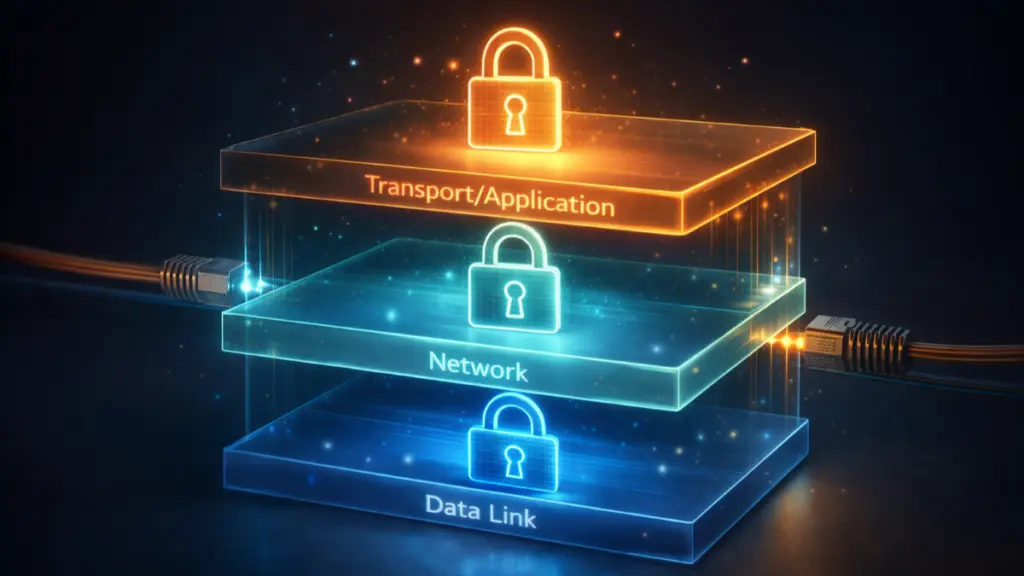
Note: This illustration focuses on the network layers where encryption protocols are most commonly applied in practice. Physical layer (Layer 1) security involves signal-level protections rather than cryptographic encryption, while application-level protections (Layer 7) are often implemented through protocols such as TLS that span multiple OSI layers.
The OSI model divides network communications into layers. Encryption technologies operate at different layers to provide overlapping protections. The following table summarizes key protocols across layers and highlights their roles.
| OSI Layer & Protocol | What It Does | Key Notes |
|---|---|---|
| Layer 2: Data Link — MACsec | Provides confidentiality, integrity and authentication between Ethernet‑connected devices. Encrypts all traffic on the link equally, protecting against fiber taps and tampering. | Operates hop‑by‑hop; uses AES‑GCM ciphers with 128‑ to 256‑bit keys. Requires hardware support and careful key management. |
| Layer 3: Network — IPsec | A suite of protocols that encrypts and authenticates IP packets, securing communications over public networks. Uses Encapsulating Security Payload (ESP) for encryption and Authentication Header (AH) for integrity. | IPsec was standardized by the IETF in the 1990s. It creates security associations via Internet Key Exchange (IKE) and supports tunneling (encrypting the entire IP packet) and transport mode (encrypting only the payload). |
| Layers 4–6: Transport/Application — TLS/SSL/DTLS | TLS (successor to SSL) secures web traffic, email, instant messaging and remote access. The handshake negotiates algorithms, authenticates certificates and establishes session keys. DTLS adapts TLS for datagram protocols like VoIP. | TLS uses public‑key cryptography for key exchange and symmetric algorithms (AES, ChaCha20) for data transmission. Forward secrecy ensures session keys aren’t compromised if long‑term keys leak. |
| Layer 7: Application — End‑to‑End Encryption | Application‑level encryption encrypts data in the user’s app before it leaves the device and decrypts it only at the recipient’s app. Messaging services, file‑sharing tools and blockchain networks often implement this model. | End‑to‑end schemes enhance privacy by reducing reliance on service providers. However, they shift key management responsibilities to users or organizations and complicate lawful monitoring. |
Table 1: Network encryption protocols across key OSI layers and their characteristics. Physical Layer (1) is not included because encryption at this level typically involves signal-level protections rather than protocol-based cryptography.
These layers are complementary rather than mutually exclusive. For instance, a business VPN may wrap IPsec tunnels inside TLS connections to traverse restrictive firewalls, while underlying hardware links still use MACsec to guard against physical tapping. A defence‑in‑depth strategy uses multiple layers to mitigate different threat vectors.
MACsec: Securing the Link
MACsec (Media Access Control Security) encrypts network traffic at the data‑link layer. Originally deployed on campus switches and WAN edges, MACsec is now gaining popularity in core routing due to regulatory pressure, fiber‑tap concerns and zero‑trust principles. Unlike IPsec or TLS, which establish unique sessions for each flow, MACsec protects all traffic on a link uniformly. It achieves confidentiality by generating short‑lived Security Association Keys (SAKs) from a long‑lived Connectivity Association Key (CAK). An Integrity Check Value (ICV) appended to each frame ensures tamper detection.
MACsec’s hardware‑centric design offers near line‑rate performance, but deployment comes with considerations. Key management scales poorly if done manually; integrating MACsec with RADIUS or EAP frameworks is essential for large networks. Interoperability is another challenge: although MACsec is standardized, vendor implementations can vary. Operators must validate mixed‑vendor links, especially in high‑speed environments. These operational realities stem from the technical framework defined in the IEEE MACsec standard, which specifies how link-layer encryption ensures confidentiality and integrity across Ethernet environments. Finally, some routers require MACsec‑verified transceivers to ensure signal integrity. Nevertheless, with support baked into modern routing ASICs, MACsec is becoming a default defence for high‑capacity links.
IPsec: Protecting the Network Layer
IPsec secures communications at the network layer by encrypting and authenticating IP packets. It’s not a single protocol but a suite that includes Encapsulating Security Payload (ESP) for confidentiality and Authentication Header (AH) for integrity. Internet Key Exchange (IKE) negotiates parameters and establishes Security Associations (SAs). Because IPsec works below the transport and application layers, it can secure all traffic regardless of the applications running on top of the IP stack. This makes it ideal for site‑to‑site VPNs and remote access.
Two modes determine how IPsec encapsulates packets. In tunneling mode, IPsec encrypts and authenticates the entire IP packet, encapsulating it into a new IP packet. This approach allows for routing changes and network address translation (NAT) traversal. In transport mode, only the payload is encrypted; the original IP header remains intact. Transport mode is used for end‑to‑end connections when both hosts can see each other directly. IPsec’s versatility explains why it remains a staple of corporate VPNs decades after its introduction. However, like all network encryption, IPsec requires careful key management and correct configuration to avoid interoperability issues and avoid undermining security with weak ciphers.
TLS and the Web’s Invisible Shield
TLS is the most widely deployed network encryption protocol, securing billions of web and API transactions each day. When a client connects to a server, it initiates a handshake to agree on cryptographic algorithms, authenticate certificates and establish a session key. The handshake includes verifying the server’s digital certificate and, if requested, the client’s certificate. Once negotiated, the session proceeds using symmetric encryption (commonly AES or ChaCha20) for performance and message authentication codes for integrity.
TLS replaced the older SSL protocol, which has known vulnerabilities. Modern standards recommend using TLS 1.2 or TLS 1.3, both of which support forward secrecy, generating unique session keys so that compromising a long‑term key does not retroactively expose past communications. TLS secures more than web browsing: it protects email, instant messaging, voice over IP and remote access sessions. Because it relies on a Public Key Infrastructure (PKI), TLS also depends on trusted Certificate Authorities (CAs) to issue and manage digital certificates. Misconfigured certificates or compromised CAs can undermine trust, emphasizing the importance of diligent certificate management.
The technical foundations of TLS are formally defined in the TLS 1.3 protocol specification, which details how secure sessions are negotiated and maintained across modern networks.
Emerging Applications: 5G and Telecom Encryption

Telecommunications networks have historically employed proprietary encryption methods, but the advent of 5G brings standardized, layered security. The evolution of these protections is reflected in the 5G security framework outlined by global telecom bodies, which defines authentication, encryption and inter-operator protection mechanisms across modern mobile infrastructure. One standout feature of 5G is mutual authentication: both the user device and the network verify each other before data exchange. Subscriber identities are masked to reduce tracking and unauthorized surveillance. Within the core network, the Service‑Based Architecture uses TLS for secure communication and OAuth 2 for authorization. For roaming scenarios, a Security Edge Protection Proxy (SEPP) encrypts and filters traffic between operators. Beyond the control plane, 5G provides end‑to‑end integrity protection for user‑plane traffic, preventing man‑in‑the‑middle attacks.
Industrial deployments highlight why network encryption in 5G matters. Ultra‑Reliable Low‑Latency Communication (URLLC) and Time‑Sensitive Networking (TSN) enable real‑time operations, but they must not compromise security. Modern 5G implementations integrate encryption without adding noticeable latency. Network slicing—segregating traffic into virtual networks—allows organizations to apply tailored authentication and encryption mechanisms to different slices. This aligns with zero‑trust principles, which require granular and adaptive permission checks. The result is a secure, low‑latency platform for emerging applications like autonomous vehicles, smart factories and mission‑critical communications.
Building and Managing Encryption Infrastructure
Encryption’s effectiveness depends not only on algorithms but on the infrastructure that supports them. Key management is fundamental: secret keys must be generated, distributed, rotated and revoked securely. In protocols like MACsec, manual key configuration suffices for a few links but doesn’t scale; dynamic key exchange via RADIUS or EAP is crucial for large deployments. IPsec similarly relies on IKE to negotiate keys and parameters. In TLS, certificate management plays a central role. Servers and clients must trust CAs to issue valid certificates. Organizations often use Certificate Management Systems and Hardware Security Modules (HSMs) to store private keys securely and automate renewals. Many enterprises align these practices with guidance from NIST cryptographic standards, which define validated algorithms, lifecycle controls and implementation requirements for secure digital infrastructure.
Hardware considerations also matter. MACsec requires hardware support in routers and sometimes in transceivers. IPsec implementations can be accelerated with dedicated crypto engines in network devices. TLS termination might occur on load balancers or proxy servers to offload processing from application servers. These choices affect latency, throughput and cost. Finally, encryption must be integrated with broader security frameworks—firewalls, intrusion prevention systems, and zero‑trust architectures. Encryption alone cannot prevent compromise; it must be part of a holistic security posture.
Trade‑Offs and Misconceptions
Implementing network encryption introduces trade‑offs and challenges. One common misconception is that encryption always eliminates performance overhead. While modern protocols like TLS 1.3 and MACsec minimize latency, encryption still consumes computational resources. In resource‑constrained devices or high‑bandwidth links, careful capacity planning is essential. Another misconception is that HTTPS alone makes a website secure; it only ensures confidentiality and integrity in transit. Vulnerabilities like SQL injection or cross‑site scripting remain threats. These misunderstandings often stem from a limited view of how encryption operates across systems, rather than from the broader encryption principles that underpin digital security models.
Compatibility also requires attention. Older devices may not support modern ciphers or protocols, leading to insecure fallback modes or handshake failures. Mixed‑vendor environments can complicate MACsec deployments due to differing implementations. IPsec’s flexibility means configurations vary widely; mismatched settings on either side of a tunnel can break connectivity or degrade security. Additionally, encryption does not guarantee anonymity. Metadata such as IP addresses, DNS lookups and traffic patterns can still reveal sensitive information. Privacy‑conscious deployments should pair encryption with techniques like DNS over HTTPS, Tor or private relay services.
Looking Ahead: Post‑Quantum and Beyond

As computing power grows, encryption standards evolve. TLS 1.3 and the latest IPsec suites already incorporate stronger ciphers and forward secrecy, but the looming advent of quantum computing threatens current public‑key algorithms. Researchers are developing post‑quantum cryptographic schemes designed to withstand attacks by quantum computers. Organizations should monitor NIST’s post‑quantum standardization efforts and plan for cryptographic agility so they can swap algorithms without disrupting operations.
Another trend is the integration of encryption into zero‑trust architectures. Instead of trusting any network segment implicitly, zero‑trust models authenticate and authorize every user, device and application continuously. Network encryption plays a central role, ensuring that even within micro‑segmented networks, data remains confidential and tamper‑proof. Meanwhile, policy‑based encryption, where encryption is dynamically applied based on data sensitivity and context, is gaining traction. In the long run, encryption will likely become more seamless and invisible—embedded into chips, protocols and application frameworks—allowing organizations to focus on governance and risk management rather than encryption mechanics.
Practical Takeaways
- Layer your defences. Use a combination of MACsec, IPsec and TLS to protect against threats at different points in the network stack. Defence in depth reduces the chance that a single misconfiguration exposes sensitive traffic.
- Prioritize key management. Centralized and automated key and certificate management reduces human error and prevents expired or compromised keys from undermining security.
- Upgrade legacy protocols. Replace outdated SSL and weak cipher suites with TLS 1.3 and modern cryptographic algorithms. Enforce strong default settings across devices.
- Plan for compatibility. Validate mixed‑vendor MACsec links and verify IPsec and TLS configurations on both ends of a connection. Use standardized profiles where possible.
- Monitor encrypted traffic. While encryption hides payloads from attackers, it can also conceal malicious activity. Employ techniques like TLS inspection with strict compliance requirements to balance security and privacy.
- Prepare for quantum threats. Follow developments in post‑quantum cryptography and choose products that support cryptographic agility.
FAQ
What’s the difference between SSL and TLS? SSL (Secure Sockets Layer) was the original protocol for securing web traffic. It has been superseded by TLS (Transport Layer Security), which offers stronger encryption and improved handshake mechanisms. Modern standards recommend using TLS 1.2 or 1.3.
Is IPsec still relevant in the age of TLS? Yes. IPsec operates at the network layer, enabling site‑to‑site VPNs and protecting traffic regardless of application. TLS secures individual application sessions, while IPsec can secure entire subnets or remote access tunnels. The two often complement each other.
When should I use MACsec instead of IPsec? MACsec secures point‑to‑point Ethernet links at Layer 2 and is ideal for protecting high‑speed trunk lines or core router connections. IPsec, by contrast, is better suited to securing traffic across untrusted networks like the internet where routing flexibility is required.
How does 5G improve network encryption? 5G introduces mutual authentication between devices and the network, masks subscriber identities and employs TLS and OAuth 2 in its core architecture. It also protects user‑plane traffic with end‑to‑end integrity checks and enables encrypted network slicing.
Does encryption guarantee privacy? Encryption protects the contents of data, but metadata—such as who is communicating, when and from where—can still leak. Deployments concerned with privacy must pair encryption with traffic‑analysis defences like onion routing or private relay networks.
Does network encryption slow down communications? Modern protocols like TLS 1.3 and MACsec are engineered for efficiency, and the performance impact is often negligible. However, high‑bandwidth or resource‑constrained environments may require hardware acceleration and careful tuning.




Reader perspectives, questions, and reactions.
No comments yet. Start the conversation.
Comments are closed for this article.