

The Storm, the Announcement and a Digital Twin
On a frosty morning in late January 2026, forecasters on the East Coast watched a complex winter storm intensify over the Great Plains. Snowfall predictions varied widely, fueling uncertainty across municipalities and media outlets. As meteorologists struggled to reconcile conflicting numerical models, Nvidia chose this moment to unveil Earth‑2, its family of fully open, accelerated AI weather models. The coincidence raised an almost conspiratorial question on social media: could Nvidia’s new models have predicted the storm weeks earlier?
Earth‑2 is not a single model but a suite of generative and transformer‑based architectures that aims to create a digital twin of Earth’s atmosphere. Jensen Huang, Nvidia’s CEO, described Earth‑2 as a “physically‑accurate, high‑fidelity, and ultra‑high‑resolution replica of Earth” that continuously synchronizes with real observations. This digital twin is built on two technological pillars: Omniverse for visualization and collaboration, and Modulus, a framework that develops physics‑informed neural networks. Together with GPU‑accelerated supercomputing, these tools allow Earth‑2 to simulate and visualize atmospheric dynamics in near real time, providing what Nvidia calls “actionable feedback in actionable time”.
In this article
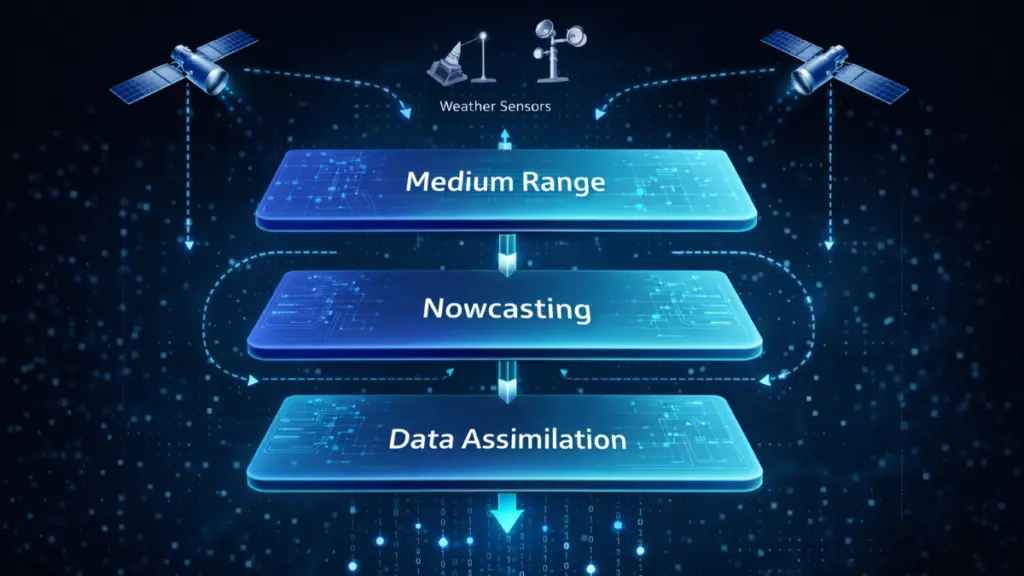
Anatomy of Earth‑2: Medium Range, Nowcasting and Data Assimilation
At the heart of Earth‑2’s January 2026 release are three open models that span the entire weather forecasting pipeline. Each model tackles a different temporal scale and problem domain:
- Earth‑2 Medium Range (Atlas architecture) – This model provides high‑accuracy forecasts up to 15 days ahead across more than 70 weather variables, including temperature, pressure, wind and humidity. It uses a latent diffusion transformer architecture to predict incremental changes while preserving critical atmospheric structures. By combining a downsampled latent space with a history‑conditioned local projector, Atlas achieves state‑of‑the‑art probabilistic skill without bespoke architectural constraints. The accompanying research found that a unified, general‑purpose model outperformed both the Integrated Forecasting System (IFS) and DeepMind’s GenCast on most variables.
- Earth‑2 Nowcasting (StormScope) – Focusing on short‑term hazards, Nowcasting generates kilometer‑resolution, zero‑ to six‑hour predictions of local storms. Trained directly on geostationary satellite and ground radar observations, StormScope produces 10‑minute temporal resolution forecasts at 6 km spatial resolution, matching or surpassing mesoscale numerical weather prediction up to six hours ahead. Its generative architecture enables large ensemble forecasts for robust uncertainty quantification. Because the model operates directly in observation space, it can be adapted to any region with sufficient satellite coverage, including countries without sophisticated modeling infrastructure.
- Earth‑2 Global Data Assimilation (HealDA) – Traditional data assimilation consumes roughly half of the total supercomputing load in weather forecasting. HealDA maps a short window of satellite and conventional observations directly to a global atmospheric state on a HEALPix grid. Without requiring a background forecast, HealDA produces initial conditions in seconds on GPUs instead of hours on supercomputers. When coupled with Medium Range, it provides an entirely AI‑driven forecasting pipeline, losing less than one day of effective lead time compared with ECMWF’s IFS ensemble.
These three models join previously released components—FourCastNet3, a rapid global forecast model that leverages spherical harmonics; CorrDiff, which downscales coarse predictions to high‑resolution fields up to 500 times faster than traditional methods; and other open models like Aurora and cBottle. Together, they form the most comprehensive open AI weather stack available to date.
Who’s Using Earth‑2: From Weather Agencies to Energy Markets
Nvidia’s announcement was not merely a technological showcase; it highlighted real‑world deployments across a range of sectors. Brightband, an AI weather tool provider, uses Earth‑2 Medium Range to issue global forecasts, noting that open sourcing “speeds up innovation and allows easier comparison and improvements”. The Israel Meteorological Service has employed Earth‑2 CorrDiff and plans to adopt Nowcasting, achieving a 90 % reduction in compute time at 2.5 km resolution compared with classic numerical models. After a recent rainstorm, their CorrDiff‑based model delivered the best six‑hour precipitation forecast among operational models. Taiwan’s Central Weather Administration, The Weather Company and the U.S. National Weather Service are evaluating the new models for severe‑weather applications.
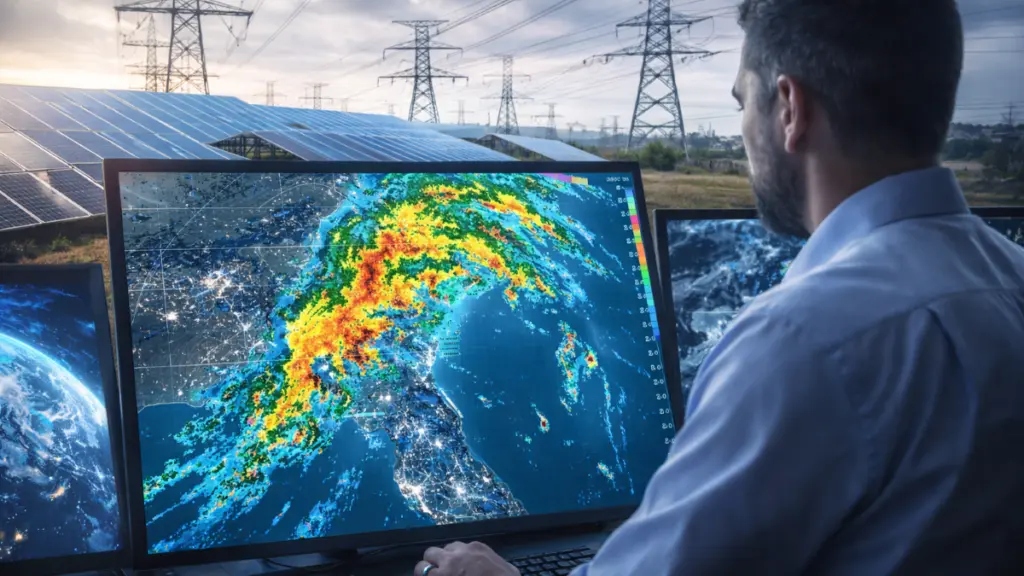
In the energy sector, companies like TotalEnergies and Eni test Earth‑2 Nowcasting and FourCastNet3 to improve short‑term risk awareness and downscale forecasts for gas demand weeks ahead. GCL, a major solar material producer, runs Earth‑2 models to predict photovoltaic power generation more accurately at lower cost. Southwest Power Pool, collaborating with Hitachi, uses Nowcasting and FourCastNet3 to enhance intraday and day‑ahead wind forecasts, supporting grid reliability. Financial risk firms, including AXA and S&P Global Energy, employ FourCastNet3 and CorrDiff to simulate thousands of hurricane scenarios and assess regional risk.
These deployments demonstrate how open AI models can shift weather forecasting from a resource‑intensive service reserved for wealthy countries to a broadly accessible tool. Medium Range and Nowcasting checkpoints are available through the Earth2Studio Python toolkit and Hugging Face hub. Developers can fine‑tune the models on their own data and infrastructure, supporting a trend toward sovereign AI, where governments and organizations retain control over forecasting capabilities. This shift addresses concerns that commercial cloud forecasts could compromise national security or limit access for under‑resourced regions.
Expert Insight: Simplicity, Transformers and a Return to Fundamentals
The success of Earth‑2’s models stems not from exotic architectures but from careful scaling and data curation. Mike Pritchard, Nvidia’s director of climate simulation, told reporters that the company is “moving away from hand‑tailored niche AI architectures and leaning into the future of simple, scalable transformer architectures”. Medium Range leverages the Atlas framework to operate within a compressed latent space, decoupling global dynamics from high‑resolution synthesis. This design proves robust across probabilistic estimators—stochastic interpolants, diffusion and CRPS‑based ensemble training—suggesting that “bespoke architectural complexity” is unnecessary for state‑of‑the‑art performance.
StormScope’s reliance on raw satellite observations rather than physics model outputs is another crucial innovation. Because geostationary satellites provide near‑continuous coverage, the model can generate local forecasts for any region with adequate satellite data, circumventing dependence on region‑specific training. HealDA’s background‑free assimilation similarly simplifies the pipeline, treating data assimilation as a standalone module and proving that initial‑condition errors, rather than model formulation, primarily limit skill.
From a computational standpoint, AI models deliver dramatic efficiency gains. Traditional medium‑range forecasts can require hundreds of CPU nodes and hours of runtime; Earth‑2’s models run on a handful of GPUs and produce outputs in minutes. FourCastNet, an earlier Earth‑2 model, was reported to generate predictions up to 60 times faster than top diffusion‑based methods. These speedups enable ensemble forecasting—running many model realizations to estimate uncertainty—which would be cost‑prohibitive with numerical models. They also democratize access, letting startups and meteorological agencies deploy sophisticated models without billion‑dollar supercomputers.
Ethical Considerations: Bias, Energy and Human Agency
While Earth‑2 promises democratization and accuracy, it also raises ethical and societal questions. AI weather models learn patterns from historical data, and that data is unevenly distributed. Urban and affluent regions often have dense sensor networks, whereas rural and marginalized communities may lack coverage. As a result, data collection bias can lead to less accurate forecasts for under‑resourced areas. Furthermore, historical weather data may reflect systemic disparities in infrastructure and disaster response, inadvertently encoding biases into models. The Prism Sustainability Directory cautions that AI‑driven forecasting could perpetuate or amplify existing social inequalities, particularly if biased models inform emergency response or insurance risk assessments. To mitigate these risks, the article advocates for equitable data collection, algorithmic audits and inclusive governance.
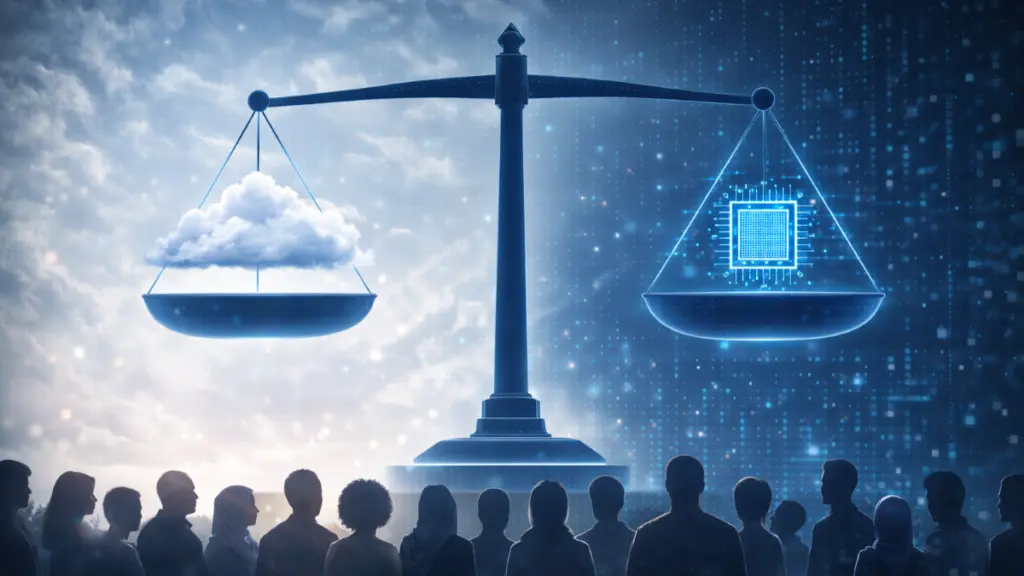
Another dimension is energy consumption. Environmental activists note that querying large AI models uses about thirty times as much energy as a conventional search and that cooling data centers can consume as much water as a small town. Earth scientists counter that AI models can be more energy‑efficient than traditional numerical methods because they avoid solving complex physical equations, yet they acknowledge that AI is not a perfect solution. As Earth‑2 scales, balancing computational efficiency with sustainability becomes essential.
Ethical practice also requires human oversight. The World Meteorological Organization (WMO) emphasizes that meteorologists must develop AI literacy, understand model strengths and limitations, and integrate AI tools responsibly. It lists three core competencies: AI literacy, effective collaboration with AI systems and ethical oversight prioritizing public safety and equitable access. The WMO warns that organizations building their own AI models need expertise in computer science, data collection, legal frameworks and ethics. By combining meteorological expertise with contextual judgment, human forecasters remain essential to translate AI outputs into actionable guidance and to prevent misuse.
A Look Ahead: Sovereign AI and the Quest for Global Inclusivity
Earth‑2’s release marks a milestone in the shift toward open, sovereign AI for weather and climate. Nvidia’s models are already integrated into local infrastructure—from Israeli radar networks to American power grids—and the open‑source ecosystem allows nations to tailor them to regional climates without relinquishing control to foreign vendors. Yet the technology’s long‑term impact depends on broader governance.
Globally, meteorological communities are debating common principles for ethical AI. A WMO conference in September 2025 called for open models, transparent verification standards and equitable access to data and tools. Participants emphasized openness, reproducibility and collaboration as foundational values. The WMO also stressed that human forecasters remain central—technology should strengthen rather than replace the global forecasting ecosystem.
There is also the question of digital sovereignty. Mike Pritchard noted that for some users it makes sense to subscribe to enterprise forecasting services, but for nations, sovereignty and weather are inseparable. Open models allow governments to maintain control over critical infrastructure and national security while still benefiting from rapid AI advances. This stands in contrast to proprietary models run exclusively on commercial cloud platforms.
International collaboration will be crucial. Climate and weather processes transcend national boundaries, and sharing data improves model accuracy. The Prism article warns that biases can be amplified if under‑represented regions lack data, underscoring the need for global observation networks and capacity‑building initiatives. Without inclusive data collection, even the most advanced AI will produce uneven benefits.
Conclusion: Harnessing Promise, Averting Pitfalls
Nvidia’s Earth‑2 models deliver a compelling glimpse into the future of weather forecasting. They offer dramatic speed and accuracy improvements over classical numerical simulations, and their open‑source nature invites innovation across academia, industry and government. Medium Range, Nowcasting and HealDA collectively cover the forecast spectrum, enabling end‑to‑end AI pipelines that are already influencing energy markets and emergency services.
Yet the excitement should be tempered with reflection. AI models are only as good as the data and assumptions that shape them. Unequal sensor distribution, entrenched infrastructural inequities and energy costs pose significant challenges. As the WMO urges, meteorologists must pair AI outputs with contextual understanding. Ethical frameworks, transparent benchmarks and open collaboration will be essential to prevent new forms of climate injustice. Ultimately, Earth‑2’s greatest achievement may not be technical prowess but its potential to foster a more inclusive, equitable and sustainable approach to forecasting—a digital twin that reflects not just the physics of our planet, but our collective responsibility to each other.



Reader perspectives, questions, and reactions.
No comments yet. Start the conversation.
Comments are closed for this article.