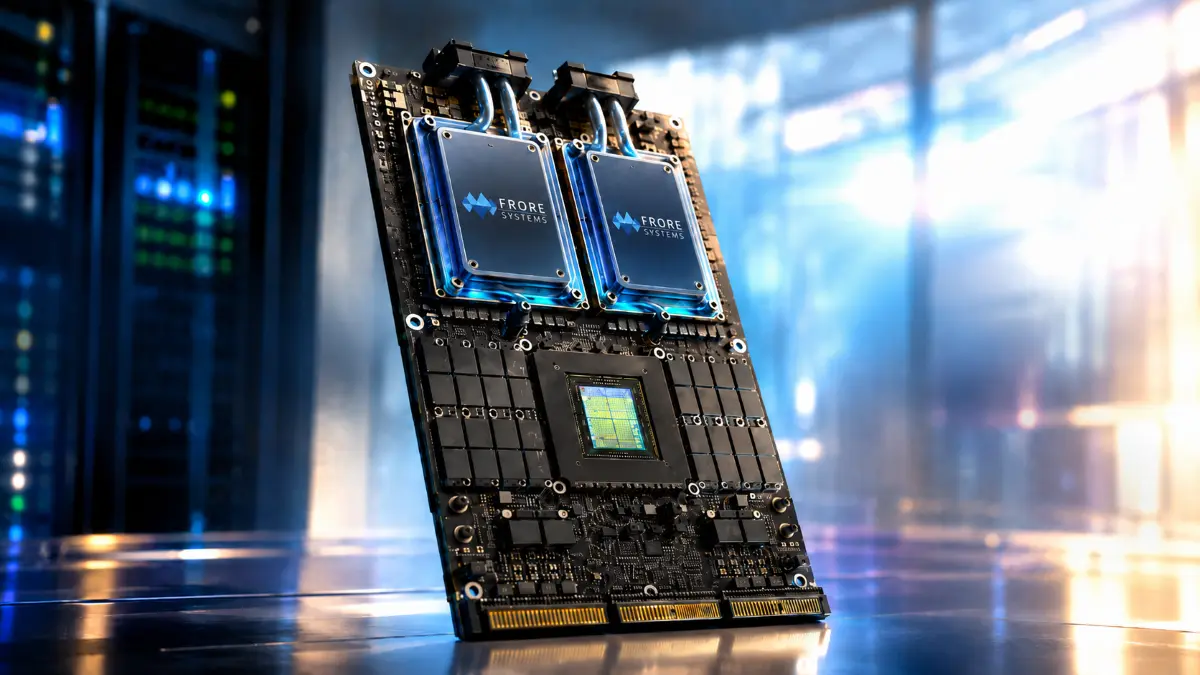

Frore claims its LiquidJet liquid cooling solution can reduce Nvidia Rubin GPU temperatures by up to 10°C while increasing performance by 15%. This development arrives as hyperscale AI data centers seek more efficient thermal management to cut costs and boost throughput. The company’s coldplate design targets the critical challenge of cooling delidded GPUs, which are increasingly favored in production environments for their thermal advantages.
Lower GPU temperatures directly translate to improved reliability and sustained performance, especially under the heavy workloads typical of AI token generation. Frore’s LiquidJet approach reportedly enables hyperscalers to push Nvidia Rubin GPUs harder without thermal throttling, enhancing operational efficiency. This could be a key factor as AI workloads continue to grow exponentially and data centers look to optimize energy use and hardware longevity.
The broader industry context highlights a growing trend toward advanced cooling technologies in data centers. Traditional air cooling struggles to keep pace with the thermal output of modern AI accelerators. Liquid cooling solutions like Frore’s are gaining traction as they offer better heat dissipation and potential power savings. The focus on delidded GPUs, where the integrated heat spreader is removed to improve thermal contact, reflects a shift toward more aggressive hardware customization in hyperscale environments.
Strategically, Frore’s claims underscore the competitive pressure on GPU manufacturers and cooling providers to deliver solutions that enable higher performance density. If validated, LiquidJet could influence how hyperscalers design their next-generation AI infrastructure, balancing cost, complexity, and performance gains. The potential 15% boost in token generation efficiency is significant in an industry where every percentage point impacts operational margins.
What to watch next is whether Frore’s LiquidJet technology gains adoption beyond early hyperscale users and if Nvidia or other GPU makers respond with integrated cooling innovations. The evolving landscape of AI hardware cooling will remain a critical battleground as demand for AI compute continues to surge.