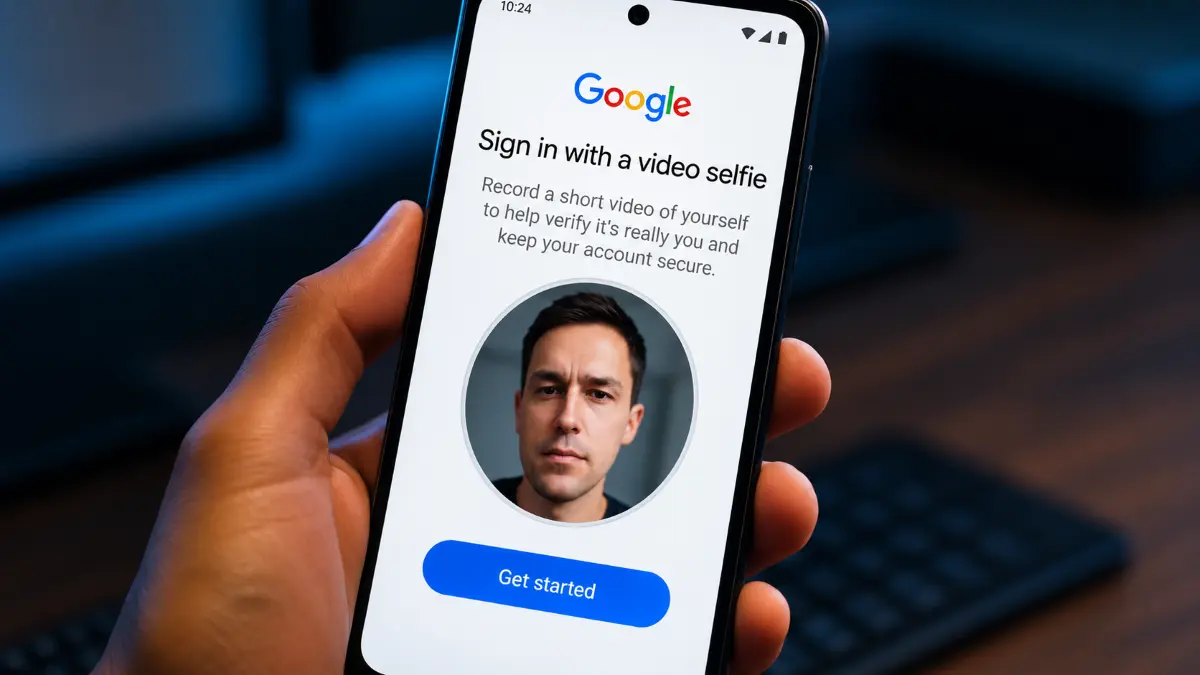

Google is beginning to prompt some users to record a short video selfie that can be used later to help recover a locked Google account. Rather than replacing a password, passkey, or two-factor authentication during everyday sign-ins, the video is intended as an additional recovery option for situations where Google needs stronger evidence that the person trying to regain access is the legitimate account owner.
The feature is being introduced gradually and remains optional. Users who receive the prompt can create the video selfie in advance, effectively establishing another identity signal that Google can use if conventional recovery methods are unavailable or insufficient.
That makes the feature different from simply using Face Unlock on a phone. Device-based facial authentication generally verifies that the person currently holding a particular device matches biometric information stored for that device. Google’s video-selfie approach is aimed at account recovery, when a user may have lost access to a trusted phone, forgotten credentials, changed numbers, or encountered another situation that makes normal verification difficult.
A short video also provides more information than a single photograph. Multiple frames can help an identity-verification system examine changes in facial position and appearance as the person moves, while also making simple attacks involving a static photograph more difficult. Depending on Google’s implementation, those additional signals could help determine whether the recovery attempt involves a real person rather than an image presented to the camera.
The timing is significant because account recovery remains one of the weakest points in otherwise well-protected accounts. A user might have a strong password, passkey, and two-step verification enabled, but those protections create another problem when the legitimate owner loses access to the devices or credentials required to authenticate.
Attackers also target recovery procedures precisely because they can provide an alternative route around normal sign-in protections. Phishing recovery codes, hijacking phone numbers, compromising recovery email accounts, and impersonating account owners are all ways criminals can attempt to take over accounts without directly defeating the primary password.
Google is effectively adding another identity check to that recovery process.
The feature should therefore not be confused with Google asking users to take a video selfie every time they log in. Normal Google Account authentication continues to rely on methods such as passwords, passkeys, security keys, Google prompts, authenticator codes, and other established mechanisms. The selfie is designed as a fallback that could become useful when those options fail.
There is an obvious trade-off. A recovery email address or phone number can be changed if compromised. A person’s face cannot. That makes Google’s handling of the video and any biometric information derived from it especially important.
Users will want clear answers about how long the original recording is retained, whether biometric templates or other derived information are created, where that information is processed and stored, whether it can be deleted, and whether it is used exclusively for account security. Those details will determine whether users view the feature as a useful recovery safeguard or an unnecessary collection of sensitive information.
Making enrollment optional gives users a choice. Someone who already maintains multiple passkeys, hardware security keys, recovery codes, and an up-to-date recovery email may decide that a video selfie adds little value. Another user who depends heavily on a single Google account for Gmail, Photos, Drive, YouTube, Android services, and other data may consider another recovery method worthwhile.
The feature also illustrates an interesting consequence of the industry’s move away from passwords. Passkeys and stronger authentication can make account takeover more difficult, but companies still need a secure answer to a deceptively simple question: What happens when the real owner loses every method normally used to prove who they are?
Google’s answer increasingly appears to involve combining possession-based authentication with stronger identity verification when recovery becomes necessary.
What matters next is not whether video selfies replace passwords. They aren’t designed to. The more important question is whether Google can make facial verification strong enough to stop fraudulent recovery attempts while giving users sufficient control over one of the most sensitive identifiers they possess: their face.