
Space exploration is often a story of bold beginnings and carefully planned endings. On September 21, 2003, NASA deliberately sent the Galileo spacecraft into Jupiter’s atmosphere, bringing one of the most important planetary missions of its era to a controlled conclusion.
The maneuver was not simply a way to dispose of an aging spacecraft. It reflected years of scientific discovery, engineering achievement, and growing concern about protecting potentially habitable worlds from contamination.
A Mission That Transformed Our View of Jupiter
Galileo had been launched aboard Space Shuttle Atlantis on October 18, 1989, beginning a journey that would ultimately transform scientists’ understanding of Jupiter and its complex system of moons.
Rather than flying directly to the giant planet, the spacecraft used gravitational assists from Venus and Earth to build enough speed to reach the outer solar system. After traveling billions of kilometers, Galileo arrived at Jupiter in December 1995.
Its arrival marked a major milestone in planetary exploration. Galileo became the first spacecraft to orbit Jupiter, allowing scientists to study the planet and its moons repeatedly rather than during the brief encounters possible with earlier flyby missions such as Voyager.
Galileo also carried an atmospheric probe that separated from the main spacecraft before arrival. The probe plunged directly into Jupiter’s atmosphere, transmitting measurements of temperature, pressure, winds, chemical composition, and other conditions before communication was lost. Meanwhile, the orbiter began a long series of encounters with Jupiter’s largest moons.
Discovering New Worlds Around Jupiter
Those encounters produced some of Galileo’s most significant discoveries. Observations of Europa provided strong evidence that a vast ocean of liquid water may exist beneath the moon’s icy surface.
Galileo detected characteristics of Europa’s magnetic environment consistent with a conductive layer below the surface, strengthening the case for a salty subsurface ocean. That discovery dramatically increased scientific interest in Europa and helped establish it as one of the most compelling locations in the solar system for investigating potentially habitable environments.
The spacecraft also studied Ganymede, the largest moon in the solar system, and discovered that it possesses its own magnetic field. Galileo observed the intensely volcanic surface of Io, where Jupiter’s immense gravitational influence helps generate extraordinary geological activity.
Callisto, another of Jupiter’s large moons, also revealed clues suggesting that liquid water might exist deep beneath its surface.
Together, these discoveries changed how scientists viewed the moons of the outer solar system. Worlds once considered largely frozen and inactive emerged as dynamic environments, some potentially containing ingredients or conditions relevant to the search for life.
Engineering Around a Major Antenna Failure
Galileo achieved these results despite significant technical difficulties.
One of the mission’s biggest problems emerged when its high-gain antenna failed to fully deploy. The antenna had been intended to transmit large quantities of scientific data back to Earth at high speed, and its failure threatened to severely limit the mission before Galileo even reached Jupiter.
NASA engineers responded with an extraordinary technological workaround. They reprogrammed the spacecraft, improved data-compression techniques, optimized how observations were stored and transmitted, and relied heavily on Galileo’s much smaller low-gain antenna.
Through software changes and careful management of the limited communications bandwidth, the mission recovered much of its scientific capability. The solution became an impressive example of extending the usefulness of a spacecraft through engineering and software rather than physical repair.
The environment around Jupiter created additional challenges. The planet is surrounded by intense radiation capable of damaging electronics and scientific instruments. Galileo repeatedly passed through this hostile region while conducting close encounters with Jupiter’s moons.
Despite radiation exposure, communications limitations, and years of operation hundreds of millions of kilometers from Earth, Galileo continued returning valuable scientific observations.
Why NASA Chose to Destroy Galileo
Galileo’s original mission was eventually extended multiple times. By the early 2000s, however, the spacecraft was aging, its onboard systems had endured substantial radiation exposure, and its supply of propellant was running low.
NASA therefore faced an important question: what should happen to Galileo when controllers could no longer reliably determine or alter its trajectory?
Europa made that question particularly important.
Galileo’s own discoveries had strengthened the possibility that Europa contained a global ocean beneath its icy crust. Although there was no evidence that life existed there, scientists wanted to preserve the moon as carefully as possible for future investigation.
An uncontrolled Galileo could theoretically have collided with Europa after ground controllers lost the ability to maneuver it. Because the spacecraft had not been sterilized to the standards required for intentionally contacting a potentially habitable environment, such an impact presented an unnecessary contamination risk.
NASA therefore chose a controlled destruction of the spacecraft.
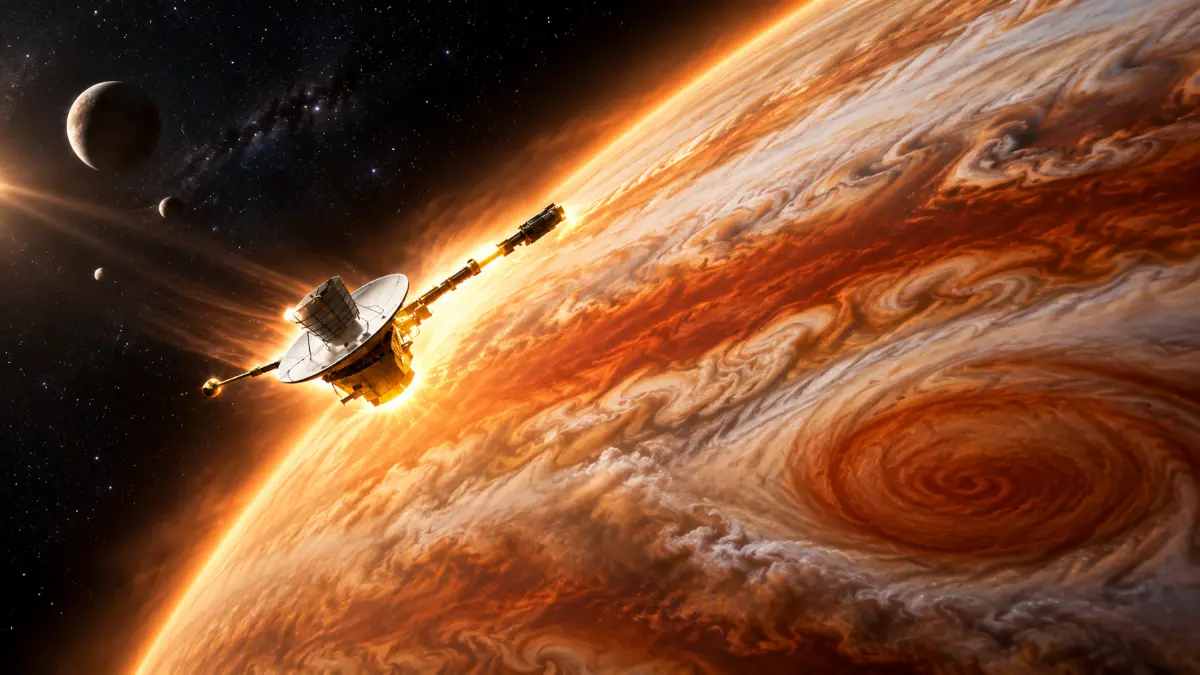
Mission controllers planned a final trajectory that would send Galileo directly into Jupiter. On September 21, 2003, after nearly 14 years in space and almost eight years operating around Jupiter, the spacecraft entered the giant planet’s atmosphere at tremendous speed.
Galileo continued transmitting information during its final approach. Eventually, its radio signal disappeared as the spacecraft plunged into Jupiter and was destroyed.
The controlled descent demonstrated the growing importance of planetary protection, the effort to prevent spacecraft from contaminating celestial environments that could be scientifically important in the search for life.
Protecting Europa was particularly significant because Galileo itself had helped reveal why the moon deserved such protection.
Galileo’s Legacy Lives On
Galileo’s scientific legacy extends far beyond its dramatic ending. The mission fundamentally changed scientists’ understanding of Jupiter’s atmosphere, magnetosphere, rings, and moons.
Most importantly, its observations helped transform Europa into one of the highest-priority destinations in planetary science and strengthened interest in studying subsurface oceans elsewhere in the solar system.
Its influence can be seen in a new generation of missions.
NASA’s Europa Clipper mission is designed to investigate Europa in far greater detail, examining its ice shell, composition, geology, and potential habitability. The European Space Agency’s JUICE mission is similarly exploring the Jupiter system, with particular emphasis on the icy moons Ganymede, Callisto, and Europa.
These missions are pursuing questions that Galileo helped bring to the forefront of planetary science.
Galileo also left an important technological legacy. Its engineers demonstrated how software updates, data compression, careful mission planning, and creative problem-solving could compensate for serious hardware limitations millions of kilometers from Earth.
Those lessons remain relevant as robotic spacecraft travel farther into the solar system and operate for increasingly long periods without any possibility of physical repair.
Looking back at September 21, 2003, Galileo’s destruction was not a mission failure or simply the disposal of obsolete hardware. It was the final planned act of a spacecraft that had already exceeded expectations and fundamentally changed planetary science.
The spacecraft that revealed compelling evidence for an ocean beneath Europa was deliberately destroyed partly to protect that same world from contamination.
That ending captured an increasingly important principle of space exploration: discovering new worlds also brings a responsibility to preserve them.
Galileo disappeared into Jupiter, but the discoveries it made, the engineering challenges it overcame, and the questions it uncovered continue to shape humanity’s exploration of the outer solar system.