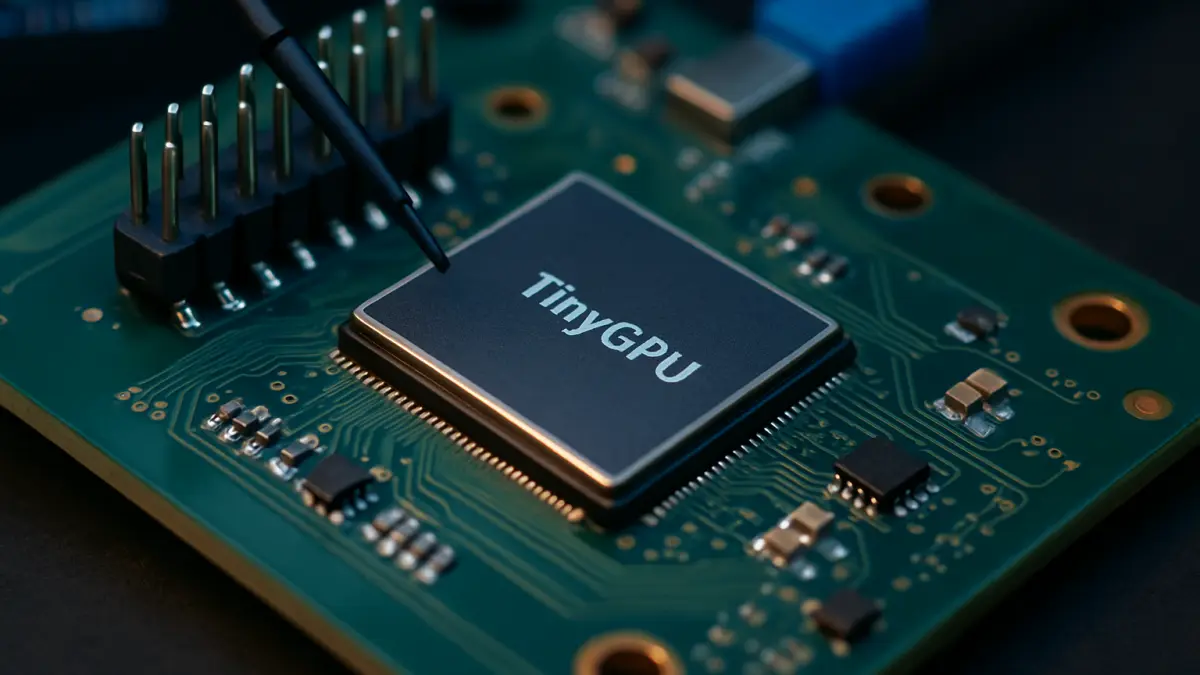

The world’s smallest GPU silicon, TinyGPU v2.0, has passed real-world testing by rendering 3D graphics at up to 15 frames per second. This ultra-compact chip, containing just 240,000 transistors, was demonstrated after completing its Tiny Tapeout production run, confirming its standalone GPU capabilities. The successful test signals a significant step forward in miniaturized graphics processing technology.
This breakthrough matters because it opens new possibilities for embedding 3D graphics in devices where space and power are at a premium. Traditional GPUs are large and power-hungry, limiting their use in ultra-compact or low-power devices. TinyGPU’s small transistor count and modest performance could enable graphics acceleration in wearables, IoT devices, or other embedded systems that previously lacked such capabilities.
The TinyGPU project fits into a broader industry trend toward specialized silicon designed for niche applications, including AI accelerators and edge computing chips. As demand grows for smarter, more visually capable devices beyond smartphones and PCs, ultra-small GPUs could become a key component in the evolving hardware ecosystem. The ability to render real-time 3D graphics on such a tiny chip challenges conventional GPU design paradigms.
Looking ahead, TinyGPU v3.0 is reportedly in development with plans for a 2026 release. While details remain sparse, the next iteration will likely push performance and efficiency further, potentially expanding the use cases for tiny GPUs. Industry watchers should monitor how this technology influences embedded graphics and whether it spurs new partnerships or product categories.
The successful demonstration of TinyGPU v2.0 confirms that ultra-compact, low-transistor-count GPUs are viable. This could reshape how graphics processing is integrated into small devices, offering a fresh alternative to traditional GPU architectures. The coming years will reveal how this innovation fits into the broader semiconductor landscape.