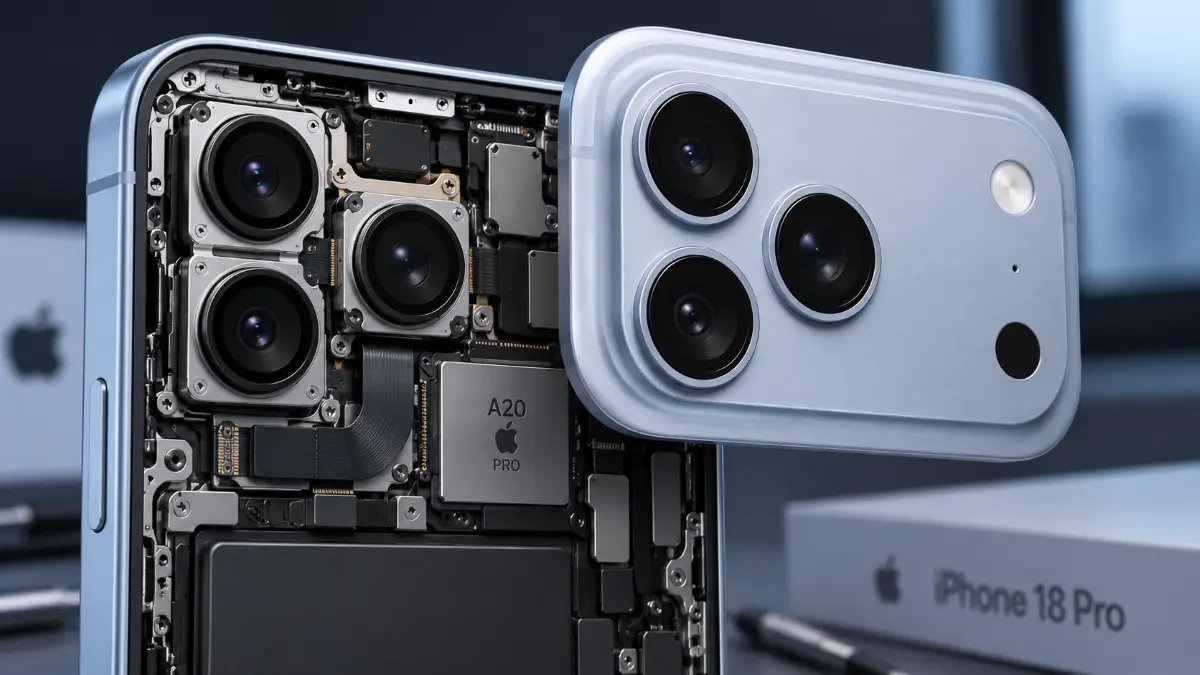

Apple’s iPhone 18 Pro arrives with a camera upgrade that looks modest on paper but changes how much control users have over the Main camera. The headline feature is a new 48MP Fusion Main camera with variable aperture, giving the iPhone mechanical control over how much light enters the lens for the first time.
Variable Aperture Comes to iPhone
Instead of using one fixed aperture, the iPhone 18 Pro can switch between f/1.48, f/1.8, f/2.8, and f/4.0. Apple uses six laser-cut aperture blades to move between those settings automatically, or users can select them manually through the new Pro controls in the Camera app.
The practical benefit depends on the scene. At f/1.48, the camera lets in the most light and Apple says low-light performance improves by around 50 percent, helping indoor and Night mode shots. f/1.8 serves as the default balance between light gathering and depth of field. Narrowing to f/2.8 or f/4 increases depth of field, which can help keep more people or background detail in focus in group photos and bright outdoor scenes.
The wider maximum aperture may end up being more noticeable than the adjustable settings themselves. Compared with the fixed f/1.7 aperture on the previous generation, f/1.48 gives the camera more light to work with and slightly more natural background separation before computational processing is applied.
New Pro Camera Controls
Apple is pairing the hardware change with a new Pro controls interface. Users can now manually adjust aperture, shutter speed, and white balance, while a live histogram provides a clearer view of exposure across the scene.
These controls work for both photos and video, reducing the need for third-party camera apps for basic manual shooting.
More Control for Video Creators
Video also gets more flexibility. Variable aperture can help manage bright outdoor scenes without relying entirely on shutter speed, while Smart Focus Tracking uses on-device models to keep a subject in focus even if that person briefly moves out of frame.
Apple also allows Cinematic effects to be applied after capture to video recorded at up to 60 fps, giving creators more room to adjust the final look after shooting.
Three 48MP Cameras and Up to 8x Zoom
The rest of the camera system remains substantial. The iPhone 18 Pro includes a 48MP Ultra Wide and a 48MP Telephoto, alongside the 48MP Fusion Main camera, with optical-quality zoom reaching 8x.
Apple has also updated Photographic Styles with new texture and grain controls and introduced a redesigned computational imaging pipeline intended to preserve more detail.
Apple Reference Image Adds Authenticity Tools
Another notable addition is Apple Reference Image. In this mode, the Main camera uses sensor data to create a signed reference image that can later be compared with an edited photo.
Apple positions the feature as a way to help verify whether an image has been altered, and third-party apps can access the capability through new APIs.
Third-Party Camera Apps Get Aperture Access
Variable aperture is not limited to Apple’s Camera app. Apple is exposing aperture control through an API, allowing third-party photography and video apps to work across the same aperture range.
That could be particularly important for professional camera apps, which can combine Apple’s new optical controls with their own exposure, focus, recording, and monitoring tools.
More About Control Than Megapixels
The iPhone 18 Pro camera story is therefore less about adding another lens or dramatically increasing megapixel counts. The bigger change is control.
Apple is giving users direct access to aperture, shutter speed, white balance, exposure monitoring, and focus behavior inside the standard Camera app.
For casual users, most of those adjustments can remain automatic. For photographers and video creators, they make the iPhone behave more like a conventional camera while still benefiting from Apple’s computational imaging. That combination may prove more useful than a single headline specification.