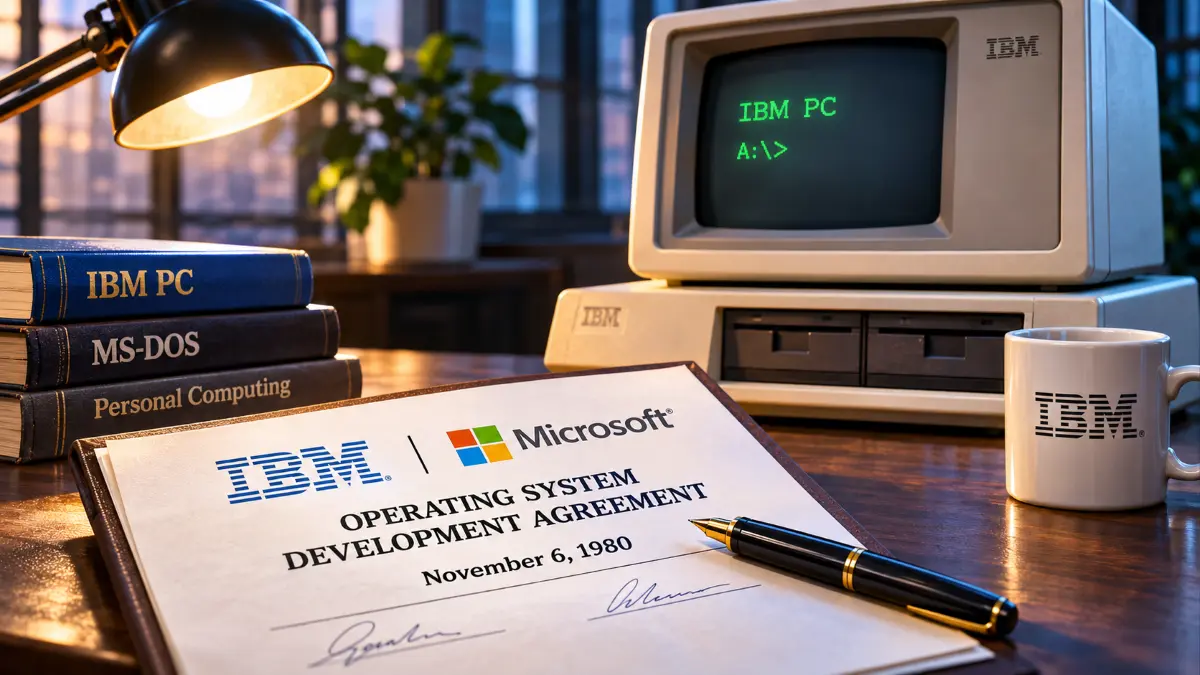

On November 6, 1980, IBM and Microsoft signed an agreement that would profoundly influence the future of personal computing. IBM was developing its first personal computer, and Microsoft, then best known for programming languages, agreed to supply software that included an operating system for the new machine. Neither company could have fully anticipated how this arrangement would reshape the computer industry, helping establish Microsoft as a dominant software company and creating the foundation for the IBM-compatible PC ecosystem.
The agreement was remarkable because Microsoft did not yet have the operating system it needed to deliver. Instead of developing one entirely from scratch, the company turned to an existing product created by Seattle Computer Products. That software would become the foundation of IBM’s PC DOS and Microsoft’s MS-DOS, two closely related products that helped define personal computing throughout the 1980s and beyond.
More importantly, Microsoft’s agreement with IBM was structured to preserve the company’s ability to license its operating system to other manufacturers. That decision would prove enormously valuable as competing hardware companies began producing IBM-compatible computers, transforming the personal computer market from one centered on individual manufacturers into a broader ecosystem built around shared software compatibility.
IBM’s Search for a Personal Computer Operating System
In 1980, IBM was preparing to enter a personal computer market already populated by companies such as Apple, Commodore, and Tandy. Although IBM dominated much of the corporate computing industry, the rapidly growing market for smaller, less expensive computers presented a different competitive environment. To enter it quickly, IBM assembled a development team in Boca Raton, Florida, and adopted an approach that relied heavily on components and software from outside suppliers.
The project, internally known as Project Chess, would eventually produce the IBM Personal Computer, model 5150. Its architecture used Intel’s 8088 processor and other commercially available components, allowing IBM to accelerate development rather than designing every element independently. However, the company still needed an operating system capable of managing files, running applications, and providing the software environment required by business users.
One of IBM’s initial candidates was CP/M, an operating system developed by Gary Kildall and marketed by Digital Research. CP/M had become an important standard among 8-bit microcomputers, and Digital Research was working on CP/M-86 for newer 16-bit processors. IBM explored an agreement with the company, but the negotiations did not produce a licensing arrangement. Although the episode has often been retold as a simple missed meeting or personal mistake, the historical circumstances were more complicated and involved unresolved commercial terms.
With development deadlines approaching, IBM returned to Microsoft, which was already involved in supplying programming languages for the project. Microsoft now faced an opportunity to provide something far more important than BASIC: the operating system that would help define IBM’s new computer.
How Seattle Computer Products Provided the Missing Software
Microsoft’s founders, Bill Gates and Paul Allen, recognized that developing a completely new operating system under IBM’s demanding schedule would be difficult. However, they knew of an existing product developed by Tim Paterson, an engineer working at Seattle Computer Products.
Paterson had created a disk operating system for computers using Intel’s 8086 processor. Initially known as QDOS, commonly expanded as Quick and Dirty Operating System, the software was later marketed as 86-DOS. It provided essential functions such as file management, program loading, and disk operations, making it a practical starting point for the IBM project.
The system drew on familiar concepts and programming interfaces associated with CP/M, helping simplify the adaptation of existing software. However, 86-DOS was an independently developed implementation, not simply a copy of Digital Research’s operating-system code.
Microsoft arranged to license the software from Seattle Computer Products and adapt it to IBM’s hardware. The precise sequence of preliminary licensing discussions and agreements is described somewhat differently in historical accounts, but Microsoft’s formal license is generally dated to late 1980, with the Computer History Museum identifying December as the initial licensing period.
The acquisition of rights to an existing operating system allowed Microsoft to concentrate on compatibility, integration, testing, and meeting IBM’s deadlines. It also established the basis for a product that Microsoft could eventually supply to other computer manufacturers.
The November 6 Agreement and Microsoft’s Strategic Advantage
The agreement signed on November 6, 1980, committed Microsoft to providing software for IBM’s forthcoming personal computer. The arrangement included programming languages and operating-system development, bringing Microsoft into a central position within the project.
What made the relationship especially consequential was its nonexclusive nature. Microsoft retained the ability to market its DOS operating system to other hardware manufacturers rather than granting IBM exclusive control over the software.
At the time, IBM’s established reputation and commercial influence made its participation in personal computing highly significant. Yet its reliance on outside suppliers created an unusual opportunity for Microsoft. IBM would manufacture and market the computer, while Microsoft could develop a software business extending beyond IBM’s own hardware.
The distinction became increasingly important as the personal computer industry evolved. If the IBM PC architecture became widely adopted, software compatibility could become valuable independently of the manufacturer producing the machine.
Microsoft’s arrangement did not immediately guarantee commercial dominance. Competing operating systems remained available, and the market had not yet settled on a single standard. Nevertheless, the agreement positioned Microsoft to benefit from the success of an entire category of compatible computers rather than the sales of one manufacturer’s products.
From 86-DOS to IBM PC DOS and MS-DOS
Following the agreement, Microsoft engineers worked to adapt 86-DOS to IBM’s developing hardware. The project required coordination between the operating system, IBM’s BIOS firmware, storage devices, and other components. Bob O’Rear played an important role in the adaptation work, while Tim Paterson joined Microsoft in 1981 and continued contributing to DOS development.
In July 1981, Microsoft purchased the remaining rights to 86-DOS from Seattle Computer Products, reportedly paying an additional $50,000 after its earlier licensing arrangement. This gave Microsoft greater control over the software’s commercial future.
When IBM introduced the original IBM Personal Computer on August 12, 1981, customers could purchase PC DOS as one of its operating-system options. The initial IBM PC did not depend exclusively on DOS, but PC DOS became the most commercially important operating system for the platform.
Microsoft also marketed its own closely related version under the MS-DOS name. The distinction between PC DOS and MS-DOS was initially more commercial than technical: IBM distributed its branded version for IBM computers, while Microsoft could license DOS to other hardware manufacturers.
This approach helped create a common software environment across different machines. As compatible computers entered the market, manufacturers could obtain an operating system supporting the growing library of DOS applications, reducing the need to develop a separate software platform for each new computer.
How the Agreement Helped Create the PC-Compatible Market
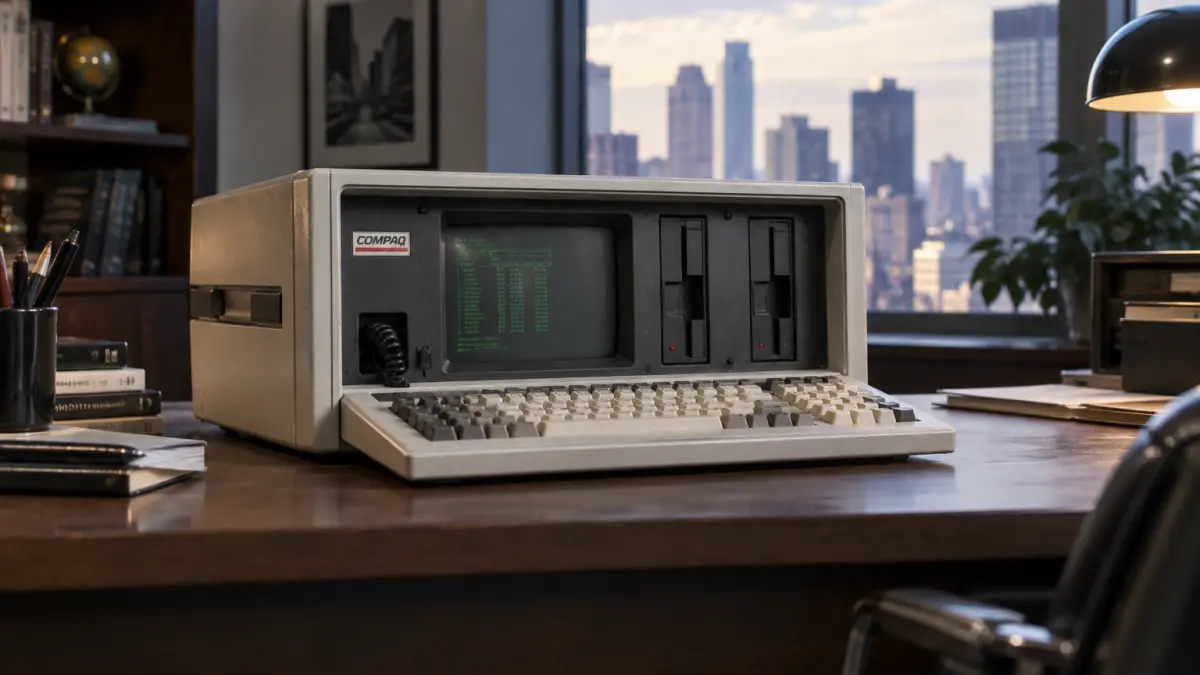
The broader significance of the IBM-Microsoft relationship became clear as companies began introducing computers designed to run software developed for the IBM PC. Manufacturers such as Compaq demonstrated that competing hardware could reproduce the necessary compatibility while offering different designs, capabilities, and pricing.
Compatibility was not automatic. Early IBM-compatible manufacturers had to address technical challenges involving BIOS behavior, hardware interfaces, memory organization, and software expectations. Nevertheless, access to MS-DOS provided a common operating-system foundation that supported the growth of the market.
As more manufacturers adopted compatible architectures, software developers gained access to an expanding customer base. Applications such as Lotus 1-2-3 helped make the IBM-compatible PC attractive to businesses, while the growing availability of compatible hardware encouraged organizations to standardize their computing environments.
This created a reinforcing cycle. More compatible computers encouraged developers to write software for DOS, and the increasing availability of software made DOS-based computers more valuable to customers.
Microsoft benefited because its operating system could be licensed across multiple manufacturers. IBM, meanwhile, found itself competing in a market where the software environment and much of the underlying hardware architecture were no longer exclusive to its own products.
The result was a major shift in the economics of personal computing. Hardware manufacturers increasingly competed on performance, reliability, price, and design, while software platforms became an important source of commercial influence and long-term customer relationships.
From DOS to Windows and the Modern Software Industry
MS-DOS became a central part of the personal computer industry throughout the 1980s, providing the operating-system environment for millions of machines. Its command-line interface reflected the technological limitations and design priorities of the era, but its widespread adoption created a foundation for an expanding software market.
Microsoft introduced Windows 1.0 in 1985 as a graphical operating environment that ran on top of DOS. Later Windows releases expanded graphical computing capabilities, while Windows 95 integrated DOS-related functionality into a more comprehensive consumer operating system.
The relationship between DOS and Windows was not a simple progression in which one operating system was renamed or directly transformed into another. Microsoft also developed the Windows NT architecture, which became the foundation for modern Windows operating systems. Nevertheless, DOS helped establish Microsoft’s commercial position, developer relationships, and distribution channels before Windows became dominant.
The IBM agreement also illustrated the growing importance of software licensing as a business strategy. Licensing operating systems separately from hardware was not invented by Microsoft, but the company’s ability to supply DOS across a rapidly expanding compatible market became one of the most influential examples of that model.
Similar questions about platform control, interoperability, software licensing, and developer ecosystems remain important in contemporary computing. Operating systems continue to shape which applications can run, how devices interact, and how manufacturers participate in larger technology markets.
The Deal That Helped Shift Power From Hardware to Software
Looking back at November 6, 1980, the agreement between IBM and Microsoft stands as a defining moment in the development of the personal computer industry. IBM’s decision to work with outside software suppliers helped bring its first PC to market quickly, while Microsoft’s acquisition and adaptation of 86-DOS provided the operating system that would become central to the IBM-compatible ecosystem.
The arrangement did not immediately establish Microsoft as an industry leader, nor did it single-handedly create the modern software business. Its importance emerged through the combination of IBM’s commercial influence, Microsoft’s licensing strategy, the engineering work behind DOS, and the growing demand for compatible personal computers.
What began as a software supply agreement became part of a larger transformation in which hardware manufacturers, operating-system developers, and application creators increasingly depended on shared technological platforms.
On November 6, 1980, IBM and Microsoft signed an agreement whose consequences extended far beyond a single computer. It helped establish the software foundation of the IBM-compatible PC market and demonstrated how control over a widely adopted operating system could become one of the most powerful positions in the technology industry.