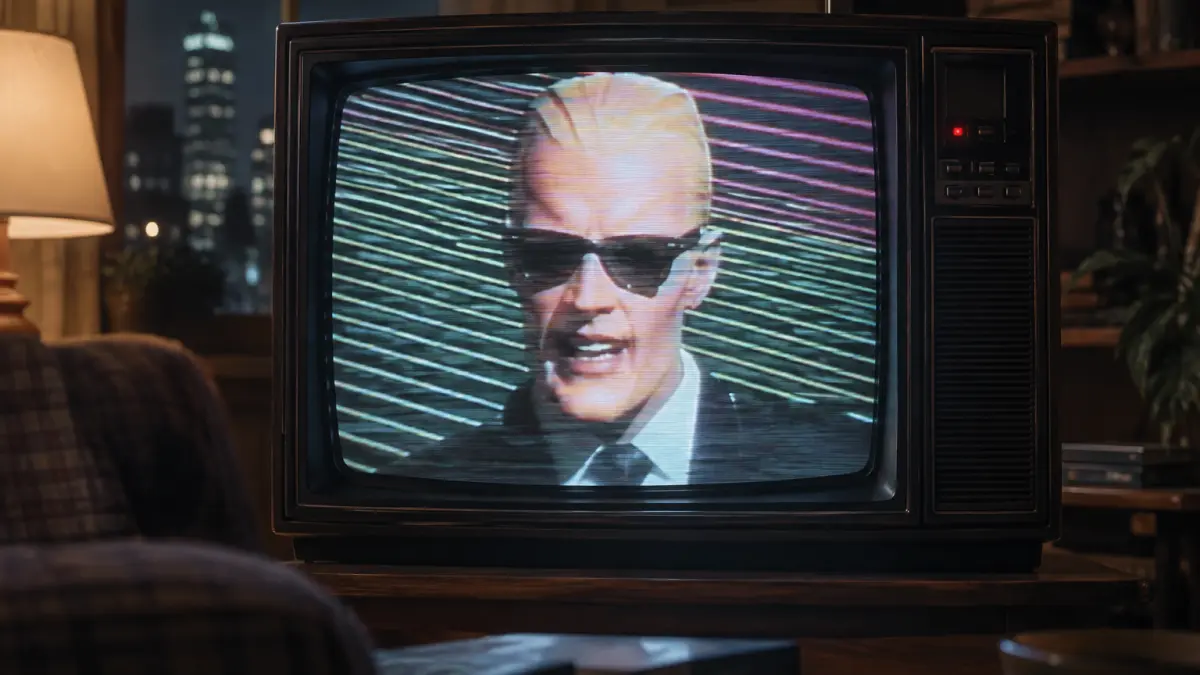

On November 22, 1987, television viewers in Chicago witnessed one of the strangest interruptions in broadcasting history. During an ordinary Sunday evening, two television stations unexpectedly lost control of their programming to an unidentified intruder wearing a rubber mask resembling Max Headroom, the fictional computer-generated television personality popular during the 1980s. The unauthorized transmissions were brief, lasting approximately 25 seconds on WGN-TV and 90 seconds on WTTW, but they demonstrated something far more serious than an elaborate prank: someone with sufficient technical knowledge could interfere with a major television station’s broadcast infrastructure and replace its programming with an entirely different signal.
The incident, now widely known as the Max Headroom signal hijacking, became one of the most enduring mysteries in television history. Despite an investigation by the Federal Communications Commission (FCC), the identity of the person or people responsible was never publicly established. Beyond its bizarre imagery and unresolved origins, the event exposed weaknesses in analog broadcast distribution systems and raised questions about the security of communication channels that millions of viewers trusted for news, information, and entertainment.
Two Television Stations Hijacked on the Same Night
The first interruption occurred at approximately 9:14 p.m. Central Time during the sports segment of WGN-TV’s The Nine O’Clock News. Sports anchor Dan Roan was reporting on the Chicago Bears’ victory over the Detroit Lions when the broadcast suddenly went dark. Moments later, viewers saw a person wearing a Max Headroom mask and sunglasses, moving erratically in front of a shifting, striped background. The image was accompanied by buzzing and distorted sounds rather than intelligible speech.
WGN engineers reacted quickly. By changing the frequency of the studio-to-transmitter connection, they were able to interrupt the unauthorized signal and restore normal programming. The disruption lasted less than half a minute, leaving viewers and station personnel confused about what had happened. Roan returned to the broadcast and acknowledged the unexpected technical problem, unaware that the same intruder would appear again later that evening.
Approximately two hours later, the attackers targeted WTTW, Chicago’s public television station, during a broadcast of the British science-fiction series Doctor Who, specifically the serial Horror of Fang Rock. This second intrusion was considerably longer and more elaborate. The masked individual appeared against a moving corrugated-metal background, delivered a rambling monologue through heavily distorted audio, made references to popular culture and television personalities, and performed a series of increasingly absurd actions. The recording ended with an accomplice apparently striking the intruder’s exposed backside with a fly swatter.
Unlike WGN, WTTW could not immediately restore control of its transmission. The unauthorized footage continued for approximately 90 seconds before disappearing, allowing the scheduled program to resume. Engineers later described the difficulty of responding to an intrusion that occurred outside their normal control of the broadcast chain.
The fact that two separate television stations were successfully targeted on the same night suggested planning, technical preparation, and a detailed understanding of Chicago’s broadcasting infrastructure.
How Analog Television Signals Could Be Hijacked
To understand the technical significance of the Max Headroom incident, it is necessary to examine how television stations distributed their programming during the analog broadcasting era. Television content was generally produced or assembled at a studio, then delivered to a transmitter that broadcast the signal over the air to viewers. When the studio and transmitter were located at different sites, stations frequently used dedicated microwave radio links to carry their programming between them.
These connections, known as studio-to-transmitter links (STLs), were an essential part of television infrastructure. In Chicago, high-rise buildings such as the John Hancock Center and Sears Tower provided elevated locations for broadcasting equipment. Microwave links allowed stations to deliver their programs to these transmitter sites without requiring a continuous physical cable connection.
The Max Headroom intrusions are widely believed to have involved interference with these microwave links. The prevailing explanation is that the perpetrators transmitted an unauthorized signal capable of overriding the legitimate feed received at a station’s transmitter. If the interfering transmission reached the receiver with sufficient strength and suitable technical characteristics, the transmitter could end up rebroadcasting the attacker’s video instead of the station’s intended programming.
This was fundamentally different from someone changing the channel on an individual television set. The interference affected a point within the broadcast distribution infrastructure, meaning the unauthorized content could reach many viewers through the station’s normal transmission system.
However, the precise equipment, transmission location, and technical configuration used by the perpetrators were never conclusively established in public records. The microwave-link explanation is strongly supported by contemporary reporting and broadcast engineers’ assessments, but it should not be presented as a fully reconstructed or proven attack method.
The incident illustrated a broader weakness of analog communication systems: when signal reception depended heavily on radio-frequency characteristics rather than cryptographic authentication, a sufficiently capable unauthorized transmitter could potentially interfere with the legitimate source.
Why the Attack Required Specialized Knowledge
Although the footage itself looked deliberately amateurish, carrying out the intrusion was not necessarily simple. Successfully replacing a television station’s programming required more than owning a video camera and a transmitter. The perpetrators would have needed to understand the relevant broadcast frequencies, signal formats, and transmission paths, as well as the practical conditions necessary for their signal to reach the intended receiving equipment.
The two successful interruptions also suggest that the attackers had prepared their operation rather than stumbled into an accidental interference event. Targeting different stations within a relatively short period required knowledge of their broadcast arrangements and enough flexibility to adapt the transmission setup.
Contemporary engineers speculated that the people responsible might have had experience in broadcast engineering, radio communications, or related technical fields. Their actual identities, professional backgrounds, and equipment remain unknown.
The WGN incident provided an especially revealing detail. Station engineers regained control by changing the frequency of the studio-to-transmitter link, effectively moving the legitimate transmission away from the interfering signal. That response demonstrated that the attack depended on a particular communication path rather than direct access to the station’s production equipment.
WTTW’s longer interruption showed the other side of the problem. When the unauthorized signal could not be immediately displaced, viewers remained exposed to whatever the intruder chose to transmit until the interference stopped.
The FCC Investigation and the Unsolved Mystery
The incident quickly attracted attention from television stations, journalists, and federal regulators. Unauthorized interference with licensed broadcasting frequencies was a violation of federal law, and the FCC began investigating how the two stations had been compromised.
Investigators examined the available recordings and sought information about the transmission methods and possible suspects. Contemporary reporting indicated that broadcast engineers considered the operation technically sophisticated, even though the transmitted material appeared intentionally ridiculous.
The case also drew comparisons with an earlier broadcasting intrusion. In April 1986, a satellite television operator known as Captain Midnight interrupted an HBO transmission to protest subscription pricing. That incident involved a different distribution system, but both demonstrated that unauthorized transmissions could exploit weaknesses in the infrastructure used to deliver television programming.
Despite the attention surrounding the Chicago attacks, investigators did not publicly identify the Max Headroom perpetrators. No definitive account of their equipment, operating location, or motivation emerged.
The mystery became an important part of the incident’s cultural legacy. Over the following decades, recordings circulated among television enthusiasts, historians, and online communities. The distorted mask, strange audio, and surreal performance transformed a brief broadcast-security failure into one of the Internet’s most recognizable pieces of unexplained media history.
What the Hijacking Revealed About Broadcast Security
The Max Headroom incident demonstrated that the reliability of a television broadcast depended on more than the security of its studio. The entire transmission chain, including intermediate radio links and remote transmitter facilities, could become a point of vulnerability.
For broadcasters, the incident reinforced the importance of monitoring transmission paths, maintaining alternative communication arrangements, and responding quickly when unauthorized signals appeared. Contemporary industry reporting indicated that Chicago stations reviewed their signal security following the intrusions, although there is no strong evidence that the event directly produced major nationwide regulatory changes or specific digital broadcasting standards.
It is also important to distinguish the vulnerabilities of analog broadcasting from those of modern digital systems. Digital transmission can incorporate more sophisticated monitoring, error detection, access controls, and authentication mechanisms, but these protections are not automatic or universal. A digital signal is not inherently immune to interference, and digital broadcasting systems can still be disrupted through radio-frequency jamming, equipment compromise, or attacks on connected infrastructure.
The broader lesson is that communication security depends on how systems are designed, configured, and operated, not simply on whether they use analog or digital technology.
From Broadcast Intrusion to Modern Cybersecurity
Although the Max Headroom hijacking was not a computer-network intrusion in the modern sense, it shares an important characteristic with contemporary cybersecurity incidents: an unauthorized actor gained influence over a trusted communication channel and used it to deliver content that the legitimate operator had not approved.
Modern examples include compromised streaming accounts, unauthorized changes to digital signage, malicious content inserted through compromised distribution systems, and attacks on the infrastructure used to deliver online services. The underlying technologies differ substantially, but the security problem is recognizable. Audiences generally assume that content arriving through an established channel is controlled by the organization responsible for that channel.
The 1987 incident challenged that assumption. Viewers tuning into WGN or WTTW had no reason to expect that a third party could replace a legitimate broadcast with an unauthorized recording. The attack exposed a gap between the apparent authority of a communication medium and the technical mechanisms protecting its integrity.
Today, organizations address similar concerns through access controls, authenticated communication, network monitoring, incident response procedures, and redundancy. These practices are especially important when communication infrastructure supports public information, emergency alerts, financial operations, or other essential services.
The Max Headroom incident is therefore best understood as an early example of broadcast signal intrusion with lessons relevant to modern information security, rather than as a direct predecessor of a particular cyberattack technique.
The Lasting Legacy of the Max Headroom Incident
Nearly four decades after the events of November 22, 1987, the Max Headroom signal hijacking remains unusual for two reasons. First, the perpetrators successfully interfered with two major television stations in a single evening, demonstrating a level of technical preparation that surprised experienced broadcast engineers. Second, the people responsible were never publicly identified, leaving the incident suspended between technological history and popular mystery.
The cultural impact of the footage has sometimes overshadowed its engineering significance. The masked figure and distorted voice made the event memorable, but the more important story concerns the infrastructure behind the television screen. Viewers saw a strange performance. Engineers saw evidence that a critical communication path could be disrupted and temporarily controlled by someone outside the broadcasting organization.
The event did not single-handedly transform television security or lead directly to today’s digital broadcasting systems. Its significance lies instead in how clearly it demonstrated the risks associated with insufficiently protected communication links.
On November 22, 1987, an unidentified intruder briefly took control of two Chicago television broadcasts. The incident lasted only minutes, but it left a lasting reminder that even the most familiar and trusted communication technologies can be vulnerable when their underlying infrastructure is not adequately protected.