
Napster, the brand that once upended the music industry with peer-to-peer file sharing, is taking on a very different kind of disruption. Its latest target is education, where the company plans to create AI-powered digital versions of teachers that students can interact with outside the classroom.
The company has signed a strategic partnership with GEMS Education, the Dubai-based private education provider, to develop AI agents and digital personas designed specifically for learning. The collaboration will begin at the GEMS School of Research and Innovation, where the technology will be tested with educators and students rather than remaining a purely experimental concept.
The idea goes considerably further than putting a generic chatbot alongside an online course.
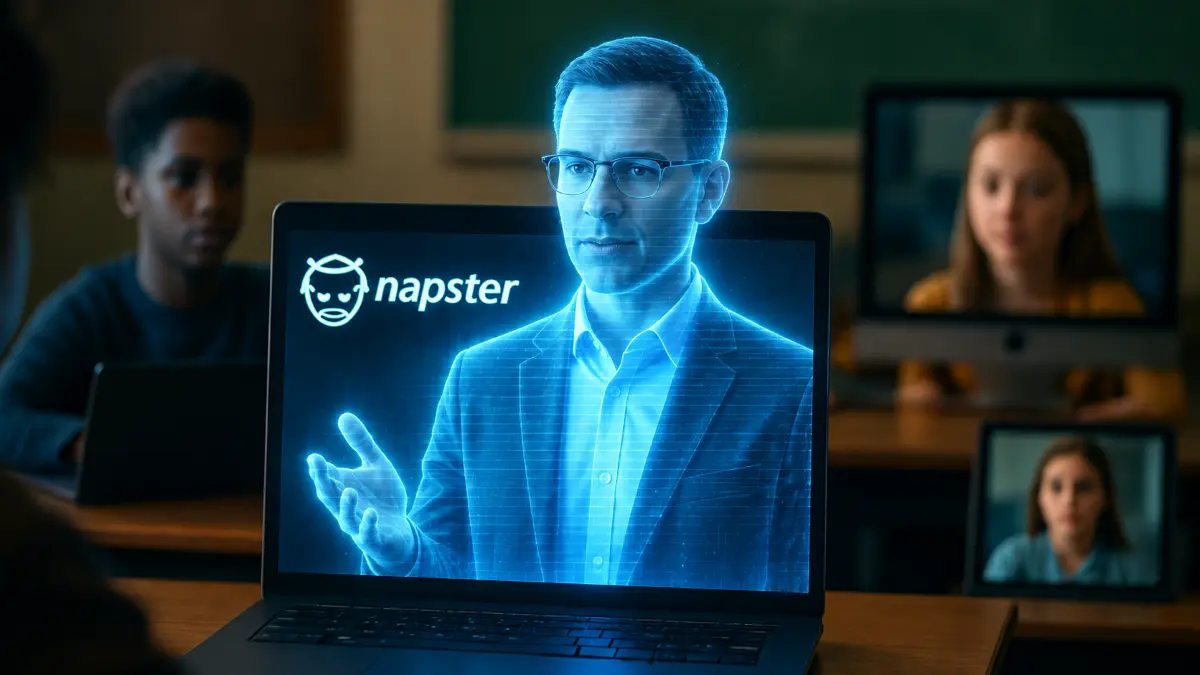
Napster wants educators to be able to create what it describes as digital twins. These AI personas would be trained using a teacher’s own materials, including courses, papers, and other educational content, allowing students to interact with an AI system built around that instructor’s knowledge and teaching context.
A student struggling with a concept after school, for example, could ask the teacher’s digital counterpart for another explanation rather than waiting until the next class. Another student could move ahead, ask follow-up questions, or revisit material at a different pace.
The attraction is availability. A human teacher might be responsible for dozens or even hundreds of students and cannot provide unlimited individual tutoring. An AI version could theoretically answer questions around the clock while preserving more of the instructor’s course-specific context than a general-purpose AI assistant.
Napster Middle East and Africa CEO Samuel Huber described the concept as creating a copy of an educator that can help “scale your time.” The company says the goal is not to replace the classroom lesson or the relationship between teacher and student, but to extend access to the educator beyond the hours when that teacher can personally respond.
More Than an AI Face on a Screen
Calling the system a “teacher clone” can make it sound as though Napster is simply generating an avatar that looks and sounds like an instructor. The company’s ambitions are broader.
Its education platform combines conversational AI with voice and video interfaces to create digital personas that students can interact with more naturally. The underlying system is designed to use an educator’s material and institutional context, while the visual persona provides a more human-like interface than a conventional text box.
That distinction matters. A prerecorded digital teacher can only deliver material that has already been created. A generative digital twin can potentially respond differently depending on what each student asks.
If one student understands a mathematical concept immediately and another needs it explained three different ways, the AI could adapt the conversation without requiring the teacher to record three separate lessons.
Napster also says teachers could receive information about the questions students are asking their digital counterparts. That could turn the system into more than an automated tutor. Patterns in student questions could help instructors identify topics that are causing confusion and determine where additional classroom attention is needed.
The GEMS partnership is expected to explore more than teacher twins. Planned proof-of-concept projects include gamified learning, AI-assisted content creation, classroom simulations, AI agents, and digital personas. The first phase will connect Napster’s technology with the GEMS Global Education AI Hub and its Intelligence 360 platform.
This Napster Is Very Different From the Original
The transformation is particularly striking because of the name attached to it.
The original Napster was launched in 1999 by Shawn Fanning and Sean Parker and became one of the defining services of the early internet by allowing users to share MP3 music files directly with one another.
Its explosive growth also triggered a historic copyright fight with the music industry. After legal defeats, the original service shut down in 2001. The Napster name subsequently passed through multiple owners and eventually became associated with legitimate music streaming.
The latest transformation accelerated after technology company Infinite Reality acquired Napster in 2025 for $207 million. Napster subsequently repositioned itself around artificial intelligence, digital personas, and what it calls embodied AI. Its music-streaming service shut down in January 2026.
Napster had already demonstrated where it was heading. Its Napster 26 platform introduced thousands of specialized AI companions covering areas such as coding, languages, business, wellness, and education, along with technology for creating AI-powered digital twins.
The education partnership turns that technology into a much more concrete use case.
Dubai Is Only Part of the Education Push
Napster’s education strategy is also extending beyond the United Arab Emirates.
Earlier in September, the company announced agreements with Nourah Cloud and Princess Nourah bint Abdulrahman University in Saudi Arabia to establish an EdTech and Embodied-AI Center of Excellence.
That initiative includes Arabic-native AI mentors, curriculum digital twins and faculty digital twins, with the technology hosted on Saudi infrastructure. Napster says inference and data processing will occur locally as part of a sovereign AI architecture designed for the country’s regulatory environment.
The Saudi deployment provides another example of how the teacher-twin concept might operate. Napster says students should eventually be able to ask questions in their own dialect at any hour and receive answers reflecting their professor’s material and university context.
The project is also expected to extend training across a network of 24 Saudi public universities over a 24-month rollout, suggesting Napster is thinking beyond isolated classroom demonstrations.
The Teacher’s Knowledge Becomes the Product
The technology also creates difficult questions that do not exist with a conventional educational chatbot.
If an AI persona is designed to reproduce an educator’s knowledge, material, voice, appearance, or teaching style, schools will need clear rules establishing who controls that digital version.
What happens if the teacher leaves the institution? Can the school continue using the digital twin? Can the educator delete it? Who owns AI-generated lessons based on the teacher’s original material? Can the digital persona be modified without the teacher’s approval?
Those questions become especially important because a digital twin could theoretically continue teaching long after the person it represents has stopped working at a particular institution.
There is also the risk of the AI saying something the real educator would never say.
Training an AI on a professor’s papers and course materials does not create a perfect digital copy of that person’s knowledge or judgment. The underlying generative model can still misunderstand questions, produce inaccurate information, or generate answers that were never explicitly provided by the educator.
That means students will need to understand that they are interacting with an AI representation of their teacher, not the teacher.
Student Data Creates Another Challenge
Education also involves unusually sensitive data.
Students may ask an AI tutor questions they are reluctant to ask publicly. Their conversations can reveal what they understand, what they are struggling with, how frequently they study, and potentially personal information disclosed during those interactions.
Napster says student data will remain within the country where required and that deployments can be hosted on an organization’s own servers. Huber also told WIRED that Napster does not use user data to train its AI models.
Its Saudi education project goes further by placing model inference and data processing on local infrastructure.
Those safeguards could become important selling points as schools face increasing scrutiny over how AI platforms handle student information.
Augmentation or Replacement?
The largest question may have less to do with technology than with teachers themselves.
Napster presents digital twins as a way to augment educators rather than replace them. The argument is that teachers have limited time, while an AI version can handle repetitive questions and provide additional one-on-one interaction outside normal classroom hours.
That could allow teachers to spend more time on instruction, mentoring, discussion, and students who need direct human assistance.
But the same scalability that makes teacher clones attractive also creates an uncomfortable economic question.
If one professor and a digital twin can theoretically support hundreds or thousands of students, institutions could eventually be tempted to increase class sizes or reduce staffing. Technology introduced as an assistant can become a substitute if economic incentives change.
Research into AI-mediated teaching already suggests the trade-off is more complicated than simply reducing workload. A 2026 qualitative study involving 23 high-school teachers found that AI tools could streamline planning and assessment while also potentially shifting some instructional judgment away from educators.
Napster’s real challenge will therefore be demonstrating that its digital twins increase access to teachers rather than gradually reducing access to actual teachers.
Napster Is Betting on a Different Kind of Digital Disruption
There is a strange symmetry to Napster’s latest reinvention.
The original Napster used the internet to separate music from the physical systems that had traditionally controlled its distribution. A song no longer needed to be attached to a CD sitting in a store.
The new Napster is experimenting with whether AI can perform something conceptually similar with expertise: separating some of a teacher’s knowledge and availability from the physical classroom and making that digital representation accessible whenever a student needs it.
Whether that analogy ultimately works will depend on something considerably more difficult than generating a convincing avatar.
Napster and GEMS will need to demonstrate that students actually learn better, teachers remain in control of their digital identities and intellectual property, AI-generated answers are dependable, and sensitive student information remains protected.
The technology can already make a teacher available at two in the morning.
The harder question is whether the digital teacher can deliver what makes the real one valuable in the first place.